
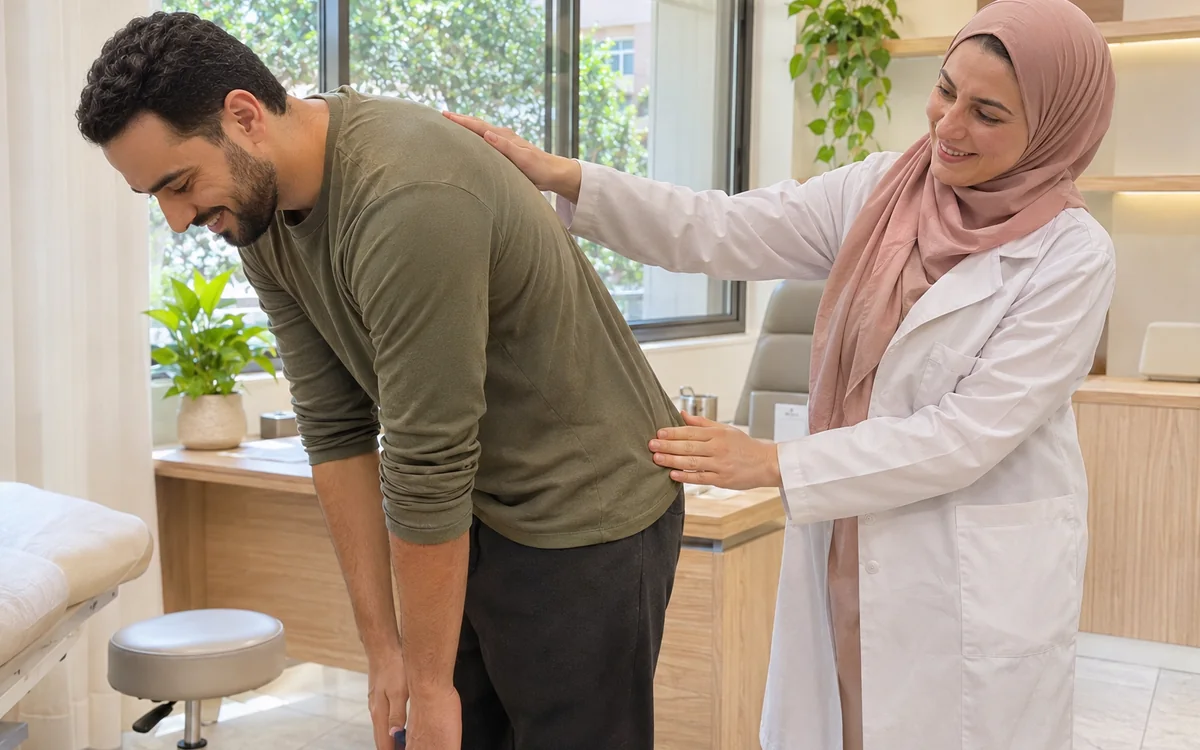
Ankylosing spondylitis doctor: the direct answer
If you are looking for an ankylosing spondylitis doctor in Maadi or Fifth Settlement, you can be seen by Dr Shimaa Sherif, a specialist in rheumatology, joint diseases, physical medicine and rehabilitation. Her Maadi clinic runs on Saturday, Monday and Tuesday from 2 to 8 pm, and the Fifth Settlement clinic runs inside CMC Medical Mall on Wednesday from 3:30 to 8 pm. Call or message 010 4066 1893 to book or ask for the nearest slot, and confirm the branch, day and time before you travel.
This page is not another general definition. It is a local guide to being assessed and followed up: when to consult a rheumatologist, what the first appointment includes, which reports and tests to bring, and how to reach either branch. Ankylosing spondylitis is a form of axial spondyloarthritis that often starts at a young age. Studies report a mean diagnostic delay of 6.7 years, which is reason enough not to postpone a persistent complaint [15]. No treatment removes the disease, but the right plan reduces pain and stiffness, protects movement and posture, and limits the effect on work, sleep and daily life [2, 6].
Read also: Book an appointment at La Rose
When should you see a rheumatologist?
The pattern that deserves a rheumatology assessment is pain and stiffness in the lower back or around the sacroiliac joints, especially when pain improves with movement and exercise, does not improve with rest, wakes you at night, and began gradually without an injury. The inflammatory back pain criteria count five features, and four of five are enough to raise suspicion: onset before age 40, gradual onset, improvement with exercise, no improvement with rest, and night pain. When pain persists for more than three months with that pattern, seeing a rheumatologist is the logical step [5, 13].
Other features raise suspicion further: heel or sole pain where a tendon meets bone, chest pain or difficulty taking a deep breath from the rib joints, persistent fatigue, recurrent eye inflammation with pain, redness and light sensitivity, psoriasis, or bowel symptoms suggesting inflammatory colitis. A family history of the disease or of chronic back pain also matters because the genetic factor plays a role, but carrying it alone is not a diagnosis [1, 4, 9].
Do not wait for stiffness to turn into restricted movement. Early assessment changes the plan because exercise and treatment protect movement, while delay is linked to worse outcomes and function. Red flags are different: fever, shivering or feeling generally unwell, severe pain that started suddenly or is worsening quickly, weakness or numbness in both legs, loss of feeling around the genitals or anus, changes in bladder or bowel control, or pain that began after a major accident need urgent assessment or emergency care, not a routine clinic slot [7].
If the complaint is in the neck or mid-back rather than the lower back, the same logic applies: a chronic inflammatory pattern deserves assessment, and chest expansion and spinal movement are part of the examination [2, 5].
What happens at the first visit?
The first appointment starts with a detailed history: when the pain began, where it is, whether it wakes you at night, how long morning stiffness lasts, how it responds to movement and rest, other sites such as the heel and chest, eye, skin and bowel symptoms, family history, current medicines, and the effect on work, sleep and function. That history is not paperwork. It separates a mechanical pattern from an inflammatory one and directs the examination and tests [2, 5].
The examination then checks spinal movement in every direction, chest expansion, tenderness over the sacroiliac joints, the heels and entheses, peripheral joints, posture and gait. The clinician is answering two questions: does the picture fit axial spondyloarthritis, and which alternatives must be excluded? No single test settles the diagnosis, so the decision rests on the combination of history, examination and selected results [5, 8].
You should leave with a clear plan: whether more tests are needed, what the treatment target is, what the exercise programme looks like, when follow-up is due, and which changes should bring you back sooner. If the diagnosis is not yet certain, the plan may be observation rather than intensive treatment, and that is a clinical decision, not a delay [2, 11].
Which reports and tests should you bring?
Bring any previous images, and bring the actual images rather than only the written report, because the clinician may want to review them. Bring blood test results, a list of medicines and doses, any earlier diagnosis or eye, skin or gut assessment, and a short note of how often the pain flares. If there is a clear family history, write it down instead of relying on memory during the visit [2, 5].
The basic image for axial disease is a plain X-ray of the sacroiliac joints. MRI is useful when suspicion is strong but the X-ray is normal or unclear, because it can show active inflammation before bone changes appear. Inflammatory markers such as ESR and CRP support the picture but can be normal, and the genetic marker associated with the disease is common in the general population and is not a diagnosis on its own [8, 9, 14].
Imaging guidance stresses that the test should answer a clinical question: radiographs first, and MRI when suspicion remains. Not every visit needs new imaging, and not every ache needs an MRI. The clinician should choose the test that will actually change a decision [12, 14].
How do follow-up and treatment work?
Follow-up is not a repeat conversation. It reviews pain, stiffness and flare frequency, function at work and at night, spinal movement and posture, blood results, and tolerance of medication. The aim is to control disease activity and protect function, not to chase a perfect X-ray [11].
Non-steroidal anti-inflammatory drugs are usually the first pharmacological step, and biologic therapy is discussed when response is inadequate according to the criteria and the assessment. Every medicine has monitoring and risks, and any change of dose or stopping is a decision for the treating doctor, not something to do alone [6, 10, 11].
Exercise and physiotherapy are core treatment, not an optional extra. The programme covers spinal movement, muscle strengthening, breathing and chest expansion, and posture correction. La Rose does not run an in-house physiotherapy unit, so the programme is set up and reviewed with an external service, and your consistency between visits is what preserves the result [2, 6].
If bone-density measurement or another specialty assessment is needed, it is arranged externally because that service is not provided inside the branch. InBody is available in Maadi and is used to assess body composition when weight or muscle mass is part of the plan. Internal medicine is available in Maadi only, while rheumatology runs in both Maadi and Fifth Settlement.
Getting to the Maadi branch
The Maadi branch is at 14 El-Mokhtar Street, off El-Nasr Street, directly behind QNB Bank, New Maadi. The bank is the easiest landmark: from El-Nasr Street, turn into El-Mokhtar Street and the clinic is on your right. Street parking is available in front of the building, which helps for evening appointments.
Rheumatology in Maadi runs on Saturday, Monday and Tuesday from 2 to 8 pm, with slight variation by the doctor's schedule, so confirm the time when booking. Maadi Grand Mall is about 1.6 km and 5 minutes by car, Degla about 2.6 km and 7 minutes, Road 9 about 3 km and 8 minutes, Old Maadi and the metro about 3.4 km and 8 minutes, El Basatin about 3.5 km and 10 minutes, Corniche El Maadi about 5.5 km and 11 minutes, Tora El-Balad about 6 km and 15 minutes, and Zahraa El Maadi about 7 km and 11 minutes.
Those times are estimates and traffic can change them, especially at peak hours, so allow extra time if you are coming from further away. Early assessment matters because the plan is easier to adjust before stiffness and posture changes become established [5, 15]. If you need help finding the clinic, call before you set off.
Getting to the Fifth Settlement branch
The Fifth Settlement branch is in CMC Medical Mall, fourth floor, North 90th Street, behind the Air Force Specialized Hospital, Fifth Settlement, New Cairo. The hospital is the landmark and the mall sits directly behind it. Enter the mall, go up to the fourth floor, and look for the La Rose name.
Rheumatology runs on Wednesday from 3:30 to 8 pm, currently one day a week, so book early. Cairo Festival City is about 5.2 km and 10 minutes via South 90th Street, El Yasmeen about 5 km and 10 minutes via North 90th Street or Moustafa Kamel Axis, Al Narges about 6.5 km and 12 minutes, El Banafseg about 6.9 km and 10 minutes, First Settlement about 7.4 km and 12 minutes, Katameya Heights about 8 km and 12 minutes, and Point 90 Mall or AUC Avenue about 9 km and 12 minutes.
Those times are estimates and depend on traffic. Choosing the closer branch reduces travel fatigue, which helps you keep follow-up appointments [11]. If you are coming from the autostrad or the Ring Road, follow North 90th Street to the mall, and message WhatsApp before the appointment if you need help finding the clinic.
Related guides that complete the picture
This page answers the decision to seek care, while the medical detail lives in dedicated articles. The ankylosing spondylitis and inflammatory back pain article explains how inflammatory pain differs from mechanical pain, what the tests and images mean, and when suspicion becomes a diagnosis. The exercise and posture article sets out a programme for spinal movement, breathing and posture, which matters because exercise is part of treatment rather than an add-on. The lumbar spondylosis article covers mechanical wear in the lower spine, a different cause of back pain with a different assessment.
Read the one that fits your situation, then bring your questions and reports, because the final decision is based on your examination rather than a general article [5].
Read also: Exercise and posture in axial spondyloarthritis · Lumbar spondylosis and lower back pain
How to choose the doctor and judge the plan
Before choosing a doctor, ask practical questions: is the diagnosis clear or does it need confirmation, which tests will change the decision, what is the treatment target and how is it measured, when is the next review, and which changes should bring you back sooner. A good clinician explains alternatives and risks and ties the plan to your case rather than one rule for everyone [11].
At La Rose, rheumatology leads diagnosis and drug follow-up, while physiotherapy and bone-density measurement are arranged externally. Internal medicine is available at the Maadi branch, which helps when a coexisting condition needs review, and rheumatology is available at both branches. If a needed specialty is not available, referral is arranged clearly instead of sending you around clinics [11].
Be cautious with promises of a permanent cure, one protocol for every patient, refusal to explain medicines or monitoring, or advice to abandon exercise completely. Chronic inflammation needs a long-term plan, and a quick promise often hides an incomplete assessment [2, 11].
Booking and preparing for the visit
Book on 010 4066 1893, and decide the branch and day before the call: Maadi on Saturday, Monday and Tuesday, Fifth Settlement on Wednesday. Ask for the available time and confirm the address and hours, because doctors' schedules change.
Prepare a medicine list with doses, old images and discs if available, blood test results, any eye, skin or gut report, and notes about pain and stiffness. If you have fever, sudden severe pain or weakness in the legs, do not wait for a clinic slot; seek urgent assessment or emergency care [7].
A first visit can take longer than follow-up because it includes history, examination and review of reports. Take your time with questions, ask for the plan in writing if that helps, and confirm the follow-up date before you leave [11].