What is gout, and why does it cause attacks?
Gout is an inflammatory arthritis that develops when urate has accumulated in the body long enough for tiny, sharp crystals to form in and around a joint. The immune system reacts to those crystals as a threat, producing a rapid wave of inflammation, severe pain, swelling and heat. An attack is not simply a minor injury or vague “salts” in the foot; it is crystal-driven inflammation that deserves a clear diagnosis and plan [1, 5].
A high blood uric-acid result is relevant, but it does not diagnose gout by itself. Many people have a high level without ever having an attack, and the level can appear lower than expected during a flare. A clinician therefore combines the pattern and speed of the pain, the joint involved, examination findings and appropriately timed tests. If the picture remains uncertain, examining fluid taken from the joint for crystals can confirm the cause and help exclude alternatives [2, 3].
Gout is a long-term condition that can be controlled, even though pain appears in separate flares. Feeling completely well between attacks does not mean the tendency to deposit crystals has disappeared. Repeated untreated flares allow the crystal burden to grow, which is why follow-up after a first attack matters more than repeatedly relying on a painkiller [1, 6].
The classic pattern of a gout attack
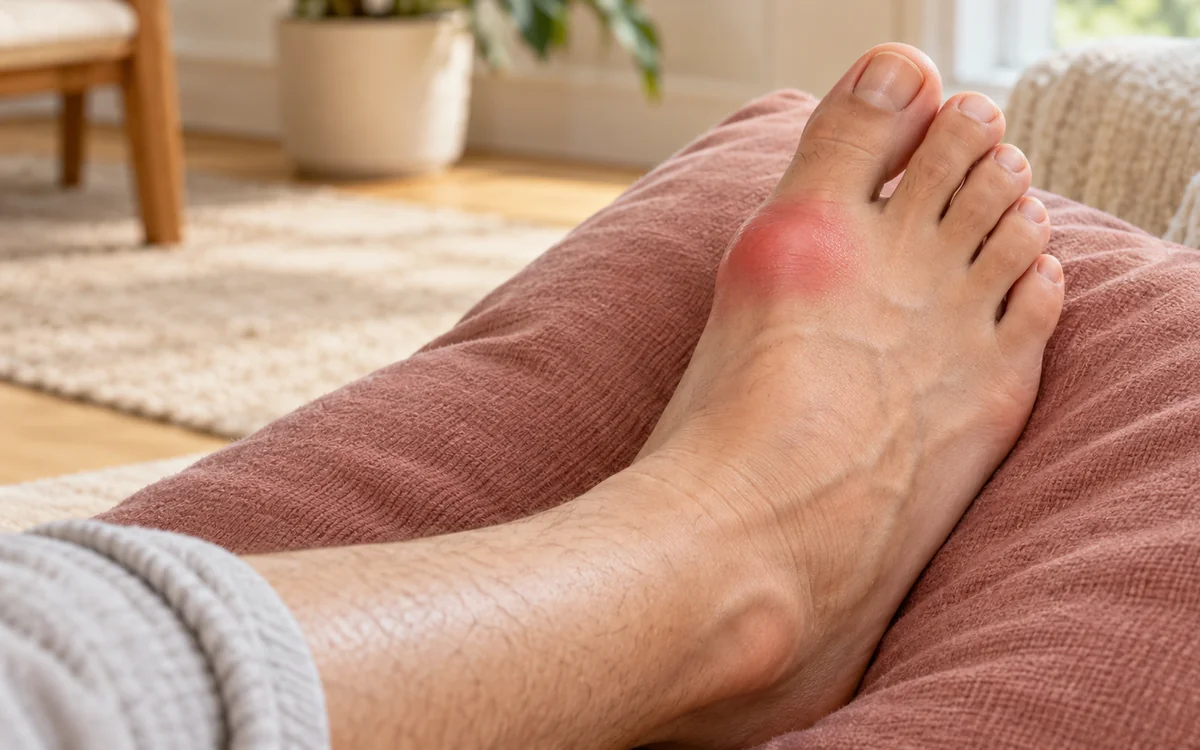
A classic flare begins suddenly, often during the night or before dawn. You may go to sleep without an obvious problem and wake with extremely severe pain in one joint. The joint at the base of the big toe is the best-known site, but gout can affect the midfoot, ankle or knee, and sometimes the hand, wrist or elbow. The skin over the joint feels warm or hot, swelling is visible, and light contact may hurt so much that even the weight of a bedsheet is uncomfortable [1, 4, 7].
Pain usually becomes intense quickly and then eases gradually after its peak. An untreated attack can last several days to one or two weeks, after which the joint may look normal again. Some soreness or stiffness can remain after the worst pain settles. Early attacks usually involve one joint; without effective control over time, flares may become longer, more frequent or involve several joints [1, 4, 8].
Redness can be less obvious on brown or dark skin, so the absence of vivid red colour does not rule out inflammation. Look for a change from normal: local heat, rapid swelling, extreme tenderness, and difficulty moving the joint or bearing weight. Although the big toe is a strong clue, the location of pain alone cannot establish the diagnosis [3, 4].
Between attacks: has gout gone away?
The symptom-free time between two flares is called the intercritical period. During it, there may be no pain or swelling at all. That quiet period is welcome, but it does not prove the problem has ended; crystals can remain, and another attack may come months or years later. Flares follow no fixed timetable, so how you feel on one particular day does not provide a complete picture of the disease [1, 5].
If urate continues accumulating for years without effective treatment, firm deposits called tophi can form under the skin. They may appear around the fingers, elbow, ear or Achilles tendon. They can begin painlessly but later become inflamed or press on nearby tissues. Chronic gout can also cause persistent pain, reduce joint movement, damage bone and soft tissue, and alter the shape of a joint [1, 7, 8].
This does not mean that everyone with gout will develop these complications. It means that repeated attacks, a new lump, or swelling that never fully settles are reasons to review the plan. Medical control aims both to settle inflammation during a flare and to prevent further crystal accumulation over time. Exact uric-acid targets, detailed dietary guidance and preventive medicines are separate topics, but the central message is simple: temporary absence of pain is not a reason to abandon follow-up or change medicine on your own [3, 6].
What can trigger a gout flare?
A flare is not always the result of one food eaten the previous day. Crystals develop over a long period, and then a sudden change in the body can ignite inflammation. Recognised triggers include dehydration, an acute feverish illness, joint injury, surgery, a very large meal, heavy alcohol intake, or fasting and crash dieting that produce rapid weight change. Some medicines, particularly diuretics, can raise gout risk in susceptible people [1, 4].
Having a trigger does not mean a person caused their own gout. Genes, kidney urate clearance, age, body weight and associated health conditions all contribute. A flare can also happen without an obvious trigger despite careful habits. Record when the attack started, which joint was involved, any recent illness, dehydration or medicine change, and how long symptoms lasted; that information helps a clinician more than blaming one meal [1, 5].
Do not stop a diuretic, aspirin or blood-pressure medicine on your own merely because it might contribute. Suddenly stopping cardiovascular treatment can be more dangerous than gout. A clinician should balance benefits and risks and decide whether a suitable alternative exists. Likewise, do not start or increase flare medicines using an improvised dose, especially if you have kidney disease, an ulcer or take a blood thinner; the safe choice varies with your conditions and current medicines [3, 6, 10].
Gout symptoms in women
Gout is less common in women before menopause, but it is not exclusively a male disease. After menopause, the likelihood of raised urate and gout increases, and onset is often later than in men. The underlying flare still has the same features: sudden severe pain, heat, swelling and tenderness in one or more joints. Because the stereotype centres on men and the big toe, gout may be considered later when a woman presents with pain in another joint [1, 9].
Research indicates that women with gout often carry a greater burden of associated conditions such as hypertension, diabetes or reduced kidney function, and diuretic use is more common in some female groups. This does not mean every woman has more severe symptoms, but it makes a review of medicines, kidney function and blood pressure an important part of assessment [9, 11].
Gout during pregnancy is uncommon. Any hot, swollen joint in pregnancy needs medical assessment rather than self-diagnosis because investigation and treatment choices must account for the pregnancy. After birth or during breastfeeding, do not reuse an old treatment or another person’s advice without consulting a clinician. Age and sex neither exclude nor confirm gout; the attack pattern, examination and exclusion of infection remain central [3, 9].
How gout relates to the kidneys and blood pressure
The kidneys remove a large share of urate from the body, so reduced kidney function can impair clearance and increase the chance of accumulation. In the other direction, a person with gout may also develop urinary stones, some of which contain uric acid. Severe pain in the side or blood in the urine is not a routine symptom of a joint flare and requires separate assessment for a stone or another kidney problem [1, 10].
High blood pressure, chronic kidney disease, obesity and diabetes are more common among people with gout than in the general population. The relationship is complex: risk factors overlap, medicines such as some diuretics can affect urate, and kidney disease itself changes which flare treatments are safe. Having gout does not prove that you have kidney disease or that gout alone caused hypertension, but it is a sound reason to review blood pressure, kidney function, urine testing and medicines with a clinician as appropriate [3, 10, 11].
If you have hypertension or kidney disease, do not assume that any readily available painkiller is automatically safe. Some anti-inflammatory medicines may be unsuitable with reduced kidney function, stomach ulcers or heart disease, while doses of other medicines may need adjustment. The purpose is not to select treatment from an article but to prevent a rushed decision from causing harm. Link joint follow-up with general health review, because managing associated conditions helps the clinician choose a safer plan [5, 10].
How is gout distinguished from a joint infection?
A hot, red, swollen joint does not automatically mean gout. Bacterial joint infection can create a very similar picture and is urgent because delay can damage the joint and allow infection to spread. Calcium-pyrophosphate crystal arthritis, an injury, and other inflammatory arthritides can also mimic a flare. Even a previous history of gout does not prevent infection on another occasion, and crystals and infection can rarely coexist [2, 3].
The clinician asks about speed of onset, previous flares, a wound or skin infection, recent joint surgery or injection, medicines, and conditions that weaken immunity. They examine the joint, temperature and general condition. A uric-acid test can support the wider assessment, but a lower result during a flare does not exclude gout, and a high result does not prove that gout caused every painful joint. When diagnosis is uncertain, taking joint fluid to examine for crystals and send for culture may be the key investigation [2, 3].
Seek urgent same-day assessment for sudden joint pain and swelling accompanied by a high temperature, shaking chills, feeling very unwell, vomiting or inability to eat, or rapidly worsening pain. Concern is greater with an artificial joint, impaired immunity, a nearby skin infection, or a recent joint procedure. Do not wait for a usual remedy to work or mask symptoms with extra doses; joint infection must be excluded promptly [3, 4].
What should you do if you suspect a gout attack?
If this is the first episode of sudden pain and swelling in a joint, arrange medical assessment rather than assuming it is gout. Until you are seen, rest the joint, elevate it if comfortable, and maintain appropriate fluid intake unless you have medical instructions to restrict fluids. A cold pack wrapped in cloth for a short period may ease pain alongside prescribed treatment, but do not place ice directly on the skin [3, 4].
If you already have a confirmed diagnosis and a written flare plan, follow it as your clinician explained and make contact if symptoms are different or treatment is not working. Do not combine painkillers from the same drug family, use someone else’s dose, or stop or alter urate-lowering treatment on your own during a flare. Record the start time, affected joint, possible triggers and medicines used; this helps review prevention once pain settles [3, 6].
The medical team at La Rose can assess the symptom pattern, review medicines and associated conditions, and decide whether the presentation resembles gout or needs urgent exclusion of another cause or further testing. La Rose has branches in Maadi and Fifth Settlement, New Cairo. If a hot joint comes with fever or general deterioration, seek urgent care immediately rather than waiting for a routine appointment; otherwise, book a consultation to begin with a clear diagnosis-based plan [2, 3].