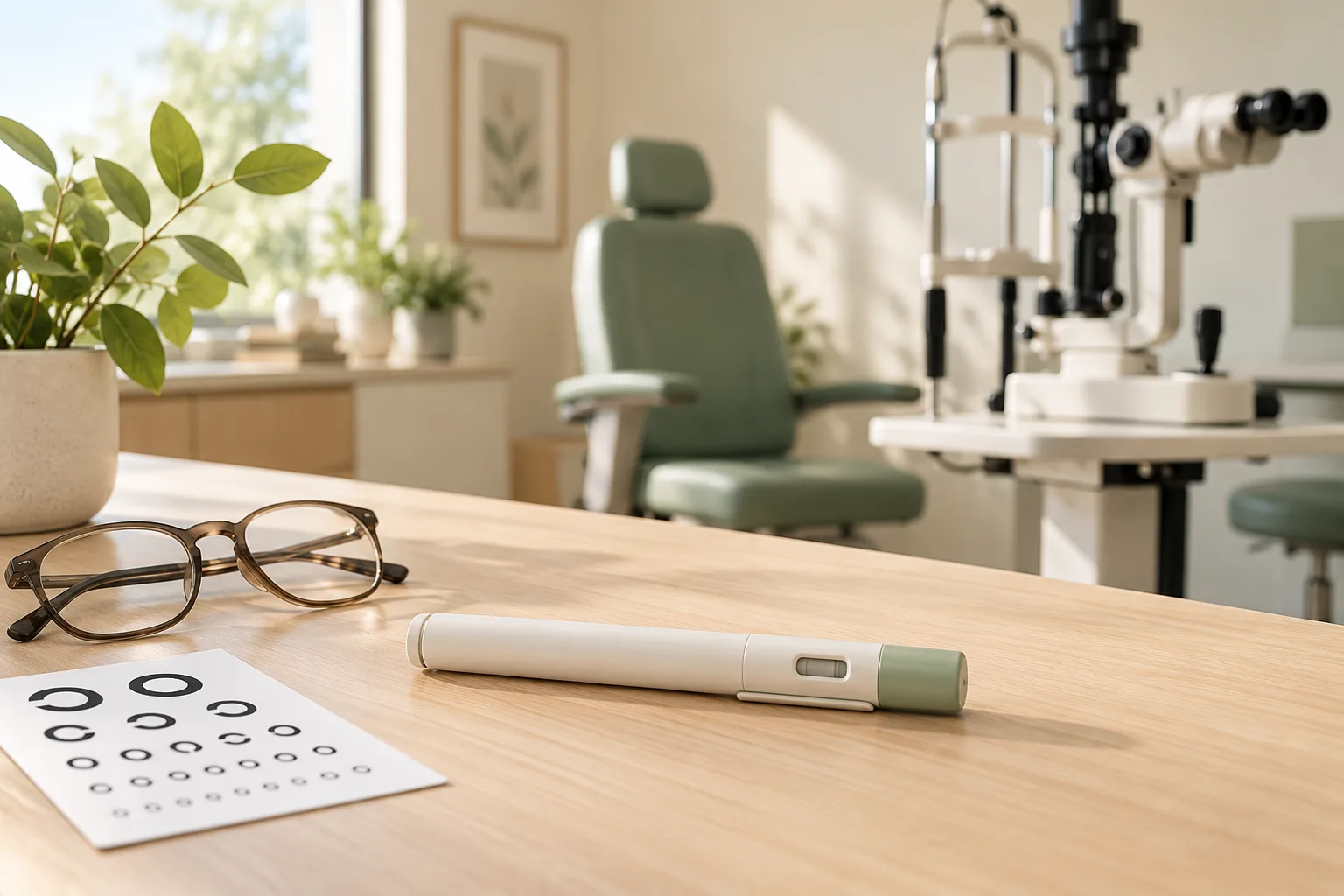
"Can Ozempic cause blindness?" Where the headline came from
Over the past few days, headlines claiming that Ozempic and Mounjaro cause blindness spread quickly across Facebook, TikTok and WhatsApp groups. Many people taking these injections became frightened, and some stopped their dose without talking to their doctor. So it is worth slowing down and looking at the whole picture rather than judging from one headline [1, 2, 5].
The real science behind these headlines involves two quite different issues. The first is that a person with diabetes who already has advanced retinopathy can see their retina temporarily worsen when blood sugar falls very fast; this has been known for years and is written in the official prescribing information [8, 11]. The second is a very rare optic nerve condition called NAION, which regulators in Europe and the UK and the World Health Organization reviewed and classified as a "very rare" side effect of semaglutide, the active ingredient in Ozempic and Wegovy [1, 2, 3].
Both issues are real and important, but neither means the medicine "blinds people". This article explains each one with numbers and sources, the questions to ask yourself when you see a headline like this, and what you should actually do [5, 6].
The story of the six cases: who were they really?
The story that circulated describes six cases of diabetes-related vision loss (diabetic-related blindness): five were taking Ozempic and one was not taking it at all. The detail the headlines left out is that those five people already had proliferative diabetic retinopathy, were already being treated with laser and eye injections, and some also had cataracts. We could not locate the original report itself, so we present the story as it circulated and explain its medical meaning from reliable sources [8, 9, 10].
Proliferative diabetic retinopathy is the most severe stage of diabetic eye disease. At this stage the retina grows fragile new blood vessels that can bleed or pull the retina out of place, and this alone is one of the leading causes of vision loss in people with diabetes worldwide, whether or not they take Ozempic [9, 10]. In other words, these patients' sight was already at real risk before they started the medicine, and a sixth case with the same problem without Ozempic underlines that the disease itself is the main driver here.
That does not mean the medicine plays no role at all. Studies show that a rapid fall in blood sugar can accelerate retinal worsening in exactly this group, which is what the next section explains [8, 9]. But there is a big difference between "a medicine that blinds anyone" and "a patient whose retina was already fragile needs close eye follow-up when their sugar falls quickly" [5, 11].
Early worsening of diabetic retinopathy: when sugar falls fast
Ophthalmology has long recognised a phenomenon called early worsening of diabetic retinopathy. It was described decades ago with intensive insulin therapy, long before Ozempic existed. The idea is that a retina adapted to high blood sugar for a long time can undergo temporary changes in blood flow and vessels when blood sugar and HbA1c fall very quickly, making retinopathy worse for a period [9, 10].
In the SUSTAIN-6 trial, which enrolled 3,297 people with type 2 diabetes, retinopathy complications occurred in 3.0% of those on semaglutide versus 1.8% on placebo [8]. Later analyses showed that most of these cases occurred in people who already had retinopathy before the trial, and that the risk was higher when HbA1c fell by more than 1.5 points within the first 16 weeks [8, 9, 10].
That is why the US prescribing information for Ozempic carries a clear warning that diabetic retinopathy complications were reported and that patients with a history of diabetic retinopathy should be monitored [11]. The Mounjaro label also states that the medicine has not been studied in people with proliferative retinopathy or retinopathy needing acute treatment, and that such patients should be monitored [12]. The message is not "do not take the medicine"; it is that a person with diabetes whose retina is already affected needs an eye exam before starting, a measured rather than rushed fall in blood sugar, and follow-up with an ophthalmologist [9, 11].
NAION: the "very rare" side effect of about 1 in 10,000
The second issue behind the headlines is non-arteritic anterior ischemic optic neuropathy (NAION). In this condition, blood supply to the front of the optic nerve drops, causing sudden blurred vision or loss of part of the visual field, usually in one eye and without pain. It is usually not total blindness in both eyes, as the headlines imply [2, 5].
The story began with a 2024 study from Mass Eye and Ear in Boston that found a higher rate of NAION among patients prescribed semaglutide [7]. However, that study was retrospective and from a single centre, so it flagged a signal that needed review; it did not prove the medicine alone was the cause [6, 7]. The European Medicines Agency's safety committee (PRAC) then reviewed all the data and concluded in June 2025 that NAION is a "very rare" side effect of semaglutide, which may affect up to 1 in 10,000 people taking it [1]. The World Health Organization issued an alert with the same message [2], and the UK MHRA confirmed the same estimate, noting that related reports were very few compared with the millions of packs dispensed [3].
What about Mounjaro? Australia's TGA reviewed this class of medicines, and its advisory committee said the evidence may support the signal for semaglutide but did not support it for tirzepatide (Mounjaro) or dulaglutide [4]. So the headline "Mounjaro causes blindness" is not built on established evidence as of today, although that does not make monitoring unimportant [4, 12].
Most importantly, "very rare" means the overwhelming majority of people taking the medicine will never experience this. The American Academy of Ophthalmology advises patients not to stop the medicine on their own, and to get an eye exam promptly for any sudden change in vision [5, 6].
How long were these medicines studied, and why finding a side effect does not make a drug dangerous for everyone
These medicines did not appear overnight. Semaglutide entered its first registered clinical trials around 2008, and the US Food and Drug Administration (FDA) approved Ozempic for type 2 diabetes in December 2017, roughly nine years of study [11, 13, 14]. Tirzepatide began phase 1 trials in 2016, and Mounjaro was approved in May 2022, roughly six years later [12, 15].
Approval is not the end of oversight. After a medicine reaches the market, the FDA and other regulators keep monitoring it through post-marketing surveillance, including side-effect reports from doctors and patients and studies covering millions of users [16]. Very rare effects such as NAION usually only become visible at this stage, because trials, however large, include thousands of people, not millions. Finding a rare effect and updating the label means the system is working, not that something was being hidden [1, 3, 16].
Every regulatory decision rests on a benefit-risk assessment. The FDA weighs how serious the treated condition is, the available alternatives, the proven benefit, and the size and likelihood of side effects [17]. The existence of a side effect, even a serious one, does not make a medicine "dangerous for everyone". Almost every medicine, from painkillers to antibiotics, has rare side effects; the question is always whether the benefit for a specific patient outweighs the risk [1, 17].
Obesity has its own risks, and the real question is whether the drug fits this person
When we talk about the risks of a medicine, we cannot forget the risks of the disease it treats. The US Centers for Disease Control and Prevention (CDC) notes that obesity raises the risk of type 2 diabetes, high blood pressure, abnormal blood lipids, heart disease and stroke, fatty liver disease, sleep apnea, joint problems and some cancers [18]. Uncontrolled diabetes is itself one of the leading causes of vision loss in adults [9, 10]. So sometimes refusing a suitable treatment carries a greater risk to the eye itself.
That is why the real question is not "is this medicine dangerous?" but "is this medicine right for this person?". The same injection can be an excellent choice for one patient and unsuitable for another, depending on their health history, eye condition, other medicines and goals [1, 11, 17].
And that is why you should not copy a friend's plan. A friend losing a lot of weight on a certain dose does not mean that dose suits you. Anyone starting these injections needs a medical assessment first, the right dose chosen and increased gradually, and regular follow-up of blood sugar, food intake, protein, muscle mass and the speed of weight loss [11, 12, 18]. Very fast weight loss is not always an advantage, neither for muscle nor for the retina in a person with diabetes [8, 9].
What to do when you see this headline
First: if you have diabetes and retinopathy, or you have previously been treated with laser or eye injections, tell your doctor before starting any of these injections. Your doctor may then request an eye exam before you start, aim for a gentler fall in blood sugar, and coordinate follow-up visits with your ophthalmologist [9, 11, 12].
Second: know the warning signs. Any sudden loss of vision, a dark area in part of your visual field, or marked blurring in one eye needs a same-day eye examination; do not wait [3, 5].
Third: when you see a frightening headline, ask yourself these questions before believing or sharing it [1, 5, 17]: - Who were the people affected? Did they already have a disease, or were they healthy? - What is the number out of? Five cases out of how many million users? - Was there a comparison group that did not take the medicine, and what happened to it? - What did the regulators say? Did they call the effect rare or common? - Is the headline about the same medicine I am taking?
Most important: do not start or stop a treatment because of a social media post. Stopping suddenly can let blood sugar climb again, and starting without supervision can expose you to unnecessary risk. Science is not a frightening headline; science is seeing the whole picture [1, 2, 3].
At La Rose clinics, Dr Shimaa Fouad and the weight management team carry out a full assessment before any treatment, covering your health history, blood sugar and medicines and a body-composition measurement; they ask about your eyes and refer you for an eye exam when needed. After that, the dose, food, protein, muscle and pace of weight loss are followed step by step. If you have a question about your situation or are worried by what has been circulating, talk to your doctor or send us a message, or book a consultation and we will review your situation with you [11, 12, 18].
Remember that Ozempic is a prescription medicine [11]. Do not buy slimming injections or pills from adverts or unknown pages; read why in unknown-source slimming pills.