
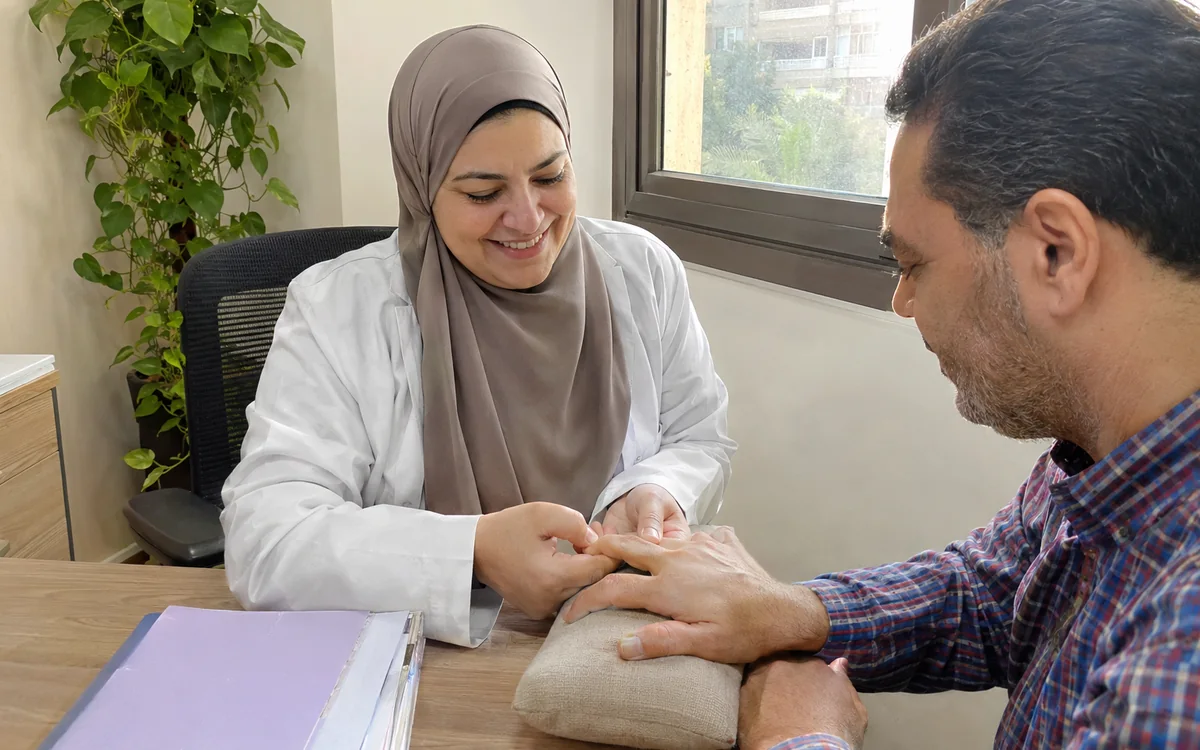
Psoriatic arthritis doctor in Maadi: the direct answer
If you are looking for a psoriatic arthritis doctor in Maadi or Fifth Settlement, start with a rheumatology and joint assessment with Dr Shimaa Sherif at La Rose. In Maadi, the clinic is at 14 El-Mokhtar Street, off El-Nasr Street, behind QNB Bank, New Maadi; rheumatology appointments are Saturday, Monday and Tuesday from 3 to 8 pm. In Fifth Settlement, the clinic is in CMC Medical Mall, fourth floor, North 90th Street, behind the Air Force Specialized Hospital, on Wednesday from 3:30 to 8 pm.
Psoriatic arthritis is the medical name for what many people call rheumatism with psoriasis. It is a chronic immune condition that can affect joints, tendons, ligaments and the spine, and it does not look the same in everyone. This page is not a substitute for an assessment, but it answers who to see and when, explains the first visit, tests, treatment principles and follow-up, and shows how to reach the branch that suits you [1, 4, 9].
When should you see a rheumatologist? Signs that deserve assessment
The key clue is psoriasis of the skin or nails together with joint pain, swelling or stiffness. Psoriasis may come years before the joints, and sometimes joint symptoms appear first or the skin disease is mild and hidden in the scalp or nails [1, 3]. Seek assessment if pain or swelling persists or keeps coming back [3], morning stiffness is prolonged, or more than one joint is affected.
Patterns that deserve a rheumatology review include a whole swollen finger or toe that looks like a sausage, pain at the heel or sole where tendons attach, nail pitting, thickening or separation, pain and stiffness in the low back or buttocks, a red painful eye or a change in vision, and sometimes severe fatigue. A family history of psoriasis or psoriatic arthritis raises the probability, but its absence does not exclude the disease [1, 2, 11].
If a joint is hot and swollen with fever or shivering, or an eye is red and painful with changed vision, do not wait for a routine appointment; seek urgent assessment.
What happens at a first psoriatic arthritis visit?
The first visit starts with your story. The doctor asks when psoriasis and joint symptoms began, where the pain is, whether it is symmetrical or one-sided, how long morning stiffness lasts, whether there is swelling or warmth, which fingers, heels or back areas are involved, and whether the eyes are affected. Current and previous medicines, any immune treatment or steroid, chronic conditions, family history, and the effect of pain on work, sleep, walking, dressing and prayer are reviewed too.
Psoriatic arthritis differs from person to person, so assessing the skin and the joints together helps the doctor understand the whole picture [2, 11].
The examination covers skin, scalp and nails, the number of tender and swollen joints, the shape of the fingers, tendon attachment points such as the heel, spine movement, gait and any features outside the joints. Photographs of a rash can help when it is not visible at the visit, especially in areas that are difficult to examine.
Bring any old X-rays, MRI scans or reports, a list of medicines with doses, recent test results, and photos of the rash or nails. Do not arrange a broad test panel or MRI by yourself before the visit; the clinician should choose what could change the decision. By the end, you should understand the likely diagnosis, the alternatives, the goal of the plan and when review is due.
Tests and imaging: what actually confirms the diagnosis?
No single test confirms psoriatic arthritis. Diagnosis starts with history and examination [11], while the CASPAR criteria provide a classification framework built from psoriasis, nail changes, swollen digits, tendon attachment disease, family history and a negative rheumatoid factor [8]. Most people with psoriatic arthritis are rheumatoid-factor negative, and that does not mean the disease is absent [11].
X-rays, ultrasound and MRI are used in the assessment to show the state of the joints and tendons [2, 3, 11]. Blood tests help exclude other conditions [2, 3].
If a joint becomes suddenly hot and swollen, the doctor may draw joint fluid to exclude infection or crystals. That is a diagnostic procedure, different from a treatment injection, and it should not be delayed when fever or signs of serious illness are present [3].
Read also: rheumatism blood tests and reading results
How psoriatic arthritis differs from rheumatoid arthritis, gout and osteoarthritis
Similar names cause real confusion. Rheumatoid arthritis is usually symmetrical in the small joints, and is often positive for rheumatoid factor. Psoriatic arthritis can be asymmetrical, and comes with swollen digits, nail changes and inflammation where tendons attach, appearing with or after psoriasis [1, 11].
Gout causes a very rapid attack, with a red, hot, intensely painful joint, most often the big toe; a high uric acid level is a contributing factor, not proof. Osteoarthritis is more mechanical: pain with movement, brief stiffness, and usually no hot swelling or systemic symptoms. The conditions can coexist, which is why examination and selected tests matter more than the label.
If you have psoriasis and joint pain, do not assume it is ordinary rheumatism, take a painkiller and wait. Early assessment matters because early treatment is associated with better outcomes and less joint damage [1]. For the full symptom and diagnosis picture, read our psoriatic arthritis article after this page.
Read also: psoriatic arthritis symptoms and diagnosis
Psoriatic arthritis treatment principles: more than a painkiller
The goal is not only to reduce pain. The plan aims to control inflammation, preserve movement and function, prevent joint damage, and manage skin and nails in coordination with a dermatologist when the case needs it. Medicine choice depends on the number of affected joints and disease activity, tendon and spine involvement, skin disease, liver, kidney and heart conditions, infection, pregnancy and other medicines [5, 6, 7, 12].
Non-steroidal anti-inflammatory drugs may help symptoms [2, 3], but they do not modify the disease course. Disease-modifying drugs such as methotrexate and sulfasalazine [2] can take up to about three months to reach full effect [11]. When response is inadequate, targeted biologics and JAK inhibitors are discussed according to the case after a risk assessment [2, 6, 10].
Do not start, stop or change a dose by yourself, even if you feel better. Regular monitoring is not optional; some medicines need a blood count, liver and kidney tests and infection surveillance. The plan is adjusted against a goal, not against an advertisement or another person's prescription.
Weight, other conditions and everyday movement
Weight and metabolism are part of the picture. Among people with psoriasis, obesity is linked to a higher risk of psoriatic arthritis [1]. The disease is also associated with type 2 diabetes, high blood pressure, raised cholesterol and heart and blood-vessel problems [2, 11], so follow-up should include blood pressure, weight and review of test results.
Movement matters, but it does not mean pushing through pain. Suitable exercise, physiotherapy and activity adjustment preserve range and strength and reduce stiffness. When back, heel or shoulder pain is present, the plan is adapted around it [2, 11].
The eyes are part of the picture too. Eye inflammation may begin with pain, redness and changed vision [1, 11], and a worsening rash deserves review. Bring these symptoms to the doctor rather than treating them alone. A healthy weight, regular activity and control of chronic conditions support the plan [2, 11].
How do you choose a rheumatology doctor or clinic in Maadi?
If you are searching for the “best doctor,” turn the question into criteria. Is the specialty rheumatology and joint disease? Does the visit include a history and examination before imaging is requested? Does the doctor distinguish psoriatic arthritis from rheumatoid arthritis, gout and osteoarthritis? Are your medicines and other conditions reviewed before treatment is chosen? Does the plan have a clear goal, follow-up, and referral to dermatology or physiotherapy when needed? [2, 11].
Dr Shimaa Sherif is a specialist in rheumatology, joint diseases, physical medicine and rehabilitation, with an MSc in Rheumatology and Rehabilitation. The clinic provides a rheumatology assessment and follow-up plan, with referral to the appropriate specialties when the case requires it.
Warning signs include a promise of permanent cure, one protocol for everyone, MRI and a broad test panel without a clinical question, frightening you away from movement, or rushing an injection or procedure before explaining alternatives. A responsible service tells you the limits of treatment and when the plan will be reviewed.
Getting to the Maadi and Fifth Settlement branches
Maadi branch: 14 El-Mokhtar Street, off El-Nasr Street, behind QNB Bank, New Maadi. Rheumatology appointments are Saturday, Monday and Tuesday from 3 to 8 pm, with street parking in front of the building. It is about 1.6 km and 5 minutes by car from Maadi Grand Mall, 2.6 km and 7 minutes from Degla, 3 km and 8 minutes from Road 9, and 3.4 km and 8 minutes from Maadi Metro Station in Old Maadi. Times are approximate and change with traffic.
Fifth Settlement branch: CMC Medical Mall, fourth floor, North 90th Street, behind the Air Force Specialized Hospital. Rheumatology runs on Wednesday from 3:30 to 8 pm. It is about 5.2 km and 10 minutes from Cairo Festival City, 5 km and 10 minutes from El Yasmeen, 6.5 km and 12 minutes from Al Narges, and 9 km and 12 minutes from Point 90.
Early treatment is associated with better outcomes and less joint damage [1], so do not postpone assessment for months when symptoms persist. Book ahead and confirm the day and time before travelling; schedules can change by doctor.
Booking and red flags
Book on 010 4066 1893 by phone or WhatsApp. Ask for a rheumatology appointment at the branch that suits you, and prepare photos of the rash or nails, old imaging and reports, a list of medicines and doses, test results, and the three symptoms that bother you most, and note when the psoriasis and the joint pain began, since the order of events helps the doctor [11]. If you are travelling from outside Cairo, confirm the address and appointment before you set off.
Seek urgent assessment for a hot swollen joint with fever or shivering, a red painful eye or changed vision [1, 11], new chest pain or shortness of breath, or rapidly worsening movement. These situations should not wait for a routine clinic appointment.
After the visit, follow the plan and review schedule, and do not adjust medicine by yourself. Write your questions before the appointment and ask which symptoms should prompt an earlier return. Controlling the disease is a journey, not a single dose.
Read also: book your appointment at La Rose