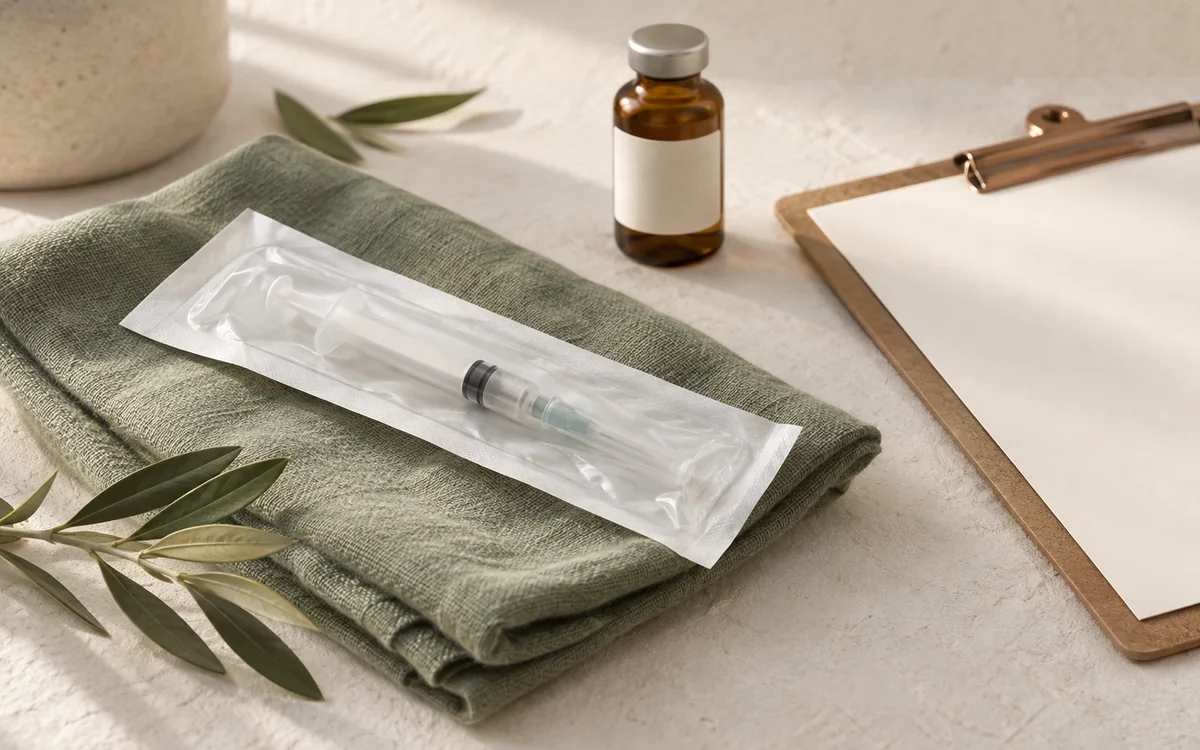
Mesotherapy contraindications: why injections cannot be treated as suitable for everyone
In clinics, “mesotherapy” does not name one standard medicine. It describes a technique that delivers small amounts of selected substances into the skin through multiple injections [1, 4, 5]. Safety therefore depends on both the needle punctures and the identity, concentration, and intended use of the injected product [4, 5]. Fat-dissolving injections are also different from superficial skin injections; substances such as deoxycholic acid disrupt fat-cell membranes at the injection site [3, 6, 7].
Products sold without approval or clear ingredient information should not be treated as harmless vitamin mixtures. The FDA has received reports of serious infections, permanent scars, skin deformities, cysts, and painful knots after unapproved fat-dissolving injections [1]. Mesotherapy guidance also notes that an injected drug can be absorbed systemically, so the contraindications of the drug itself must be considered alongside risks from the injection technique [4].
The international guidance does not place every condition into a fixed two-tier system. It calls for a medical history and examination and specifically lists significant coagulation problems or anticoagulant use, autoimmune disease, a tendency to hypertrophic or keloid scars, active herpes, therapies that can alter skin repair, permanent fillers at the injection site, and allergic tendency [4]. A later consensus statement adds that mesotherapy should not be used when a contraindication comes from the technique or the injected product [5]. For a wider overview, see our guide to mesotherapy risks and warning signs. Before any session, know exactly what will be injected and review your health history and medicines with a qualified clinician [1, 4, 5].
Pregnancy, breastfeeding, and younger age: why injections are deferred
During pregnancy, aesthetic mesotherapy and fat-dissolving injections should be avoided because safety information is insufficient. The Kybella label states that there are no adequate, well-controlled trials in pregnant women to inform drug-associated risk [3]. Injection-lipolysis guidance also lists pregnancy and breastfeeding among conditions to exclude before treatment [7]. This advice rests on missing safety data.
For breastfeeding, the Kybella label says there is no information on whether synthetic deoxycholic acid is present in human milk, its effects on a breastfed infant, or its effects on milk production [3]. Because this is an elective cosmetic treatment, it is reasonable to defer it until breastfeeding has ended rather than expose an infant when the evidence is incomplete. Our guide to weight-management medicine during pregnancy and breastfeeding explains why treatment decisions in this period need medical review [3, 7].
For age, FDA-approved Kybella is indicated for adults with moderate to severe fullness associated with fat below the chin. Its label says safety and effectiveness have not been established in pediatric patients and that it is not recommended for children or adolescents [3]. This is a product-specific statement, not an automatic rule for every substance used under the broad name mesotherapy. In anyone under 18, the product, route, indication, and authorized age must all be checked; otherwise the use is off-label and requires the corresponding medical and consent safeguards [4, 5].
Ingredient allergies: know every component in the vial
Allergy history must be reviewed before any injection, together with the ingredients of the specific product. Mesotherapy guidance lists allergic tendency and says that contraindications of the injected drug also apply [4, 5]. The phosphatidylcholine preparation discussed in source [6] is derived from soybean lecithin, so anyone with soy allergy should tell the clinician and should not receive a soy-derived product until its formulation has been checked [6].
The official Kybella label lists benzyl alcohol as an inactive ingredient [3]. It also says a clinician may consider topical or injectable local anesthesia, such as lidocaine, for comfort; lidocaine is not listed as an ingredient inside the Kybella vial itself [3].
The practical safety rule is simple: do not accept an unidentified injection. Ask for the product name, active ingredient, concentration, inactive ingredients, and manufacturer, and ask whether a separate local anesthetic will be used [1, 3, 4]. Our ingredient-level mesotherapy guide explains how to check those details. If you have a drug or food allergy, tell the clinician the exact substance and what reaction occurred before the clinician decides whether the product is suitable or should be avoided [1, 4, 6].
Bleeding disorders and blood thinners: risks of bruising and deep hematomas
Repeated needle punctures can cause bleeding, bruising, or a hematoma beneath the skin. Mesotherapy guidance says that significant coagulation problems or anticoagulant use may prolong bleeding and contribute to hematoma formation after needle insertion [4]. The Kybella label likewise advises caution in people with bleeding abnormalities or those taking antiplatelet or anticoagulant therapy because excessive bleeding or bruising may occur in the treatment area [3].
The clinician therefore needs to know about every anticoagulant and antiplatelet medicine you take, whether it is warfarin, a direct oral anticoagulant, prescribed aspirin, or clopidogrel [3, 12]. Taking one of these medicines is not a reason to stop it for a cosmetic session. Anticoagulants are prescribed to reduce the chance of serious clots such as stroke or heart attack, and any temporary change must be decided by the prescribing clinician or anticoagulation service in the context of your condition [12].
Never stop an anticoagulant or antiplatelet medicine on your own. Tell the clinician assessing the injections about every prescription medicine, over-the-counter medicine, and supplement you use, and let the relevant clinicians decide whether the session should be deferred, declined, or discussed with your usual medical team [4, 12]. The purpose is to protect the treatment you need and to keep an elective procedure from disrupting an important clot-prevention plan [12].
Active infections and uncontrolled diabetes: why skin healing matters
If there is an infection in the treatment area, the session must be postponed. The Kybella label states: “KYBELLA is contraindicated in patients with an infection in the injection area” [3]. It also records post-injection infections, including cellulitis and abscesses requiring intravenous antibiotics and incision and drainage, and instructs clinicians to discontinue Kybella if an injection-site infection develops [3]. Mesotherapy guidance also lists active herpes as a contraindication, so any infection, open wound, or inflamed eruption at the site calls for examination and deferral until the clinician confirms treatment is appropriate [4, 7].
Nontuberculous mycobacterial (NTM) infection has been reported after mesotherapy, particularly when injected fluid was contaminated [8]. The systematic review covered 423 patients from case reports and case series. Most patients with recorded lesion counts had multiple lesions, ranging from subcutaneous nodules to abscesses and suppurative ulcers [8]. Treatment was prolonged in the reported cases: 95% of recorded treatment courses lasted three to eight months, and 71.1% of patients with a recorded regimen received more than one antibiotic at the same time. Most infections resolved, but scarring was the most commonly reported complication among patients for whom complications were recorded [8]. These data come from varied case reports and do not mean that every infection inevitably causes disfigurement.
Diabetes does not produce one automatic answer for every person. The NHS notes that type 2 diabetes can be associated with cuts or wounds taking longer to heal and with complications such as ulcers and infections, especially when nerve or circulation problems are present [13]. Before an elective procedure involving multiple punctures, the clinician should review glucose control, current wounds or infections, and complications affecting the skin, sensation, or circulation. If diabetes is not controlled or there is a slow-healing wound or infection, injections should be deferred until the condition has been assessed and stabilized [7, 13].
Keloids, autoimmune disease, and permanent fillers: points to review
A keloid is a raised scar that can follow skin injury and grow beyond the original wound. The NHS notes that people who have had a keloid before are more likely to develop another and advises those at higher risk to avoid elective skin injuries such as tattoos and piercings [11]. Mesotherapy guidance lists a tendency to keloid or hypertrophic scarring as a contraindication [4]. Multiple needle punctures may therefore carry a risk of keloid scarring, but the evidence does not justify saying that every injection point will inevitably become a permanent raised scar.
The same guidance lists autoimmune disease among the contraindications that should be identified in the medical history when weighing risks and benefits [4]. It does not say that every autoimmune condition will produce sterile granulomas or a specific foreign-body reaction to an injected ingredient. The decision should therefore consider the condition, its activity, current treatment, and the proposed product without adding an unsupported mechanism [4, 5].
The guidance also lists a permanent filler at the intended injection site as a contraindication to mesotherapy [4]. In practice, tell the clinician about any permanent filler or prior injection in the area, even if it was placed years ago [4].
Mandatory pre-injection clinical assessment and care pathways at La Rose
A decision about mesotherapy begins with a medical examination and history, not with the name of the procedure alone. Guidance calls for review of medicines, allergies, previous conditions, contraindications related to the technique, and contraindications of the selected product [4, 5]. Tell the clinician if you take an anticoagulant or antiplatelet medicine, have an autoimmune condition, have previously formed a keloid, have a permanent filler in the area, or have herpes, an infection, or a wound near the planned injection site [3, 4]. If you have diabetes, include its current control and any problems with wound healing, sensation, or circulation [13].
Direct examination of the area also matters. Before Kybella treatment, the label tells clinicians to screen for other causes of fullness below the chin, assess the skin and tissues, and consider previous surgical or aesthetic treatment that may have changed local anatomy [3]. The clinician should identify the product, whether its use is authorized for the area and purpose, its active and inactive ingredients, and any separate anesthetic. Kybella is approved for submental fat in adults; it is not approved or recommended for fat outside the submental region [3]. For any other product, its own information must be checked instead of automatically transferring Kybella's rules to it [4, 5].
Ask plainly: What is the substance? What is its concentration? Who manufactured it? Is this use authorized? Which symptoms require contacting the clinician? If there is an infection at the site, postpone treatment. If you take a blood thinner, do not stop it on your own. If the ingredients are unclear, do not accept the injection [1, 3, 4, 12]. You can book a consultation with the medical team at La Rose in Maadi or Fifth Settlement, New Cairo, to review your history, examine the area, and discuss whether injections are appropriate, should be deferred, or should be replaced by another plan [1, 4, 5].