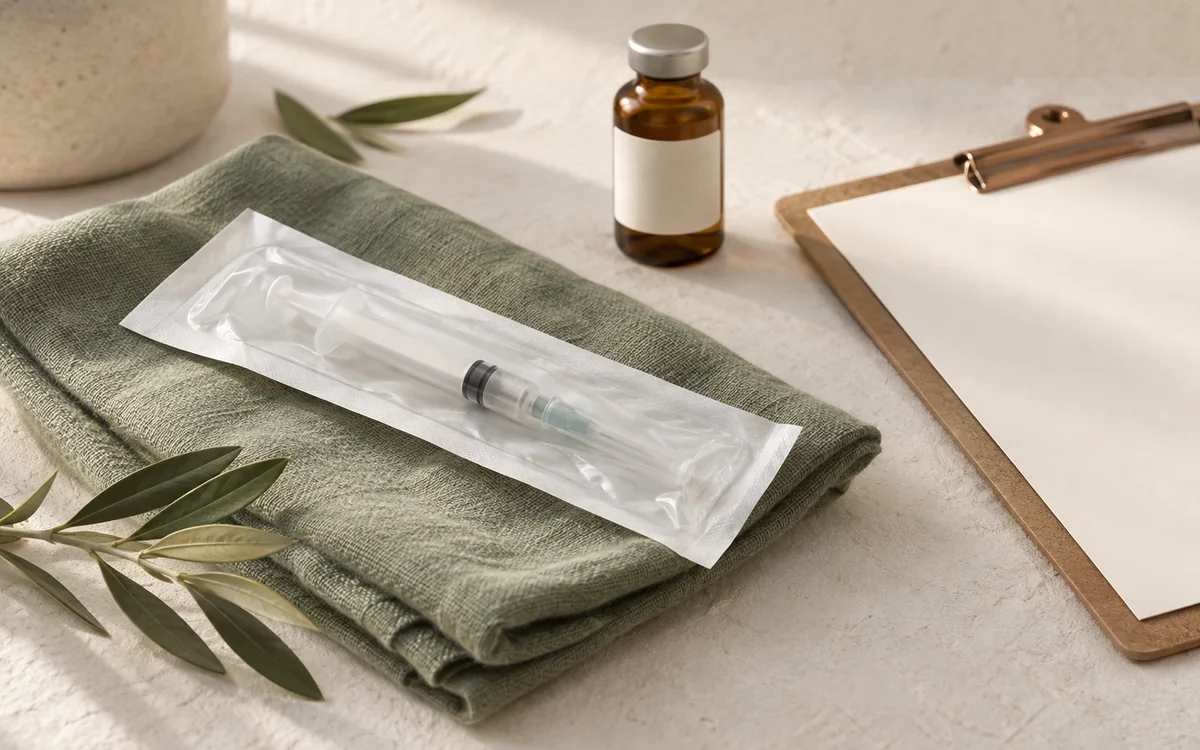
The popular name does not identify what is being injected
The phrase “slimming injections” is used for different procedures, which can create confusion before a decision is even made. Weight-management injections are medicines that act on appetite and whole-body signals, whereas local fat-dissolving injections are placed under the skin to alter a small fatty bulge in a defined site. They do not treat obesity, explain weight gain, or establish that glucose, blood pressure or fatty liver will improve. “Mesotherapy” is also not the name of one substance; it describes an injection approach that may contain different ingredients and concentrations. Safety and effectiveness therefore cannot be transferred from one formulation to another [1, 11].
The clear regulatory evidence concerns deoxycholic acid, a medicine that disrupts fat cells when correctly injected into adult submental fat. The FDA states that this is the approved use and that injection outside the submental region is unapproved and not recommended. The useful question is therefore not whether “fat injections” work in general, but: What substance and concentration will be used? Which body area? Is that exact use approved and studied? Who will administer it? If the vial identity, source or complication plan is unclear, there is not enough information for informed consent. For the broader confusion between formulations, read Is mesotherapy safe? Risks and warning signs without treating a trade name as evidence by itself [1, 2, 3].
Do they work? Yes for a defined product and site, with limits
For deoxycholic acid under the chin, randomized trials compared the medicine with placebo injections in adults with moderate or severe fullness. A greater proportion of treated participants achieved at least a one-grade improvement on clinician and patient scales, and some studies confirmed volume reduction using magnetic resonance imaging or fat-thickness measurements. European and US studies point in the same general direction: there is a real effect in selected people, but response is not guaranteed and it is not a large transformation of the whole body [6, 7, 8, 9].
The outcome must be read at the right scale. These measures concern submental fullness and satisfaction with the face and chin, not kilograms lost, and they do not test abdominal, arm or thigh fat. Most trials involved repeated sessions, with primary assessment weeks after the final session, so a next-day photograph proves neither success nor failure. Follow-up of some trial participants for up to three years suggests that a response, once achieved, can remain visible for many people. However, that follow-up applies to studied submental participants and cannot become a personal guarantee or evidence for other body sites [6, 7, 10].
When the substance or body area differs, the evidence also changes. Older small studies tested deoxycholate alone or combined with phosphatidylcholine, but they do not amount to approval of every mixture or every body area. A small study or published clinical experience does not remove the need to evaluate the exact product independently for quality, safety and effectiveness [1, 11].
The outcome is a small contour change, not weight loss or obesity treatment
The cosmetic purpose of local fat-dissolving injections is to reduce a limited bulge under the skin. Even when treatment works, the scale may not move at all because the amount of tissue targeted is small and the procedure does not alter appetite, eating patterns or fat distribution elsewhere. If the main goal is better health, weight loss or treatment of weight-related complications, that is a different medical pathway. The difference between body contouring and weight loss explains why success is measured differently in each pathway, without confusing the shape of one area with health outcomes [4, 5].
The expected change is also less dramatic than liposuction. The American Academy of Dermatology describes nonsurgical fat-removal results as gradual and subtle compared with surgery, while the American Society of Plastic Surgeons explains that nonsurgical procedures are not a direct replacement for liposuction. This does not make the procedure valueless; it means the decision should begin with a small, assessable goal rather than a promise of comprehensive change [4, 5].
A fat cell that has been destroyed does not return in the same form, but remaining fat cells can enlarge with weight gain, and skin, muscle and age-related changes continue over time. “Permanent” therefore does not mean the area's appearance will remain fixed regardless of future change. A result may become less visible if weight increases or skin becomes lax, and pre-existing asymmetry may remain. Before treatment, the clinician should explain what the procedure can alter and what lies outside its capability [4, 5].
The first examination asks whether the bulge is local fat at all
Not every bulge or fold is injectable fat. Under the chin, fullness may reflect loose skin, prominent muscle bands, jaw structure, an enlarged thyroid or lymph nodes. In the abdomen or elsewhere, a bulge may instead be a hernia, muscle separation, swelling, an old scar or normal body variation. The prescribing information itself requires screening for other causes of submental fullness and warns that marked skin laxity or local anatomy can produce an undesirable cosmetic outcome even if fat is reduced [3].
Assessment covers the location and feel of the tissue, skin condition, previous operations or injections, medicines, allergies, and unusual bleeding or bruising. Tell the clinician about current swallowing difficulty, a nearby nerve or muscle problem, infection or inflamed skin, or a previous procedure that altered the anatomy. Pregnancy and breastfeeding also call for deferring unnecessary cosmetic procedures; the American Society of Plastic Surgeons advises against nonsurgical fat-reduction procedures during pregnancy or breastfeeding [3, 5].
If you are unsure whether the tissue is skin or fat, read Loose skin or localised fat after weight loss? The difference changes the choice, then rely on an in-person examination rather than a home test or photograph. Suitability is not decided by body weight alone or by whether you can pinch a fold. It combines anatomy, the goal, general health, evidence for the substance, and the medical service's ability to provide follow-up [3, 4].
Sessions and waiting: results are neither immediate nor guaranteed
For the approved under-chin use, treatment is delivered through multiple injection points into subcutaneous fat and may require more than one session according to clinical assessment and response. US prescribing information permits up to six sessions at least one month apart, but it does not say that everyone should receive the maximum. Continuation is decided after swelling settles and the result can be reviewed. A clinician may stop earlier because the goal has been reached, benefit is insufficient, or risk has become greater than the likely gain [2, 3].
Swelling, bruising, firmness, numbness and pain are common after injection, so the area's appearance during the first days is not suitable for judging the outcome. The American Academy of Dermatology notes that the full effect of injections for chin fat is usually seen about three to four months after the final treatment. Useful photographs use comparable lighting, head angle and facial expression at an agreed time, not immediately after a session [3, 4].
Before starting, agree on a clear definition of success: Is the aim a lower fullness grade? Is a small difference worthwhile? At what point will treatment stop? Trials provide group averages and probabilities, not an individual prediction. Some people have a noticeable response, some see a modest difference, and some remain dissatisfied. A realistic stopping plan is as important as a treatment plan [6, 7, 8, 9].
Expected reactions and complications are not the same thing
Pain, swelling, bruising, redness, numbness and firmness at the injection site were common in deoxycholic-acid trials and were often localized and improved with time. However, “common” does not mean every symptom is harmless or that follow-up can be skipped. Official prescribing information also describes marginal mandibular nerve injury that can cause an uneven smile or facial weakness, difficulty swallowing, tissue damage after superficial or misplaced injection, vascular injury, ulceration, necrosis and infection [2, 3, 6, 12, 13].
In September 2026, the FDA added a warning about injection-site nodules or masses that may not resolve and may require medical intervention. It also warned about neuromuscular and other serious reactions when the medicine is used outside the approved submental region. Unapproved products add uncertainty about ingredients, concentration and sterility, with reports of infections, scars and lasting skin deformity. Buying a vial online or injecting yourself is therefore a risk, not a shortcut [1, 2].
Informed consent means knowing the product name, active ingredient, body site, whether that use is approved, the injector's training, expected reactions, important complications and whom to contact if a problem develops. Ask who will assess asymmetry or a persistent lump and whether the service can arrange appropriate onward care. If answers remain vague or dismiss every possibility of complications, pause until you can obtain a reliable clinical assessment [1, 2, 3].
When is prompt or emergency assessment needed after injection?
Contact a clinician promptly if pain is severe or worsening rather than settling, redness is spreading, fever or discharge appears, skin becomes very pale, blue or dark, an ulcer or open area develops, or a lump enlarges or fails to improve. Prompt assessment is also needed for a newly uneven smile, facial muscle weakness, increasing unusual numbness, new difficulty swallowing, or neurological or muscular symptoms after injection at any body site. These signs cannot be safely diagnosed from a message or photograph alone [2, 3, 12].
Seek emergency care immediately for difficulty breathing, rapidly developing swelling of the face, tongue or throat, fainting, or other features of a severe allergic reaction. If injection was near the eye and blurred or reduced vision occurs, do not wait; the FDA warning describes visual complications after unapproved use around the eye. The treating clinician or emergency team determines urgency and treatment after examination, because not every episode of post-injection swelling has the same meaning [2].
Bring the product name, clear photographs of the packaging, the lot number if available, the date and site of injection, number of sessions and any medicines taken afterwards. Do not massage the area, open a lump, or inject another substance yourself in an attempt to “neutralize” the first. These details help the medical team distinguish an expected reaction from infection, vascular injury or nerve injury and choose suitable observation or treatment [1, 2, 3].
Base the decision on the substance and goal, not a quick promise
Before agreeing, write down clear answers to five points: What is the substance? Which body site? What evidence supports that exact use? What small result would be worthwhile? What is the follow-up plan if there is no improvement or a problem develops? Then weigh likely benefit against repeated sessions, swelling, waiting time and complications. The individual decision remains with the treating clinician after examination because an article cannot assess your anatomy, medicines or expectations [2, 3, 4].
If the real goal is weight loss, weight-related symptoms or better health, start with the first weight-management visit rather than a local procedure. A structured assessment reviews health history, medicines, eating and activity patterns, and separates a health goal from a cosmetic step. If the concern is a small stable bulge, the clinician can explain the options and limits of each, including no intervention. Deferring a procedure is a valid medical choice when evidence for the product or body site is weak or the likely benefit does not justify the risk [4, 5].
At the clinic, the useful next step is a neutral assessment of tissue type and a realistic goal, including whether a procedure has any role, without promising an outcome. You can request a body-contouring assessment and review the information before giving consent. Bring the proposed product name, photographs, medicines, allergies and previous-procedure details. A calm decision based on specifics is more reliable than responding to an advertisement or before-and-after image [1, 3, 4].