Fatty liver treatment in Maadi: what actually works?
If you are looking for fatty liver treatment in Maadi, the short answer is that the core treatment is not a magic pill but a plan with four parts: gradual weight loss, food and movement you can keep up, follow-up with blood tests and ultrasound, and, in selected cases, a medicine discussed with your doctor. The modern name is MASLD, metabolic dysfunction-associated steatotic liver disease, which replaces the older term NAFLD [10]. The major guidelines agree that weight loss is first-line, and that no drink or herb "cleanses" the liver [2, 3, 8, 9]. If you want to build this plan with a liver and internal medicine doctor in Maadi, Dr Mohab Ashraf Fouad sees patients at the La Rose branch on Saturdays and does the examination and the ultrasound in the same visit. This article walks through the plan step by step, with no doses and no promises of a cure. For more on this, see our guide on who follows liver patients in Maadi.
Who is this plan for, and who needs a different route?
The plan suits someone who has been told "you have fat on your liver" on an ultrasound, or whose liver enzymes came back high, usually together with extra weight or a bigger waist, diabetes or prediabetes, high blood pressure, or high blood fats. Fatty liver can also appear in people with a normal weight, and then the target is a smaller weight loss plus close attention to the metabolic factors [4, 8]. Simple fat alone often does little harm, but once there is inflammation together with scarring, the picture changes and a more detailed assessment is needed [2, 4].
Some people need a different route or a wider assessment before any food plan. If you drink alcohol regularly, the condition is handled as alcohol-related liver disease and stopping completely is the priority [9]. If there is viral hepatitis B or C, a medicine that may be the cause, or symptoms such as yellow eyes or skin and a swollen abdomen, the diagnosis must be settled first. You can also read about fatty liver with scarring in its own article. For more on this, see our guide on fatty liver with fibrosis.
Weight target: what percentage helps your liver?
The numbers that recur in the references are these: losing 3 to 5% of body weight reduces liver fat, and usually 7 to 10% is needed to reduce inflammation and scarring [8]. The Egyptian fatty liver guideline sets 7 to 10% for people with overweight or obesity, about 5% for those with less excess weight, and 3 to 5% for lean patients, with loss that is gradual, at most about a kilogram a week [4]. This is not a two-week figure, it is a target for several months.
A study of 293 patients with biopsy-proven steatohepatitis followed for 52 weeks on lifestyle change found that among those who lost 5% or more, 58% had resolution of the inflammation, and among those who lost 10% or more, about 45% had scarring move back a stage and 90% had the inflammation resolve [1]. So the more weight lost, the greater the improvement, but very fast loss or severe restriction can harm the liver and muscle [8, 4]. This is why the target is set as a percentage of your own weight, not a number on a scale chosen at random, and it is revisited at each visit.
Food and movement: what goes into the plan?
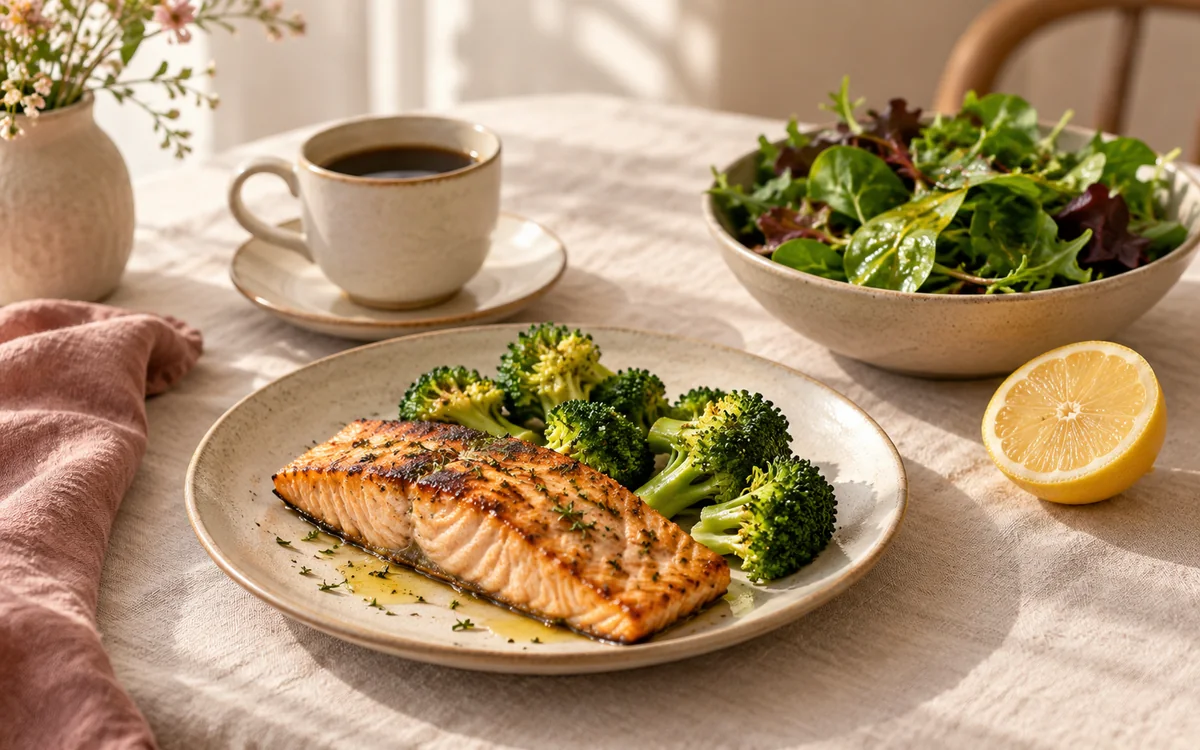
There is no single compulsory diet. The references favour a modest calorie deficit rather than hunger, a Mediterranean-style pattern (vegetables, legumes, fish, olive oil), less processed food, fewer sweetened drinks and less added fructose, together with regular movement [4]. Plain unsweetened coffee appears in the Egyptian guideline as a helpful item, but it is not a treatment on its own [4]. The movement target is roughly 150 minutes a week of moderate activity such as brisk walking, plus resistance training two or three days a week; both reduce liver fat to a similar degree, so pick the one you can keep doing [4]. Movement helps the liver even when weight does not fall much [8].
Protecting muscle matters, because starving yourself weakens muscle and does not repair the liver [4]. The practical details of the Egyptian plate and daily examples are in the article on the right food for fatty liver, so they are not repeated here.
Follow-up: how often for blood tests and ultrasound?
Follow-up is part of the treatment, not an extra. The Egyptian guideline says someone without scarring and with stable risk factors can be reviewed every two to three years, someone with scarring or uncontrolled metabolic factors yearly using a non-invasive scarring score such as FIB-4 or a liver stiffness measurement, and someone with cirrhosis every six months with ultrasound to look for tumours [4]. These are minimum intervals from the reference, and the doctor may shorten them for your case.
In the first months of the plan the tests that matter are the liver enzymes ALT and AST, plus sugar and blood fats, compared with the first reading. The updated AASLD guidance uses the change in ALT and non-invasive tests to judge response to treatment [6]. One key point is that normal liver enzymes do not rule fatty liver out, and the reverse, so tests are read together with the ultrasound and weight, not alone [2, 4]. Ultrasound shows fat but is not accurate for scarring, and the details are in the ultrasound article. For more on this, see our guide on fatty liver ultrasound and tests.
When is a GLP-1 medicine discussed?
People often ask about "Mounjaro" and "Wegovy". Wegovy is a brand name of the substance semaglutide. In the phase 3 ESSENCE trial of patients with steatohepatitis and stage 2 or 3 scarring, semaglutide produced resolution of inflammation without worsening of scarring in 62.9% versus 34.3% on placebo at 72 weeks, improvement in scarring in 36.8% versus 22.4%, and mean weight change of -10.5% versus -2.0%, with more digestive side effects [5]. The November 2025 AASLD update explains that patients are selected using non-invasive tests, that the medicine is not approved for cirrhosis, and that the gallbladder, pancreas and loss of muscle need attention [6]. A liver-directed medicine, resmetirom, also improved inflammation and scarring in a phase 3 trial [7].
This does not mean everyone with a fatty liver gets an injection. A medicine is discussed when there is documented inflammation and scarring, or obesity or diabetes alongside, after the basic plan has been tried, with a prescription from a licensed pharmacy, and the assessment decides. Newer medicines in the same family still need more liver-specific evidence, so ask your doctor rather than rely on an advertisement. The details of reading the trials are in the article on Mounjaro, Wegovy and fatty liver.
Herbs and supplements: the evidence position without hype
Many advertisements say "cleanse your liver" with a drink or a mixture. The references say otherwise: no medicine or herb has been proven to treat fatty liver, and some herbal products can harm the liver [8, 9]. The Egyptian guideline notes that vitamin E and pioglitazone may improve the liver's appearance under the microscope but have safety concerns, so they are not something to start by yourself [4]. In practice this means: ask your doctor before any supplement or herb, and bring the package or its name, because some medicines and herbs interact.
The same goes for alcohol: if the liver is fatty, stopping alcohol completely is the safest decision [9]. And do not stop a long-standing medicine by yourself even if you suspect it is the cause, because your doctor decides whether to change it [9].
The visit in Maadi and how to choose where to follow up
At the visit with Dr Mohab Ashraf Fouad at La Rose Maadi you are asked about your medical history, medicines, alcohol, sleep and eating, a clinical examination is done, and then an abdominal ultrasound is done in the same visit, which the doctor reads in light of your symptoms. Dr Mohab holds an MSc in general internal medicine, hepatology, gastroenterology and endoscopy, and also follows diabetes and blood pressure. Next your weight target is set, tests for enzymes, sugar and blood fats are requested if missing, and a review date is agreed. If your case needs an additional test such as liver stiffness measurement or endoscopy, the doctor explains which one and where.
When choosing any place for follow-up, ask: who the doctor is and what their specialty is, whether the assessment includes examination, ultrasound and tests together, whether you receive a written target and review dates, and whether you are told when a medicine may be discussed and when not. Be wary of any place that promises a "permanent cure" or "liver cleansing" or sells you a product at the first visit [2, 8].
Getting to and booking the Maadi branch
The exact address is 14 El-Mokhtar Street, off El-Nasr Street, behind QNB Bank, New Maadi, Cairo. Dr Mohab Ashraf Fouad sees patients in Maadi on Saturday only, from 4 to 7 pm. To book or ask for directions, call or use WhatsApp on 010 4066 1893. Schedules can change, so confirm the day and time when booking before travelling.
According to the recorded road measurements from La Rose, Maadi Grand Mall is about 4–5 minutes by car, Degla about 7–8 minutes, Road 9 about 8 minutes, and Old Maadi about 8–11 minutes. El Basatin is about 9–10 minutes, Corniche El Maadi about 11 minutes, Tora El-Balad about 14–15 minutes, and Zahraa El Maadi about 11 minutes. These are approximate Google Maps measurements and can change with traffic.
Before the visit, prepare your medicine list and any previous ultrasound or test results, and write down your questions. If you develop yellow eyes or skin, vomiting blood or black stools, severe abdominal swelling, confusion or unusual drowsiness, or severe persistent abdominal pain, do not wait for a clinic appointment; seek emergency care [8, 9]. For a non-urgent concern, book at the Maadi branch. When you are ready: Book at the Maadi branch.