Osteoporosis doctor in Maadi and Fifth Settlement: the direct answer
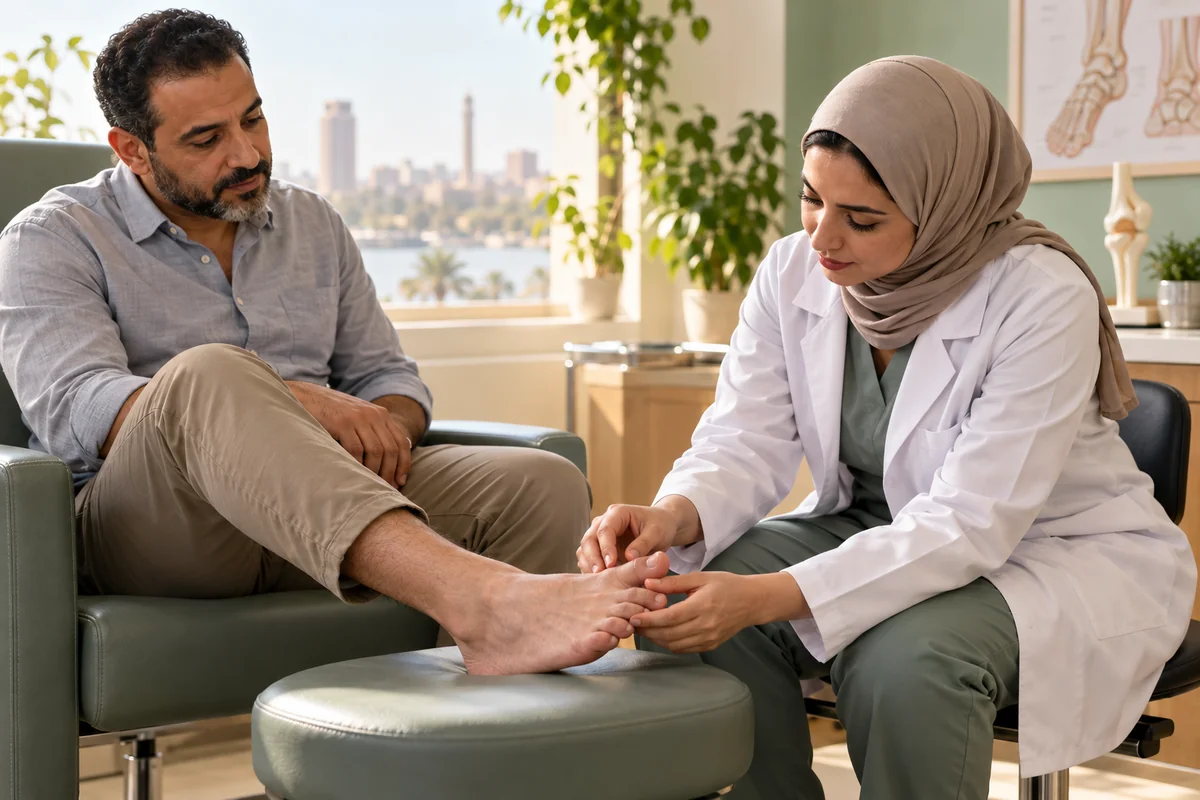
If you are looking for an osteoporosis doctor in Maadi or Fifth Settlement, start with a rheumatology and joint assessment. Osteoporosis is a metabolic bone disease that a rheumatologist can assess and manage medically, with orthopaedic surgery involved if there is a fracture or an injury that needs an operation [9]. At La Rose, rheumatology is available at the Maadi branch and at the Fifth Settlement branch inside CMC Medical Mall on Wednesdays from 3:30 to 8 pm. Book by phone or WhatsApp on 010 4066 1893, and bring the bone density report you had done externally, because the scan itself is not performed in the clinic; the doctor reviews the report and builds the treatment and follow-up plan from it [12, 10]. Below, you will learn when to seek assessment, what happens at a first visit, which reports and tests to prepare, and how to reach either branch.
Osteoporosis weakens bone and raises fracture risk without obvious symptoms at first, and many people only discover it after a first fracture [6, 9]. The purpose of the visit is therefore not to wait for a fracture. It is to assess risk early, review any previous fracture that followed a minor fall, and build a prevention and treatment plan suited to your age and medical history [2, 4].
When should you see an osteoporosis doctor?
The clearest signal is a fracture after a minor fall or from a height below your own, such as a wrist, hip or spinal fracture. A fragility fracture calls for bone assessment and a plan to prevent the next one [2, 6]. Loss of height, a visibly stooped posture, or sudden severe back pain can all point to a vertebral fracture, even without a major fall [9, 6].
Several groups need assessment even without a fracture: women after menopause, especially over 65, or under 65 with risk factors [10, 8]; anyone who has taken oral glucocorticoids for 3 months or more [1, 12]; people with rheumatoid arthritis or another chronic inflammatory disease [8]; early menopause before 45; low body weight; smoking or heavy alcohol use; a family history of hip fracture; malabsorption disorders or eating disorders; and some medicines that affect bone [12, 8].
If back pain comes with fever, loss of the ability to walk, tingling or weakness in the legs, or a change in bladder or bowel control, do not wait for a routine appointment; those signs need urgent assessment. If you have rheumatoid arthritis or another inflammatory disease, read about the link between rheumatoid arthritis and osteoporosis and how risk is assessed, because inflammation itself and glucocorticoid treatment both affect risk [1, 8].
What happens at a first osteoporosis visit?
A first visit starts with a detailed history: any previous fracture and how it happened, repeated falls, current and past medicines, especially glucocorticoids, menstrual and menopause history, family history of hip fracture, diet, activity, smoking and alcohol, and any old reports or X-rays [1, 8]. The examination follows: height and weight, posture and curvature, walking and balance, muscle strength, and the spine and joints [8, 10]. The doctor compares your current height with an older measurement when available, because height loss can be a sign of a vertebral fracture [9].
After the examination, the external bone density report is reviewed, and 10-year fracture risk is estimated using factors such as age, sex, previous fracture and glucocorticoid use [11, 10]. The visit does not end with a number on a page. It ends with a clear plan: whether more tests are needed, whether medicine is needed, what to change in diet, activity and falls prevention, and when to follow up [4, 7]. If there is no recent bone density report, the doctor directs you to have one done at an external imaging centre and to bring it to the next visit [12].
Which reports and tests should you bring?
Bring the full bone density report, not just a slip with one number; the report should include the scan image, the hip and spine results and the standard scores [10, 12]. If the report is old or unclear, ask the imaging centre for a copy before the appointment. Also bring any spinal or pelvic X-rays or MRI, a list of all medicines and doses, the record of any previous fracture, the date of your last period or menopause, and any family history of hip fracture [8, 1].
Depending on your case, the doctor may request blood tests to look for other contributing causes and to check safety, such as kidney and liver function, calcium, vitamin D, thyroid function and a complete blood count, as the doctor decides. A blood test alone does not diagnose osteoporosis; the primary diagnosis rests on bone density measurement [10, 8]. The scan itself is done at an external imaging centre, usually takes 10 to 20 minutes, and needs no special preparation [13, 12]. If the doctor also requests blood tests, ask the laboratory about any fasting those tests require.
If you are unsure whether you need a bone density scan at all, read our guide on who needs a bone density test before booking, because it explains the difference between osteoporosis and osteoarthritis and who deserves assessment [10, 12].
How to read a bone density result without letting the number scare you
A bone density report contains a score comparing your bone density with that of a healthy young adult, known as the T-score. A score of -1 or higher is healthy. From -1 to -2.5 is osteopenia, and -2.5 or lower may indicate osteoporosis [10]. Each 1-point drop in the T-score raises fracture risk by about 1.5 to 2 times [10]. In premenopausal women, men under 50 and children, the report usually uses an age-matched Z-score, and -2.0 or lower means low bone density [10].
The number alone does not decide treatment. The doctor considers age, sex, fracture history, glucocorticoid use and other diseases, and estimates 10-year fracture risk [7, 11]. One person with mild low density may not need medicine immediately, while another with the same number may need treatment because of a previous fracture or high risk [6, 7]. That is why the report should be reviewed with the doctor rather than judged on your own [10]. If your result does lead to a plan, read our guide to osteoporosis treatment after a bone density result to understand what follows the number and how follow-up works [4, 7].
The osteoporosis treatment plan: what actually changes?
The treatment plan starts with a clear goal: lowering fracture risk, not just improving a density number [9, 2]. The foundation is enough calcium from food, with a supplement only if the doctor decides it suits you [7]. Vitamin D helps the body absorb calcium, and the doctor decides whether you need a supplement [7]. Do not start high-dose supplements on your own; the doctor decides what suits your case and kidney function [7].
Movement is essential: weight-bearing exercise, muscle strengthening, balance work and falls reduction, which lowers fracture risk even when density does not change quickly [3, 9]. If you have an old vertebral fracture or back pain, the exercise programme must be adapted and safe, and external physiotherapy helps with that [3]. Falls prevention includes better home lighting, removing loose rugs, correcting vision and wearing suitable shoes [9].
Medicines depend on how severe the osteoporosis is, your fracture risk and your other conditions. Bisphosphonates slow bone breakdown, take 6 to 12 months to show their effect, and may need to continue for 5 years or longer [7]. Other options include selective oestrogen receptor modulators, parathyroid hormone treatment and biological medicines, each with its own indications, conditions and contraindications [7, 4, 5]. The doctor reviews kidney function, dental history and current medicines before choosing [7]. Never stop or change the dose of a bone medicine on your own; any adjustment is made with the doctor [4, 5]. La Rose offers InBody body-composition analysis, but it is not a substitute for bone density measurement [10].
Follow-up after starting treatment: when to return and what is reviewed
Follow-up is not the same schedule for everyone. The first visit sets a clear plan; after that, the doctor reviews symptoms, falls, adherence and side effects, and adjusts the plan when needed [4, 5]. The interval for repeating bone density testing depends on your case, age, first result and the doctor’s judgement, not on one fixed period for every patient [10, 4].
If you take glucocorticoids for another disease, the doctor needs to know the dose and duration, because this affects osteoporosis treatment decisions [1]. If you have rheumatoid arthritis or another inflammatory disease, controlling the inflammation itself is part of protecting bone [1, 8]. Follow-up may include coordination with specialties outside the centre when needed, because La Rose does not have in-house cardiology, endocrinology, nephrology or orthopaedic surgery. A new fracture, severe back pain or leg weakness means earlier review, not waiting for the routine appointment [9].
Follow-up is also the place to review diet, activity and falls prevention, not only medicine. If a medicine is not working clearly or is causing side effects, the doctor changes the plan rather than you stopping it yourself [4, 5].
Getting to the Maadi branch and its hours
If you are coming after a minor fracture, try to book soon, because fragility fracture assessment and prevention of the next fracture start early [2]. The Maadi branch is at 14 El-Mokhtar Street, off El-Nasr Street, directly behind QNB Bank, New Maadi. It is open Saturday, Monday and Tuesday from 2 to 8 pm, and each doctor’s times vary, so confirm the rheumatology slot when booking.
From Maadi Grand Mall it is about 1.6 km, about 5 minutes by car; from Degla about 2.6 km, about 7 minutes; from Road 9 about 3 km, about 8 minutes; and from Old Maadi and the metro station about 3.4 km, about 8 minutes. From El Basatin it is about 3.5 km, about 10 minutes; from Corniche El Maadi about 5.5 km, about 11 minutes; from Tora El-Balad about 6 km, about 15 minutes; and from Zahraa El Maadi about 7 km, about 11 minutes. Street parking is available in front of the building, and if you need help with directions, call or message 010 4066 1893.
Getting to the Fifth Settlement branch and its hours
The Fifth Settlement branch is in CMC Medical Mall, 4th floor, North 90th Street, behind the Air Force Specialized Hospital, Fifth Settlement, New Cairo. Rheumatology runs there on Wednesdays from 3:30 to 8 pm, and times vary by doctor, so confirm the rheumatology slot when booking.
From Cairo Festival City it is about 5.2 km, about 10 minutes via South 90th Street; from El Yasmeen about 5 km, about 10 minutes via North 90th Street or Moustafa Kamel Axis; and from Al Narges about 6.5 km, about 12 minutes via South 90th Street. From El Banafseg it is about 6.9 km, about 10 minutes via North 90th Street; from First Settlement about 7.4 km, about 12 minutes via Moustafa Kamel Axis; from Katameya Heights about 8 km, about 12 minutes via South 90th Street; and from Point 90 Mall and AUC Avenue about 9 km, about 12 minutes via North or South 90th Street.
Enter CMC Medical Mall and go up to the fourth floor; the clinic is under the La Rose name. If you are coming from far away or need directions, call or message 010 4066 1893 before the appointment. If you are still choosing between branches, Maadi suits patients in southern Cairo and Fifth Settlement suits New Cairo residents, bearing in mind that rheumatology there runs one day a week. Whichever branch you choose, bring your external bone density report so the doctor can read the results with you [10].
How to book, and when to go to emergency
Book by phone or WhatsApp on 010 4066 1893, or through the booking page. When you call, say you want an osteoporosis assessment with Dr Shimaa Sherif and choose the branch: Maadi on Saturday, Monday and Tuesday from 2 to 8 pm, or Fifth Settlement on Wednesday from 3:30 to 8 pm. Ask for the available rheumatology slot, because doctors’ times vary within the same branch day. Before the appointment, prepare the external bone density report, the medicine list, and any old X-rays or tests [10, 12]. If this is your first visit, bring a companion if you need one, wear comfortable clothing, and arrive 15 minutes early.
Emergency signs: after a fall, being unable to stand or walk, an obvious deformity, severe back pain with fever or shivering, tingling or weakness in the legs, or loss of bladder or bowel control. These need emergency care immediately, not a routine clinic appointment [9, 6].
If the report is not ready yet, you can still book and discuss risk factors first, but the visit is more precise when the report is with you. If you take glucocorticoids or other medicines, bring a complete list with doses, because the doctor reviews it before any decision [1, 7].
Read also: book an appointment