What has changed in the way we think
The World Health Organization guideline on complementary feeding for infants and young children aged 6–23 months brings nutritional needs together with learning and development. Complementary food generally begins around six months alongside milk, when milk alone no longer meets every need, while the child's readiness and health still matter. This period is an opportunity to encounter varied foods and textures, not a test of finishing a prescribed bowl. [1, 5]
The guidance considers both breastfed and non-breastfed children, but application remains individual. A premature child, a child with faltering growth, illness or swallowing difficulty may need a different plan. Age therefore opens the conversation without replacing assessment of development, growth and feeding safety. [1]
Complementary feeding does not mean milk disappears from the picture. It adds developmentally appropriate food when milk alone is no longer enough, usually from about 6 months. The exact timing also depends on the child being able to sit with support, control the head and handle food, not on comparison with another baby [1, 3].
Readiness signs matter more than the number on the calendar
Before starting complementary feeding, clinicians and parents look for specific signs that a child is genuinely ready: the ability to sit upright with little or no support, good head and neck control, interest in food such as watching the plate, leaning toward it or opening the mouth, and a fading tongue-thrust reflex that used to push food back out automatically. These signs together matter more than reaching exactly six months of age. [3, 5]
If a child has not shown these signs around six months, or has a clear developmental delay, that is worth discussing with a paediatrician rather than waiting passively or starting early without reason. Starting before genuine readiness can make swallowing harder or lead the child to reject food from the start. [3]
Do not add infant cereal or any solid food into a bottle of milk, or try to 'bulk up' a feed to make a baby sleep longer; this can raise choking risk and is not supported evidence for better sleep. Complementary feeding takes its own time with a spoon and a separate sitting, not a hidden addition to a bottle feed. [3]
Responsive feeding is neither neglect nor force
Responsive feeding means that the caregiver offers suitable, safe food, notices hunger and fullness signals, helps patiently and avoids pressure and distraction. A child may open their mouth and lean towards food, or close the mouth and turn away when full. We encourage and allow time, but refusal should not become a battle and a screen should not be used to place food without awareness. [1]
The adult still holds real responsibility: regular opportunities, variety, textures that reduce choking risk, hygiene and appropriate preparation. Responsiveness does not mean allowing biscuits or juice throughout the day, or removing a rejected food forever. Calm re-offering and gradual progression with development support learning without bribery or punishment. [1, 6]
Responsive feeding means the adult decides what suitable food is offered, when and where, while the child decides how much to eat or whether to refuse that time. Leaning toward the spoon or opening the mouth can signal hunger; closing the mouth or turning away can signal fullness. Pressure turns a meal into conflict, while calm repeated exposure lets the child learn flavours and textures gradually [8, 9].
Iron and first foods are not just a matter of taste
One of the most important points in current complementary-feeding guidance is that every infant needs iron-rich foods from the start, such as pureed meats, iron-fortified cereals or legumes, because the baby's natural iron stores begin to fall around six months while growth needs keep rising. Children on a vegetarian diet need extra attention to iron and zinc sources. [4, 5]
Avoid adding salt or sugar to food, and delay honey completely until after the first year because of the risk of infant botulism. Sugary juices or sweetened drinks are not necessary and can reduce appetite for more useful foods. Introducing common allergenic foods such as egg and peanut early and safely, rather than delaying them without reason, is now part of current recommendations depending on the child's situation and family history; discuss the right timing with a paediatrician. [3, 4]
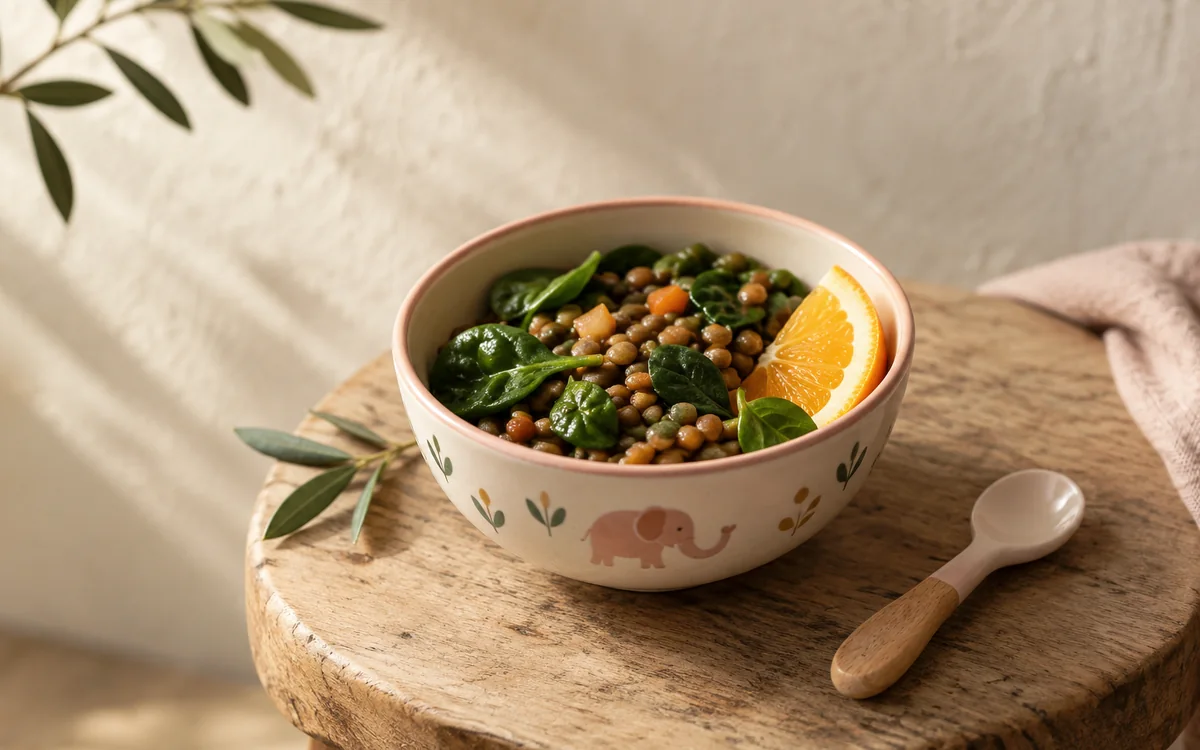
Once solids begin, include an iron source regularly: meat or poultry prepared to a safe texture, mashed lentils or beans, egg, or iron-fortified infant cereal. Vitamin C foods can help absorption of plant iron. A baby born preterm or with a health condition may need an individual plan, so supplementation should not be guessed [7].
Texture progression and choking safety
Start with a smooth or fully pureed single-ingredient texture, and progress gradually to thicker or lumpier textures as the child responds. Avoid round or firm shapes such as whole grapes, whole nuts, hard or sticky candy, and cut food into small, safe pieces. Keep the child sitting upright under continuous supervision while eating, and never leave them alone during a meal. [2, 3]
It matters to distinguish ordinary gagging from true choking: gagging is a normal, loud and protective reflex that helps a baby learn to control food inside the mouth, while true choking is usually silent, dangerous and needs immediate action. Learn basic infant choking first aid before starting complementary feeding; this is part of preparation, not an optional extra. [2, 3]
Portion size and meal frequency build up gradually
At the start, around six months, two to three spoonfuls of soft food once or twice a day is enough, while breastfeeding or formula remains the main source of energy and nutrients. As the child approaches eight months, portion size and frequency gradually increase to roughly half a cup two to three times a day, with a snack sometimes added between meals depending on appetite. [6]
No single number suits every child, and the gradual increase follows the child's cues rather than a strict schedule. Do not measure success by how many spoonfuls were eaten at one sitting; the overall pattern across days matters more, and a paediatrician can review whether the pace fits your child's specific situation. [1, 6]
Purées or soft finger foods: there is no single correct method
Some families prefer starting with smooth spoon-fed purées, while others lean toward baby-led weaning, where the child self-feeds soft finger foods from the start. Current guidance does not mandate one method; both can be safe and suitable when applied carefully with the texture, size and continuous-supervision rules described above. [2, 3]
Choosing a method depends on family comfort, the child's motor readiness, and a paediatrician's advice in particular situations such as prematurity or developmental delay. The two approaches can also be mixed depending on the situation; what stays constant is choking safety and responding to the child's cues, not the label of the method itself. [2, 3]
A practical family response
Offer a small amount with more available, and keep the child safely seated under continuous supervision. Record foods, textures and any coughing, vomiting, rash or constipation, and follow the growth curve rather than daily weight. Do not add salt, sugar or random supplements simply to 'make the child eat', and do not delay assessment of swallowing difficulty or recurrent choking. [1, 3]
Dr Alyaa Abu Taleb reviews readiness, growth, breastfeeding or milk, food variety and the family routine, then adapts the plan to age and health. Bring the child's record plus a food and supplement list. If starting feels confusing or every meal has become a battle, a consultation can help the family build calm, safe steps instead of moving between contradictory advice. [1]
By around the first birthday, the child moves closer to family food: By around the first birthday, a child can generally eat an adapted version of the same family food, provided pieces are soft, sized safely, and free of extra salt, sugar, honey or strong spices. Sharing family meals helps a child learn by watching adults, and reduces the need to prepare entirely separate food every time. [6]
This does not mean every home-cooked dish is suitable without adjustment: saltiness, spice level, piece size and choking risk still need checking. If the family eats very spicy or salty food, set aside your child's portion before those additions. The goal is gradual: not a sudden jump from puréed food to full adult meals in one day. [1, 6]
When faster review with a doctor is appropriate
Seek faster review if the child refuses food entirely for a long period, has clear difficulty swallowing or repeated coughing during meals, or shows signs of an allergic reaction such as widespread rash, swelling of the face or lips, breathing difficulty or repeated vomiting after a particular food. These signs need assessment according to severity and are not suitable for waiting or repeated home trials of the same food. [3, 4]
Also discuss the plan with a paediatrician before introducing new foods if you notice a clear flattening of the growth curve, unusual lethargy or pallor, or a family history of severe food allergy, rather than relying on another child's experience or online advice. [1, 3]
Keeping a short food diary (what was offered, when, and any reaction) makes these conversations faster and more accurate than trying to recall details from memory during a rushed appointment. This is a practical habit, not a requirement to test yourself before seeing a clinician. [1]
If you need to connect this information with your health history and current plan, you can book an assessment and review the decision with the clinician or dietitian.