Gallbladder stones doctor in Maadi: the direct answer
If gallstones were found in your gallbladder, or you have pain that looks like biliary colic, you can start with an internal medicine visit with Dr Mohab Ashraf at the La Rose Maadi branch, 14 El-Mokhtar Street off El-Nasr Street, behind QNB Bank, New Maadi. The doctor reviews your symptoms, examines the abdomen, and an abdominal ultrasound is available at the same branch. With clinical nutrition support, the right eating pattern is set while the decision is being made [1, 4, 7].
Dr Mohab sees adults at the Maadi branch only, on Saturdays from 4 to 7 pm, and it is best to check the current schedule when booking. The Fifth Settlement branch has no internal medicine. Surgery itself is not done at La Rose: if the assessment shows you need gallbladder removal or an endoscopic procedure on the bile ducts, the doctor refers you and coordinates follow-up after the report. To book, call or send a WhatsApp message to 010 4066 1893 or use the booking link below [5, 7].
This page will not repeat ultrasound-report wording or surgery details at length; each of those has its own article, linked where it fits. Here you get the practical steps: red flags, the first visit, tests, follow-up, and how to reach the branch.
Read also: Book at the Maadi branch · Internal medicine doctor in Maadi: when to go and what happens
Symptoms: biliary colic or silent stones?
Most people who have gallstones feel no symptoms at all, and these silent stones usually need no treatment. They are often found by chance during an ultrasound done for another reason, which is what the medical sources say [1, 3, 8]. Trouble starts when a stone briefly blocks the gallbladder outlet, and then biliary colic happens.
Biliary colic is pain in the middle of the upper abdomen or under the right ribs. It can be severe and constant, it may spread to the back or under the right shoulder, and it comes with nausea or vomiting. Attacks often follow a heavy meal and usually happen in the evening or at night, lasting longer than half an hour and sometimes several hours [1, 3, 8]. If one attack has happened, more are likely, so it should not be ignored [3].
One important point: a systematic review of 24 publications found that biliary colic itself is the symptom that points to gallstones, but 80% of referred patients with gallstones presented with other, non-specific abdominal symptoms [12]. General abdominal pain alone is not proof, and the examination with ultrasound settles it. Some conditions look similar, including appendicitis, ulcers, pancreatitis and reflux [3], which is why assessment matters before assuming every upper abdominal pain is the gallbladder.
By the British guideline definitions, asymptomatic means symptom-free for at least 12 months before diagnosis, and symptomatic means stones seen on imaging with symptoms now or within the 12 months before diagnosis [7].
Red flags: when to go to emergency instead of waiting for an appointment
Some signs do not belong in an appointment slot; they belong in emergency right away. Sudden severe abdominal pain, pain spreading to the back with vomiting, a very high temperature or feeling hot, cold and shivery, or yellow skin or eyes should all be dealt with immediately [1].
The American sources add: pain lasting several hours, nausea and vomiting, a fever even if low-grade, chills, jaundice, and tea-coloured urine with light stools are all reasons to see a doctor straight away [3]. The British source says pain that lasts longer than 30 minutes needs urgent advice [1].
What can be behind these signs? Inflammation of the gallbladder itself, which is caused by gallstones in about 95% of cases. The pain is sudden and sharp in the upper right abdomen, can spread to the right shoulder, and lasts beyond a few hours, with a high temperature and nausea or vomiting [2]. Pancreatitis and jaundice with itching, dark urine and pale stools are other complications [1].
Practical rule: if the pain is persistent or severe, or comes with fever, yellow skin or continuous vomiting, go to the nearest emergency department now and do not wait for Saturday. If an attack settled and you are sure it has passed, book the internal medicine visit and ultrasound at the Maadi branch so the cause is identified and a plan is set. This page is not a replacement for emergency care, and acute cases are not handled in the clinic.
The first visit in Maadi: what actually happens
The first visit with Dr Mohab is built on history and examination, which is the first step in diagnosis according to the sources [4]. The doctor will ask about the timing, location and duration of the pain and its link to food, whether there is vomiting, fever or yellowing, whether attacks have repeated, and which medicines you take now. This matters because biliary colic is the one distinctive symptom, while other complaints can overlap with other conditions [3, 12].
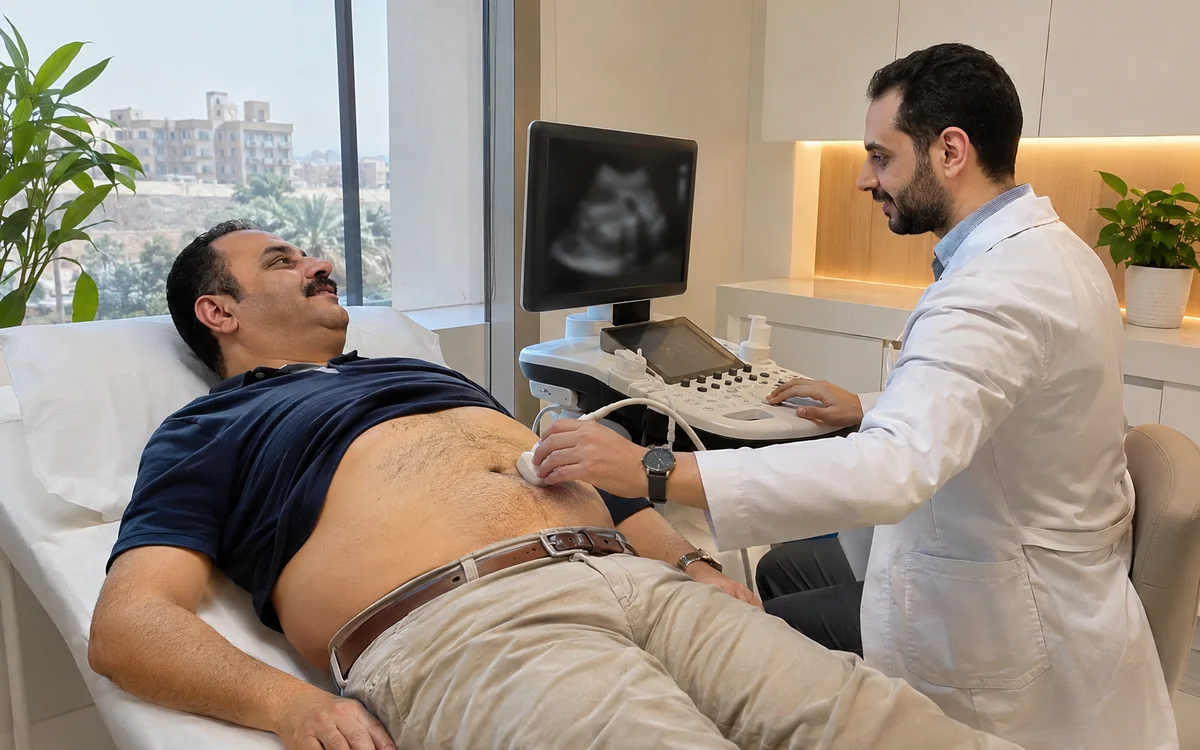
Then comes the clinical abdominal examination, followed by ultrasound. Ultrasound is the best imaging test for finding gallstones [4]. It uses no radiation and takes around 10 to 45 minutes, with gel on the skin and a probe moved over the abdomen, and sometimes the result is given at the end of the scan [9]. Abdominal ultrasound is available at the Maadi branch, and the doctor decides whether you need it at the same visit or at a separate appointment, depending on your case.
Blood tests such as liver function and white cell count help detect inflammation or blockage [4, 7]. The British guideline recommends liver function tests and ultrasound together for anyone suspected of having gallstones [7].
By the end of the visit you leave with clear answers to specific questions: are the stones silent and only need follow-up? Do the symptoms point to biliary colic? Are there red flags? And is a surgical referral needed? If the ultrasound used words such as sludge or microlithiasis, that has its own dedicated article.
Read also: Gallbladder sludge or stones? What the ultrasound wording means
Which tests and reports to bring with you
The visit works better when you bring papers that clarify the picture. The most important are any previous ultrasound report that mentions stones, sludge or polyps in the gallbladder, with the images if available. If an MRI of the bile ducts or other imaging was done, bring the report and the disc. If you went to emergency before because of an attack, bring the discharge paper and the tests from that day, because a fever or raised liver enzymes at the time affects the decision.
Bring your latest blood tests too: liver function and a blood count, plus sugar and lipid results if you have them, because diabetes, obesity and rapid weight loss are known risk factors for stones [1, 3]. Bring a list of your current medicines with names and doses as they are, without changing anything; the doctor is the one who decides whether anything needs review.
Note before the visit: when was the last attack, how many attacks in recent months, what food came before them, and has your weight dropped fast or are you on a strict diet? The number of attacks helps decide whether the stones count as symptomatic [7]. In a study of 3016 patients admitted after a first episode who did not have gallbladder removal during that admission, only 63% remained relapse-free at 12 months, which shows why attack details matter [11].
If you will have an ultrasound in Maadi, ask about preparation when booking; preparation follows the clinic's advice [9]. Bring your ID and keep the reports together in one folder.
Read also: Gallbladder polyps on ultrasound: next steps
Which stones need a surgical referral
Surgery for gallstones is decided by symptoms and complications, not by the mere presence of a stone. According to the British guideline (number 188): a person with stones and no symptoms is reassured that no treatment is needed unless symptoms develop. A person with symptomatic stones is offered laparoscopic cholecystectomy, as a day case where possible. For acute cholecystitis, early laparoscopic cholecystectomy is advised within 1 week of diagnosis. Stones in the main bile duct need clearing together with cholecystectomy [7].
Removal of the gallbladder is the usual treatment [1, 5], and an endoscopic procedure on the bile ducts is used for a stuck duct stone [1, 4]. La Rose does not perform surgery or endoscopy; Dr Mohab's role is to decide, from symptoms, ultrasound and blood tests, whether a referral is needed, to point you toward a suitable surgeon, and to follow up with you after the report.
As for non-surgical treatment: medicines that dissolve stones and shock-wave lithotripsy are used only in special situations, and stones can return [5]. A recent systematic review of 4 randomized trials with 677 patients found that cholecystectomy reduced biliary colic (RR 0.43), while conservative management had fewer surgical complications and there was no significant difference in mortality, acute cholecystitis or acute pancreatitis [13]. So the choice is made together with your doctor, according to your case. A broader comparison of keyhole versus open surgery is in the dedicated article.
Read also: Gallbladder removal: laparoscopic or open surgery?
Eating while you wait for a plan
Until stones are removed, if the doctor decides on that, the guidance says to avoid trigger foods [7] and to choose a low-fat diet [1]. Practically, fried and fatty food and heavy desserts count as unhealthy fats, and it is better to raise fibre, cut refined carbohydrates and sugar, and use healthy fats such as olive oil and fish oil [6].
A point often missed: crash dieting or fast weight loss raises the risk of stones, and very low-calorie diets should not be started without advice [1, 6]. The same source says to talk with a healthcare professional before changing your eating plan [6], which is why clinical nutrition support works with you after the doctor's assessment, not before it.
Clinical nutrition is available at the Maadi branch, and at the Fifth Settlement branch in CMC Medical Mall on Wednesdays from 3:30 pm. You can start with a meal plan that reduces attacks without deprivation, and an InBody scan to track body composition if you are losing weight in a planned way. These nutrition plans are not a treatment for the stones; they reduce triggers until a decision is made.
Do not change or stop any medicine on your own because of gallstones; the doctor decides that. And after removal, if it happens, eating is reintroduced step by step, which has its own article below.
Read also: Eating after gallbladder removal
Follow-up: how it works after the visit
Follow-up depends on the result of the assessment. If the stones are silent and there are no symptoms, no treatment is needed [5, 7, 8], and follow-up means knowing the red flags and reporting if symptoms appear. A review visit in that case is set as the doctor decides, because the decision is individual.
If colic keeps repeating, the doctor refers you to a surgeon, and priority is set by symptoms and test results. Delay has a health cost: in the RELAPSTONE study of patients admitted after a first episode who did not have gallbladder removal, relapse-free survival was 0.79 at 3 months, 0.71 at 6 months and 0.63 at 12 months [11]. That study was of hospital patients with a mean age of 76.6, so do not treat it as a number for you directly, but it shows why a repeated attack should not be ignored. The European liver guideline covers prevention, diagnosis and treatment of gallstones [10].
After you receive the surgeon's or endoscopy report, return to Dr Mohab with it. He reviews remaining symptoms, blood tests and the eating plan, and adjusts follow-up. After removal, some people notice softer or more frequent stools [5], which is discussed in the diet and follow-up.
Any red flag such as fever, yellow skin or severe ongoing pain means emergency, not follow-up.
Reaching the Maadi branch, branch days and booking
Address: 14 El-Mokhtar Street off El-Nasr Street, behind QNB Bank, New Maadi, Cairo. From El-Nasr Street turn into El-Mokhtar and the clinic is on your right. There is street parking in front of the building.
By car from nearby areas: Maadi Grand Mall is about 1.6 km, 5 minutes away; Degla Square 2.6 km, 7 minutes; Road 9 about 3 km, 8 minutes; Old Maadi (metro) 3.4 km, 8 minutes; El Basatin 3.5 km, 10 minutes; Corniche El Maadi 5.5 km, 11 minutes; Tora El-Balad 6 km, 15 minutes; and Zahraa El Maadi 7 km, 11 minutes.
The branch is open Saturday, Monday and Tuesday from 2 to 8 pm, and each doctor's hours differ. Dr Mohab Ashraf, internal medicine, is in on Saturdays from 4 to 7 pm, so check the current schedule when booking. To book: 010 4066 1893 by call or WhatsApp, or use the booking link below. The Fifth Settlement branch, in CMC Medical Mall, 4th floor, North 90th Street, offers clinical nutrition on Wednesdays from 3:30 to 8 pm, but it has no internal medicine.
Before you come: keep your reports and tests in one folder, write down your attack notes, and if you have any red flag, go to emergency rather than the clinic [1, 3].