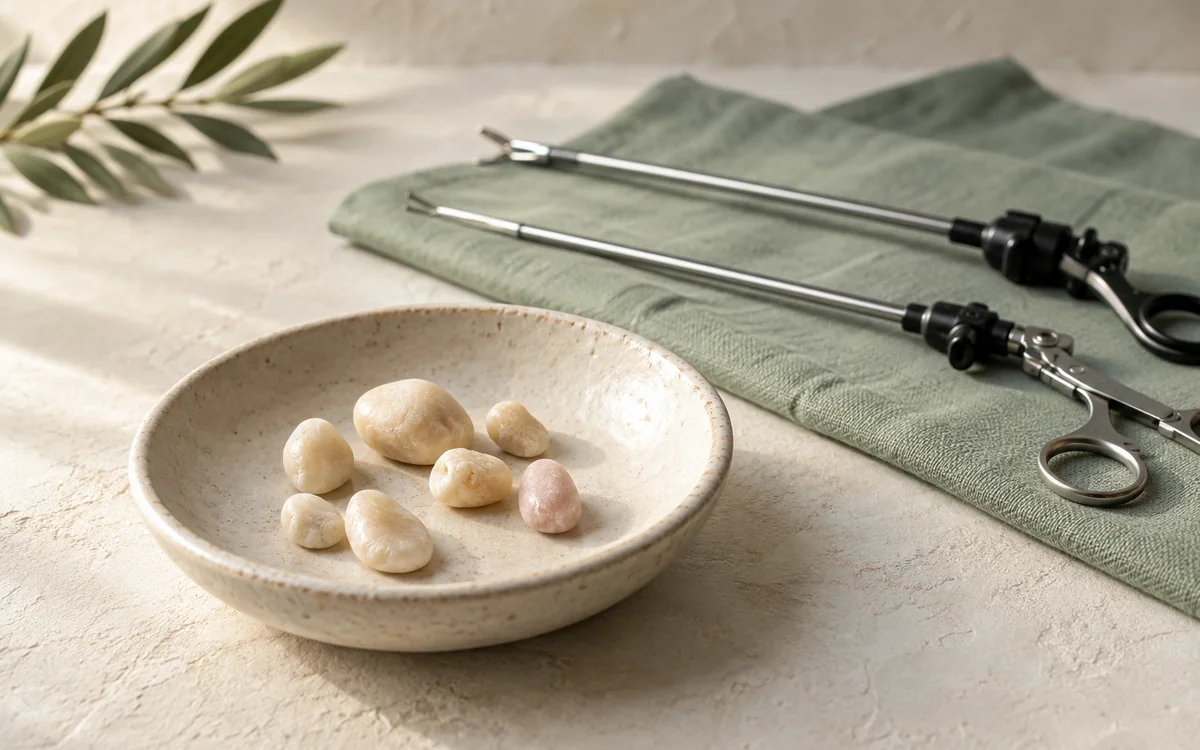
A stone does not explain every pain
Gallstones can be present without symptoms, while upper-abdominal pain, nausea and bloating have more than one possible cause. The NHS notes that gallstones are common and that most people who have them get no symptoms at all. Assessment starts with the story: where pain occurs, how it starts, how long it lasts, whether it relates to meals, whether it repeats and what comes with it. [1, 2, 8]
A stone on an earlier report does not prove that every new symptom comes from it, and the absence of a stone does not explain every pain by itself. Connecting an imaging finding with the history and examination determines the next question. [1, 3]
The pattern worth recording
Record pain episodes instead of relying on memory: timing, location, severity, duration, nearby food or medicines, vomiting or fever, and whether the pain settles or escalates. These details help distinguish a possible biliary pattern from symptoms that need another path of assessment. [1, 2, 4]
A record is not for self-diagnosis or random food restriction. Its use is to bring a clearer question to review, particularly when symptoms recur or affect sleep, work, eating or drinking. [1, 4]
Ultrasound has a defined question
Ultrasound is often useful for looking for stones and selected gallbladder or duct changes, but it does not choose surgery or explain every pain without the history, examination and tests when needed. A clinician may request blood tests or different imaging if the clinical question is different. NICE recommends liver function tests and ultrasound for people with suspected gallstone disease, and suggests MRCP when ultrasound has not found duct stones but the bile duct is dilated or liver tests are abnormal. [1, 3, 5]
Both a normal result and a stone finding need context. Ask which question the scan answered, what it cannot answer and what the next step is if symptoms continue. [1, 3]
Features that should not wait for routine review
Severe or persistent pain, fever or chills, repeated vomiting, yellow skin or eyes, dark urine, fainting, confusion or inability to keep fluids down need urgent assessment according to severity. These features do not prove one complication online, but they are not appropriate for waiting or home treatment. [1, 2, 6]
Seek earlier assessment as well when pain is new during pregnancy, with chronic illness or important medicines, or when it is changing rapidly. Do not drive yourself to an appointment or wait for ultrasound if you feel faint or clearly deteriorate. [2, 6]
Treatment follows the problem, not the stone label
Not every stone needs surgery, and pain does not always make surgery the next step. The decision is influenced by symptoms, complications, tests, imaging, overall health and the expected balance of benefit and risk. The aim is a decision that matches the actual problem, not simply removing a report finding. NICE advises reassuring people whose stones cause no symptoms, in a normal gallbladder and bile ducts, that they do not need treatment unless symptoms develop; it recommends laparoscopic cholecystectomy for symptomatic stones, and surgery within one week of diagnosis for acute cholecystitis. [1, 3, 7]
A team may discuss observation, temporary changes, surgical referral or additional tests. Ask what makes each option suitable, what should be monitored and when to return or seek help sooner. [1, 7]
How to make a review useful
Bring an ultrasound report if available, a medicines and supplements list, pain record and earlier results. Mention previous surgery, pregnancy, and liver, blood or heart conditions because these can change the meaning of symptoms and testing choices. [1, 3, 5]
Ask which explanations remain possible, which tests answer a defined question and which signs mean contacting the team before the next appointment. A good decision leaves a clear plan instead of general reassurance or broad food avoidance without evidence. If you would like the symptoms and reports reviewed together, you can book a visit at La Rose and bring the paperwork with you. [1, 4, 7]
Similar symptoms can follow different paths
Upper-abdominal pain or nausea can occur with reflux, ulcer disease, gastritis, pancreatic or liver problems and other causes. A person does not need to diagnose themselves from a list, but needs to know that pain site, timing, duration, relation to food and examination can change the question. [1, 3, 4]
Improvement after a lighter meal or avoiding one food does not prove that a stone caused the symptom, and bloating alone does not prove gallbladder disease. Review may suggest targeted tests, follow-up or referral according to the story rather than one symptom. [1, 2, 7]
Do not start supplements claiming to dissolve stones or a severe diet because of a search result. Products can delay assessment or interact with medicines, while the practical question is whether a symptom fits a problem needing treatment or faster review. [1, 6, 7]
Incidental stones and the next decision
Stones are sometimes found when imaging is performed for another reason. This does not mean every person needs urgent intervention, nor that the finding should be ignored. A team considers whether matching symptoms exist, whether complications occurred, and the individual benefits and risks of observation or intervention. [1, 3, 7]
If observation is advised, ask which symptoms change the plan, whom to contact and when review happens. If surgery is discussed, ask why it is being considered in your case, alternatives, preparation, recovery, and what an operation may not resolve if pain has another source. [1, 7, 8]
An organised decision is neither neglect nor a rush to surgery. It uses symptoms, tests and overall health to choose a step with a clear purpose and a reviewable effect. [1, 3, 7]
Tests work as a set, not one answer
A clinician may use blood tests with ultrasound when asking whether there are signs of inflammation, an effect on the liver or ducts, or another cause of pain. An abnormal result does not automatically mean that a stone moved, and a normal result does not end every possibility. A test is useful to the extent that it answers the question it was designed to answer. [1, 3, 5]
It is normal for a plan to change after a new result. That may mean closer follow-up, repeat testing, referral or different treatment. Ask what changed the level of concern, which sign makes timing important, and what can be safely monitored at home while awaiting instructions. [1, 3, 7]
Do not omit a medicine, chronic condition or pregnancy when discussing tests. These details can affect selection, timing and interpretation, and they are reason enough not to rely on another person’s results or an online conversation. [1, 5, 7]
A safe plan between visits
If symptoms are stable and the team sees no urgent need, follow the instructions given and record changes rather than trying overlapping remedies. It can help to keep contact information, a copy of the report and knowledge of the right place to seek help outside clinic hours. [1, 2, 7]
Do not test how much pain you can tolerate or repeat a meal that triggered an episode simply to prove the cause. The purpose of any temporary adjustment is comfort and preparation for review, not proving a diagnosis or delaying assessment if fever, jaundice, vomiting or escalating pain appears. [1, 2, 6]
Before leaving a visit, make sure you know the next appointment, why follow-up is planned and what to bring. Even when the plan is observation, observation should be active: it has a question, warning symptoms and a clear route back. [1, 3, 7]
How a result becomes an understandable next step
After receiving a report, do not stop at searching for the words ‘stone’ or ‘normal’. Read the test name, the area examined, the description and conclusion, then discuss them with the clinician who knows the history and examination. A report may answer whether stones or selected gallbladder changes are present, but it does not by itself establish why an episode happened or whether intervention is appropriate. [1, 3, 5]
Two simple questions make a result practical: what does this result make more or less likely, and what next step could change that answer? The response may be symptom follow-up, a blood test, referral or clear instructions for returning sooner. Keep a copy of the report and do not compare its wording with another person’s; context gives the words their meaning. [1, 3, 7] If you want the symptoms and reports reviewed together, you can book a visit at La Rose.