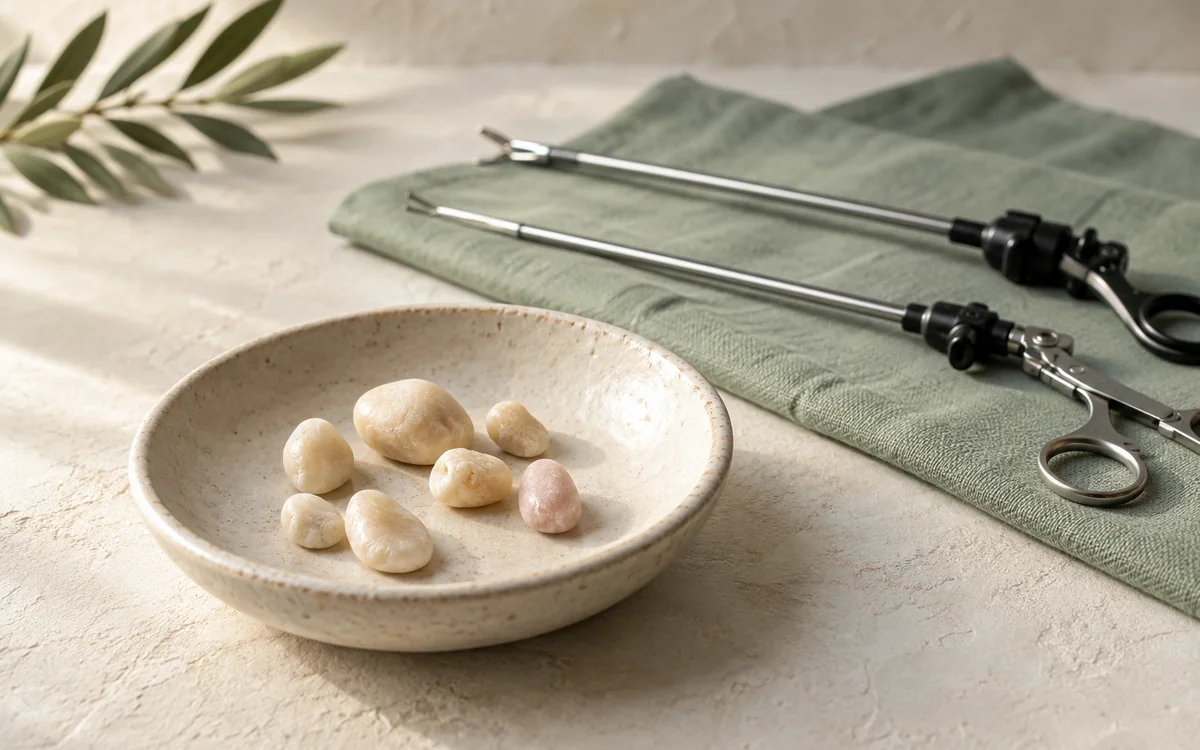
A stone on an ultrasound report is not the same as gallbladder disease
Many people learn they have one or more gallstones purely by chance, on an ultrasound ordered for something else entirely, without ever having had a pain attack. Silent or incidental stones are very common: a large share of people who carry gallstones, possibly up to around 80% by recent reviews, never notice a symptom throughout their life. The word 'stone' appearing in a report matters, but it is not automatic proof that every episode of bloating, reflux or abdominal pain comes from the gallbladder, and it is not a ready-made decision for surgery. [1, 4, 8]
British NICE guidance and Egyptian Health Council guidance agree on the same principle: a person whose gallstones were found without symptoms, with a normal gallbladder and biliary tree on ultrasound, can be reassured and does not need treatment unless real symptoms appear. This is an important distinction from stones that cause recognised pain attacks, inflammation or obstruction, which follow a completely different assessment and treatment path. [1, 2]
Why a silent stone usually stays silent
Long-term follow-up studies generally show a reassuring course for silent stones. Recent reviews estimate that only about 10% of silent stones become symptomatic over roughly 9 years, and the risk of a complication tends to fall rather than rise with increasing age. An older Rome cohort followed a large group of people with silent stones and found the 10-year probability of a complication was only about 3% in the silent group, compared with 6.5% in those who already had symptoms. [4, 5]
A randomised trial also followed patients for 14 years, comparing observation with early removal, and found no clear difference in major events or complications between the two groups. This is part of why international guidance, including the American Academy of Family Physicians, favours follow-up over routine preventive surgery for most silent cases. [3, 4, 5]
The same reviews also describe who is somewhat more likely to see a silent stone turn symptomatic: younger age, female sex, and having several stones or larger, older stones each raise the likelihood a little, though none of these alone is reason enough for surgery. And even when a silent stone does become symptomatic, most people first present with a typical biliary pain attack of the kind described below, not a sudden dangerous complication without warning; this is part of why ordinary follow-up, rather than frequent intensive testing, is enough for most people. [4, 5]
Why follow-up, not preventive surgery, is the default for most people
Major guidelines, led by NICE, the Egyptian Health Council and the American Academy of Family Physicians, agree that follow-up is the default for silent stones without added risk features, because the rate of turning symptomatic is low and the risks of an unnecessary operation are real. Laparoscopic gallbladder removal is not risk-free: bile-duct injury, though rare, can occur even in a skilled surgeon's hands, and can affect quality of life for years. [1, 2, 3, 10]
Quality-of-life data after removal illustrate the difference: clear improvement is seen in around 94% of people who had genuine symptoms before surgery, compared with only about 53% of those who were silent beforehand. In other words, a person who felt nothing before the operation gains less clearly from it, and sometimes develops new digestive symptoms afterwards. The point is not that surgery is wrong, but that it deserves a clear discussion of benefit and risk rather than an automatic reaction to the word 'stone'. [4, 10]
A Cochrane systematic review looked at the available evidence and concluded it was not sufficient to prove or rule out a benefit from surgery in silent gallstones, which is another reason the decision rests on your situation rather than a general rule. Bile-duct injury, the most serious recognised complication of laparoscopic removal, has become rare at centres experienced in the procedure thanks to better instruments and standardised safety steps during surgery, but it remains a real possibility worth stating plainly before any preventive decision. [4, 10]
Specific exceptions a clinician may discuss even without symptoms
Follow-up remains the default, but there are specific groups where a clinician reviews the benefit of earlier surgery even without a pain attack, because the risk of a complication or malignancy runs higher than usual. Examples discussed in recent reviews include: a single large stone (roughly over 2-3 cm), a fully calcified gallbladder (sometimes called a 'porcelain gallbladder') for its possible link to cancer, a gallbladder polyp, especially a large one or one that grows on follow-up, haemolytic conditions such as sickle cell disease, and immunosuppression or candidacy for organ transplantation. Even within transplant candidacy, practice is not uniform: cardiac transplant candidates are sometimes advantaged by preventive surgery, while kidney transplant candidates are usually managed conservatively, another example of why each case is assessed on its own. [4, 5, 10]
People with diabetes and those undergoing rapid weight loss or bariatric surgery are also discussed individually, but the decision is not automatic even in these groups: age, overall health and the ultrasound findings are all part of the discussion. No single rule applies to everyone in these categories, and the aim is for a clinician to explain the expected benefit and risk in your specific situation rather than basing a decision on someone else's experience. [4, 5]
When the picture changes from a silent stone to a real symptom
Not every episode of bloating, gas or reflux alongside an incidental stone proves the gallbladder is the cause. Typical biliary pain has a recognisable pattern: steady and substantial in the upper right or middle abdomen, sometimes travelling to the back or right shoulder, occasionally with nausea or vomiting. A clinician reviews the pain's location, duration, recurrence, relation to food, examination, liver tests and ultrasound before linking every complaint to the stone. [3, 9]
If fitting pain attacks begin to recur, or signs of inflammation or obstruction appear, that changes the discussion entirely away from a silent stone, and deserves an organised surgical opinion. Bring the complete report rather than a remembered phrase, and mention any earlier episodes and test results at review.
Pregnancy, rapid weight loss and coexisting conditions
Pregnancy changes bile composition and gallbladder motility, and can raise the chance of new stones forming, but a silent stone found during pregnancy is not an automatic explanation for every episode of nausea or abdominal pain. Very rapid weight loss or bariatric surgery are also recognised factors that increase the risk of new stones forming afterwards, which is one reason some care teams discuss preventive medicine or closer follow-up with certain patients after major weight-loss surgery. Medicines that contain estrogen, such as some oral contraceptives or hormone therapy after menopause, are another recognised factor that can raise the risk of stone formation, so mention any such medicine to your clinician at review rather than stopping it yourself. [4, 7, 8]
People with diabetes or other chronic conditions need an individual plan that accounts for medicines and overall health, not one rule for everyone. Do not stop a prescribed medicine, and do not delay reporting severe pain or fever out of fear of surgery; the care team weighs symptoms, results and your safety together.
Urgent signs that should not wait for a routine appointment
Severe or persistent upper-abdominal pain, fever or chills, yellowing of the eyes or skin, repeated vomiting, dark urine, or very pale stool all need prompt assessment according to severity. These signs do not prove one single diagnosis, but they can indicate inflammation, obstruction or another problem unsuitable for a home food or medicine experiment. [1, 2, 6]
If stones become clearly symptomatic, a surgical opinion can discuss benefit, risk and timing. If they remain silent and none of the exceptions above applies, follow-up should reflect your situation rather than defaulting to preventive surgery simply because a report mentioned a stone.
Leave review with one clear next step
Bring the ultrasound report itself, not a remembered phrase, and mention earlier episodes, test results and medicines you take. Ask the clinician: is this the kind of stone that needs ordinary follow-up, or does it carry one of the exception features that deserves an earlier surgical discussion? And if follow-up is chosen, what should prompt earlier contact? [1, 3, 4]
The aim is neither to diagnose yourself from the word 'stone' nor to delay an important symptom through fear of surgery. If surgery turns out to be the right choice, ask what to expect for recovery after surgery and which signs should prompt an earlier call, rather than guessing its meaning alone.
If you want to review the ultrasound report and a follow-up plan with a doctor, book an assessment and bring the report, your test results and the names of the medicines you take.