The short answer: who, where and how to book
The clinical nutrition and weight-management team at La Rose, with Dr Shimaa Fouad supervising nutrition patients, serves Katameya, Katameya Heights and the surrounding compounds from two branches. The nearest is the Fifth Settlement branch inside CMC Medical Mall, open on Wednesdays from 3:30 pm. Katameya Heights is about 8 km, or roughly 12 minutes, away via South 90th Street. The Maadi branch is the second option if its day suits you better.
You book through the booking page or by WhatsApp on 010 4066 1893, mentioning that you live in Katameya and want a nutrition consultation. The visit is a full medical assessment, not a ready-made diet sheet: guidelines say assessment starts with body mass index plus waist circumference, and looks at overall health rather than the scale number alone [1, 3]. This page does not repeat the branch pages; it is written specifically for Katameya residents.
When to see a specialist instead of trying on your own
Not everyone who wants to lose weight needs a doctor. Some signs, though, make a specialist visit better than random trial and error. First, weight that has reached the point of affecting your health or movement. The newer definition of clinical obesity separates excess weight alone from excess weight that actually affects how the body functions, and that needs a medical assessment rather than just a number [3].
Second, diabetes, insulin resistance, polycystic ovary syndrome or fatty liver. In these conditions food is part of the treatment itself, so it is adjusted to your case rather than to a general rule [2, 10, 12]. Third, a history of many diets with the weight returning each time: you need to understand the reason rather than start another plan.
There is also a sign from the opposite direction: if you are losing weight without trying, that needs checking and is not something to celebrate. The NHS advises a medical review in that situation because the causes are many and some are medical [5]. The same applies when thinness comes with tiredness or weak muscles, since muscle weakness is a medical condition with a recognised definition and diagnosis [9].
The first visit: what actually happens
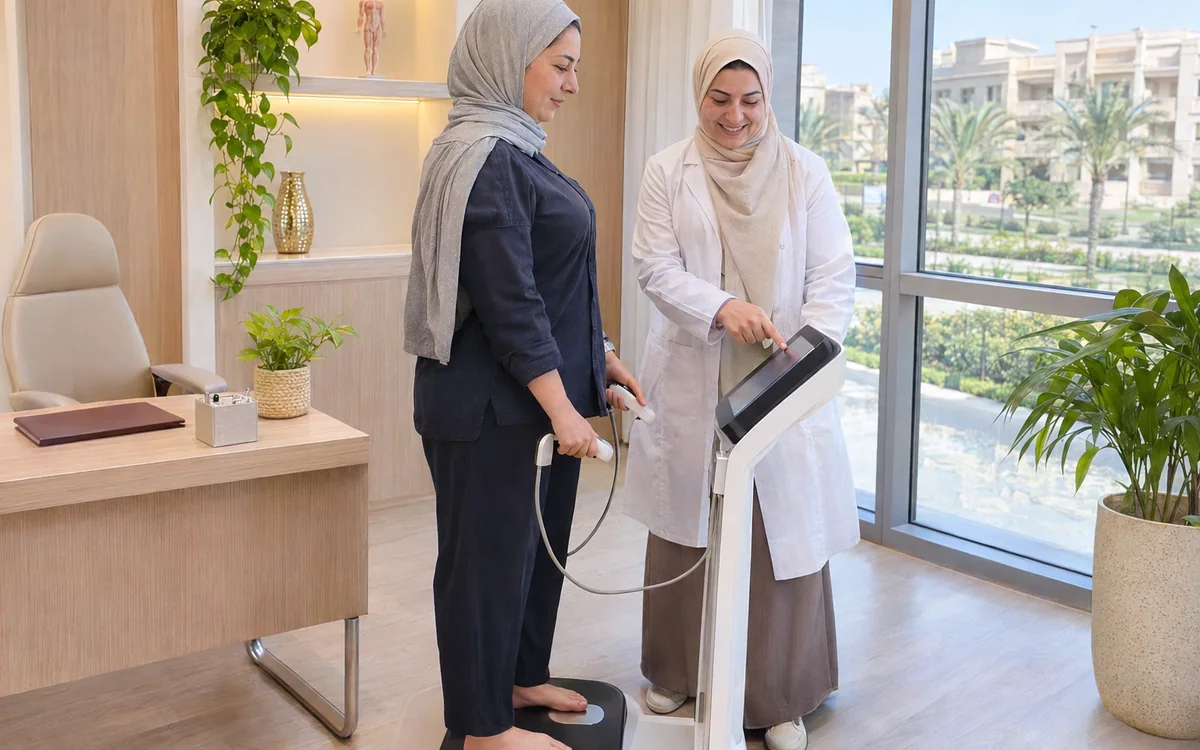
At the Fifth Settlement branch, the nutrition consultation includes a full InBody body-composition analysis, a body-contouring measurement, and a complete consultation with a clinical nutrition doctor who reviews your tests and medical history. The doctor then decides the suitable plan, whether sessions, injections or a food plan, and reviews your current tests and medicines.
The logic behind this order is that medical guidelines ask first for a comprehensive assessment of the causes of weight gain and its related conditions, before any treatment choice [1, 2]. The Canadian guideline also stresses that treatment should be built around the patient's own goals and circumstances, which helps with sticking to it later [2].
The details of the body-composition scan are covered in the InBody first-visit guide, so we do not repeat them here.
The tests and reports to bring with you
Prepare a simple folder before the appointment. Your latest blood tests, especially blood sugar, HbA1c, blood fats, liver function and thyroid if done. Reports of any abdominal or liver ultrasound. And a list of every medicine and supplement you take, with names and strengths, because some medicines affect weight and appetite and the doctor reviews them [1, 2].
A written weight history, such as your weight a year ago and since, helps too. With polycystic ovary syndrome, bring old hormone reports and ultrasounds, because the international guideline makes lifestyle change the foundation for everyone, with the rest of the assessment deciding what else is needed [10].
Do not delay booking until every test is complete. At the visit the doctor tells you what is missing and you add it afterwards. What matters is to come with what you have and to bring all your medicines.
Weight loss and weight gain: the same assessment, a different plan
For weight loss, the plan is built on balanced eating you can sustain long term, not on deprivation. The World Health Organization recommends keeping free sugars below 10% of daily energy, cutting salt, and emphasising vegetables, fruit, legumes and whole grains [6]. The clinical guideline places food together with activity and behavioural support as the base of any programme, and discusses medicines after assessment [2]. In a well-known type 2 diabetes trial, a doctor-supervised primary-care weight programme brought 46% of participants to diabetes remission after a year, against 4% in the control group [11].
For weight gain, we first understand the cause. Is it low intake, poor absorption, an illness or muscle weakness? Unexplained thinness needs a check, not just extra calories [5]. After assessment, the plan is built on enough food to support muscle, because the healthy goal is more than a higher number [9].
In both cases, the difference between a nutrition doctor and a dietitian is covered in a separate article, which we do not repeat.
Read also: Nutrition doctor or dietitian
Diabetes, insulin resistance, PCOS and fatty liver
These four conditions share one thing: food and weight are a core part of treatment. In diabetes and insulin resistance, the plan is adjusted to the type and spread of carbohydrates, alongside the medicines you take, which the doctor reviews with you and which you do not change on your own [2, 11].
In polycystic ovary syndrome, the 2023 international guideline puts lifestyle change, covering food, activity and psychological support, as a recommendation for everyone regardless of weight, and discusses other treatments according to symptoms [10].
In fatty liver, the 2023 American Association for the Study of Liver Diseases guidance treats weight loss through food and activity as the base of care; the more weight lost, the greater the improvement in liver fat, and inflammation and scarring risk is assessed alongside [12].
It is important to know that La Rose does not provide in-house cardiology, endocrinology, nephrology or surgery. If your case needs one of them, the doctor guides you after assessment and tests.
Child nutrition, sports nutrition and InBody tracking
For children, the World Health Organization treats childhood overweight as a real health problem that starts early, and the focus is balanced family eating and activity, not deprivation of the child [7]. If the worry is the child's own growth, height or weight, the first stop is the paediatrician, after which we discuss the eating pattern at home.
For athletes and regular exercisers, the International Society of Sports Nutrition position stand explains that people who train need more protein than inactive people, in the range of 1.4 to 2.0 grams per kilogram of body weight per day [8]. The plan is adjusted to your goal, whether building, cutting or performance.
As for tracking with InBody, it separates fat from muscle, which helps because low muscle is a recognised medical condition that the scale alone does not reveal [9]. It is repeated at follow-up visits so the plan can change according to what actually changed.
If you are thinking about Mounjaro
Obesity medicines, Mounjaro among them, are a medical decision that follows assessment rather than comes before it, and they are used alongside food and activity change, not instead of it [2]. The doctor reviews your condition, tests and current medicines before discussing it with you. For more on choosing a Mounjaro doctor in New Cairo, there is a full article on it.
Read also: Best Mounjaro doctor in New Cairo
Follow-up: how it works after the first visit
The first visit builds the plan; follow-up is what makes it work. At each follow-up visit the measurements are reviewed and the plan adjusted. Guidelines stress that continuing support and regular review are part of any successful weight programme, and that weight needs long-term management [2, 4].
What gets reviewed: change in weight and body composition, how well you can keep to the eating plan, any side effects, and the results of tests that were requested. If new symptoms appear between visits, contact the clinic on WhatsApp rather than waiting for the appointment.
A practical tip for Katameya residents: since the Fifth Settlement branch opens one day a week, book your follow-up before leaving the current visit so you secure the slot for the week you need.
The route from Katameya to the two branches
The Fifth Settlement branch is the nearest for Katameya residents. It is in CMC Medical Mall, 4th floor, on North 90th Street, behind the Air Force Specialized Hospital. From Katameya Heights it is about 8 km, roughly 12 minutes, via South 90th Street and then North 90th Street to the mall. Enter the mall and go up to the 4th floor; the clinic is under the La Rose name, and if you get lost, send a WhatsApp message and the team will guide you.
Other nearby areas: Cairo Festival City about 5.2 km, 10 minutes. El Yasmeen about 5 km, 10 minutes. Al Narges about 6.5 km, 12 minutes. El Banafseg about 6.9 km, 10 minutes. First Settlement about 7.4 km, 12 minutes. Point 90 Mall and AUC Avenue about 9 km, 12 minutes. Choose the branch you can reach easily, because regular follow-up is what makes the difference to the result [2].
The Maadi branch is at 14 El-Mokhtar Street, off El-Nasr Street, behind QNB Bank in New Maadi. From El-Nasr Street turn into El-Mokhtar Street and the clinic is on the right, with street parking in front of the building. Nearby landmarks: Maadi Grand Mall about 1.6 km, 5 minutes, and Degla Square about 2.6 km, 7 minutes.
Read also: Nutrition clinic in Fifth Settlement · Nutrition clinic in Maadi
Branch days and booking
The Fifth Settlement branch opens on Wednesdays only, from 3:30 pm to 8 pm, with times varying by doctor. The Maadi branch opens on Saturdays, Mondays and Tuesdays from 2 pm to 8 pm, also with times varying by doctor. Dr Shimaa Fouad sees nutrition patients at the Fifth Settlement branch, and Dr Alyaa Abu Taleb is at the Maadi branch only. If you live in Katameya and want the earliest slot, say so in your message.
Book through the booking page or by WhatsApp on 010 4066 1893. Before you come, prepare your tests, reports and medicine list, and you will find the first visit far more useful [1, 2].
Read also: Book your appointment