The short answer: ordinary thinness is one thing, illness-driven weight loss is another
If you are looking for a weight gain doctor in Maadi, the first question should not be "what should I eat to put on weight?" but "why is my weight low in the first place?". Some people have been slim since childhood, with normal eating, normal activity and normal tests. That is ordinary, often inherited, thinness. Others had a steady weight that then dropped for no clear reason, and that is a signal that something inside the body needs to be examined before any eating plan starts [3].
The common yardstick is that a body mass index below 18.5 means a weight below the healthy range and can point to malnutrition [2]. If you have lost 5 to 10 percent of your body weight over 3 to 6 months without trying, that alone is enough reason to see a doctor [2]. The US medical reference puts it similarly: losing more than 5 percent of your usual weight over 6 to 12 months with no known reason deserves a review [3].
So the sound route has three steps in order: understand the cause, start a gradual gain plan, then follow up with InBody to confirm that what you gain is muscle and not only fat. This article walks through those steps and separates what you can begin at home from what belongs in a clinic. It is written for adults; children and teenagers follow a different route.
How do you tell ordinary thinness from thinness with an illness behind it?
Ordinary thinness is usually steady over years. Your weight barely moves, your appetite is reasonable, your energy is fine and no other symptoms follow you around. The whole family may be slim, and your body may simply burn or store energy a little differently. That is not a disease. For more on this difference, read [inherited thinness or illness](../articles/qa-underweight-inherited-or-illness.html).
Thinness with a medical cause usually shows up as change: the weight used to be higher and is now lower, or it keeps slipping month after month, or you eat the same and the scale still falls. Medical references list digestive causes that reduce calorie absorption, such as coeliac disease, long-lasting diarrhoea and parasites; hormone causes such as an overactive thyroid and undiagnosed diabetes; and mental-health causes such as depression, stress and eating disorders [3].
A quick question to ask yourself: did something change before the weight dropped? A new medicine, an emotional crisis, more trips to the bathroom, a weaker appetite. If yes, get checked first. The NHS advice is also to see a doctor if weight is lost suddenly or without a change in your diet or activity [1].
Illnesses that can pull weight down: thyroid, diabetes, gut and eating disorders
An overactive thyroid is one of the best-known causes. The signs that come with it include nervousness and anxiety, trouble sleeping, persistent tiredness and weakness, heat sensitivity, trembling, a fast heartbeat and weight loss. Diagnosis starts with a blood test of how the thyroid is working, and if the result shows overactivity, further tests look for the cause [4].
Undiagnosed diabetes is another. Type 1 diabetes is a condition in which the body cannot make the hormone insulin [7], and undiagnosed diabetes appears on the list of causes of unintentional weight loss [3].
The gut matters too. Coeliac disease can show up as diarrhoea, bloating, tiredness and unintentional weight loss [5]. Crohn's disease can bring diarrhoea, stomach pain, loss of appetite and weight loss, and sometimes blood or mucus in the stool [6]. This is why a digestive review is an important part of the picture when weight falls alongside gut symptoms.
Eating disorders such as anorexia nervosa also have to be named honestly: an intense fear of gaining weight together with severe thinness is a sign that deserves specialist help [9]. Details of the symptoms and warning signs are on the NHS page [8]. In that situation a plan that only says "eat more" is not enough; it needs medical and psychological support together.
Red flags that say: see a doctor before starting any gain plan
Treat these as a signal to get checked first, not simply to start eating more:
- Unintentional weight loss of 5 to 10 percent over 3 to 6 months or more [2], or more than 5 percent over 6 to 12 months with no known reason [3]. - A body mass index below 18.5 together with tiredness and slow recovery from illness [2]. - Weight loss with other symptoms: long diarrhoea, bloating, stomach pain, loss of appetite [5, 6]. - Nervousness, palpitations, trembling and heat sensitivity along with the weight loss [4]. - An intense fear of gaining weight, avoiding eating in front of others, or exercising far beyond what is needed [9].
For faster action: if your stool is black or dark red, or you have bloody diarrhoea, seek urgent medical help and do not wait for a clinic slot [6].
One point matters here. Any single flag does not mean something terrible; it means the check comes first, and it costs far less time and effort than a year of food plans when you do not know the cause. And if none of these apply and your thinness has been steady for years, you can go on to the gradual gain plan in the sections below with more confidence.
What happens at a first weight gain visit?
Dr Alyaa Abu Taleb, a physician and clinical nutrition specialist, sees underweight and healthy weight gain cases at the Maadi branch. The first visit follows a clear order. You are asked about your weight history: what it was, what it is now, and since when. You are asked about a normal day of eating, sleep, activity, medicines and supplements, and any digestive or mental-health symptoms.
Then comes a clinical examination and an InBody body-composition analysis, so you see muscle, fat and body water rather than the scale alone. Depending on the case, blood tests may be requested, including a thyroid test. If you want to understand that result yourself, read [TSH thyroid test results](../articles/tsh-thyroid-test-results.html). The digestive symptoms mentioned above may need an internal medicine and gastroenterology review at the same branch [4, 5, 6].
The plan that comes out of the visit is built on the home food you can actually get, not on strange regimens. It is followed up weekly so it can be adjusted if weight is not moving or is rising too fast. You are not told to start appetite stimulants or supplements on your own, because that decision comes after the assessment, not before it [1].
A gradual gain plan: real food, not stuffing
Once a medical cause has been excluded, the core idea is to eat gradually more energy than you burn. The NHS suggests that adults could try adding about 300 to 500 extra calories a day [1]. That does not mean stuffing yourself or forcing meals; it means improving what you already eat.
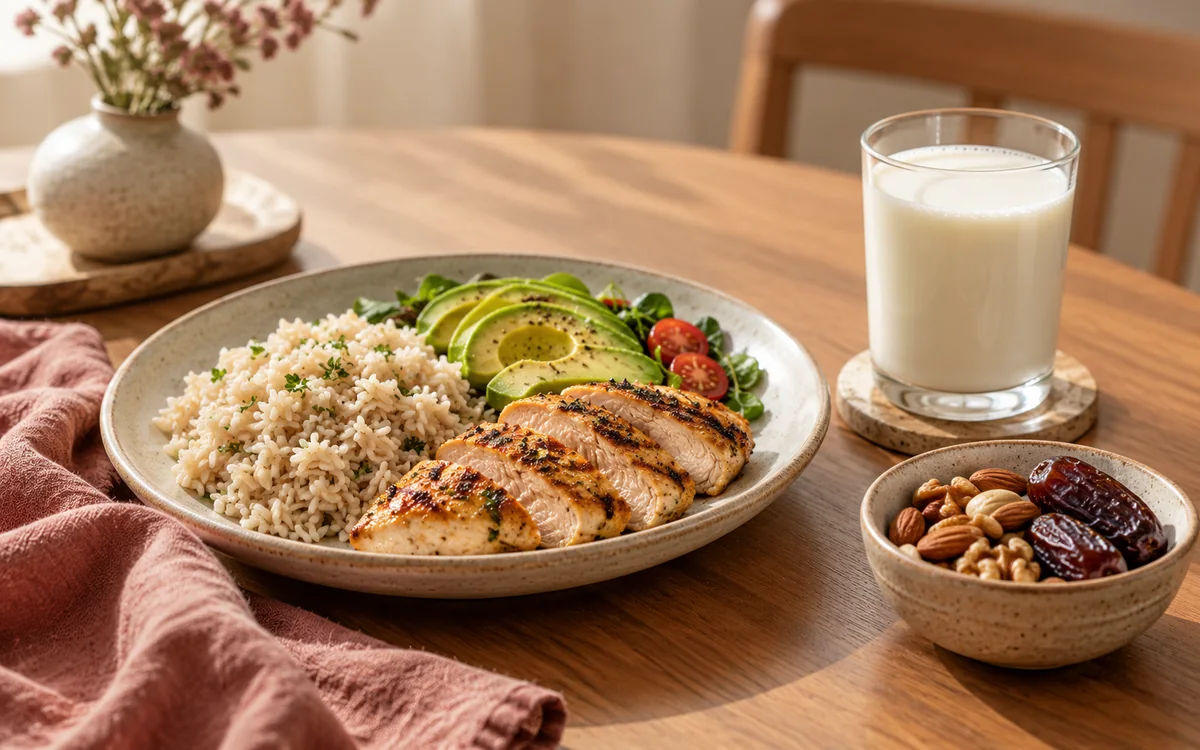
What works in practice? Small frequent meals instead of three big ones if fullness arrives early. Enrich the food you already like: olive oil over meals, nuts in oats or yoghurt, whole milk, eggs and dried fruit. Snacks between meals should be mini-meals rather than empty sugar [1].
The food still has to stay varied: protein at every meal, whole starches, vegetables and fruit, because the goal is not any weight but a healthy weight. Do not rely on fast products loaded with sugar and saturated fat just to hit the calorie number.
The safest start is one or two small changes held steady for two weeks before adding more. One steady change beats five that you drop after two days. And if appetite weakens clearly, or nausea or pain appears with eating, go back to the doctor rather than forcing it [1, 2].
Muscle, not only fat: protein and resistance training
If you raise calories without training, a large part of the gain can go to fat, especially around the abdomen. That is why the plan pairs food with resistance training (weights or your own body weight), at a level suited to your condition. The International Society of Sports Nutrition position stand supports the idea that protein together with resistance training helps maintain and build muscle mass [10].
A meta-analysis in adults aged 60 and over found that milk protein with resistance training boosted lean mass gains [11]. To be clear, that study was in older adults, not in every thin person, so we take it as a pointer rather than a promise.
In practice: put a protein source in every meal (eggs, milk, yoghurt, cheese, legumes, fish, chicken, meat as suits your case). Protein supplements are not the first step, and that decision comes after assessing your need, not from an advert [10]. Training increases gradually, with rest and enough sleep.
If you want to see why the scale alone can mislead you, read [muscle assessment in nutrition care](../articles/muscle-assessment-in-nutrition-care.html). Two kilograms gained might be muscle, or it might be water and fat, and that difference matters for your long-term health.
InBody follow-up: how do you know what you gained is muscle?
The scale gives you one number, while InBody splits the body into muscle, fat and water. That matters especially in thinness, because a slim person can gain weight while visceral fat rises and muscle stays flat, which is not the goal. For preparation and the test itself, read [InBody test in Maadi](../articles/inbody-test-maadi.html).
Follow-up is usually every few weeks under the same conditions: the same time of day, fasted or a fixed time after eating, no hard training in the hours before, and the same device if possible, because body water affects the reading.
We look at muscle mass, body fat percentage and water. If weight rose and muscle rose, the plan is working. If weight rose but only fat did, we adjust training and protein. And if weight is steady but muscle rose and fat fell, that is real progress even though the scale did not move.
At every reading we also ask about energy, sleep, appetite and digestion, because numbers are not the whole story. And any time a flag from the red-flags section appears, the plan pauses and we review the medical cause before going on [2].
Getting to the Maadi branch and booking
The address is 14 El-Mokhtar Street, off El-Nasr Street, directly behind QNB Bank, New Maadi, Cairo. Dr Alyaa Abu Taleb is at the Maadi branch on Saturday and Monday from 2 to 7 pm. From Maadi Grand Mall the distance is about 1.5 to 1.7 km and roughly 4 to 5 minutes by car, from Road 9 about 2.9 to 3.1 km and 8 minutes, and from Old Maadi (the metro station) about 3.4 to 4.1 km and 8 to 11 minutes. These are typical times and traffic changes them.
[Book at the Maadi branch](../patients/booking.html), or call or WhatsApp 010 4066 1893, and confirm the day and time before you travel because schedules can change. For the cost, ask on WhatsApp and the team will tell you before you book.
Bring your medicine and supplement list, recent tests if you have them, your weight history, two or three days of food notes, and your questions. For a non-urgent concern where you want a starting assessment and follow-up, this is the right route [1, 2].
But if you have bloody diarrhoea or black or dark red stool, do not wait for the appointment; go to emergency care [6].