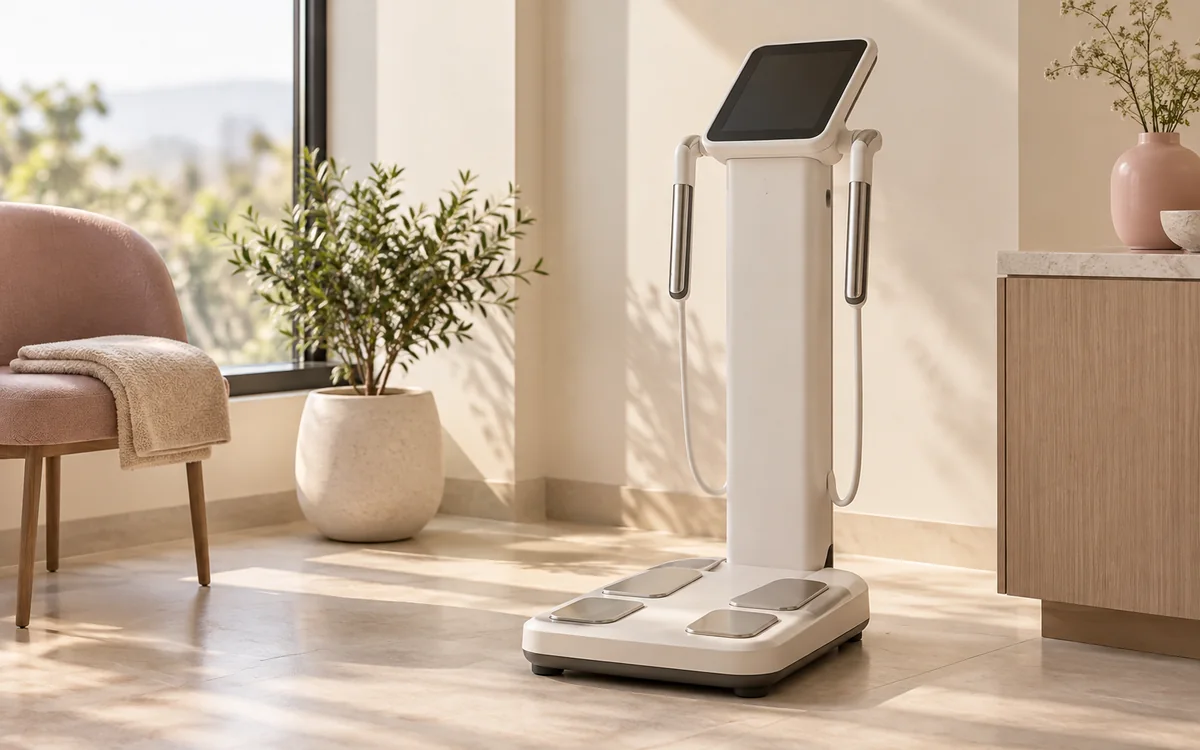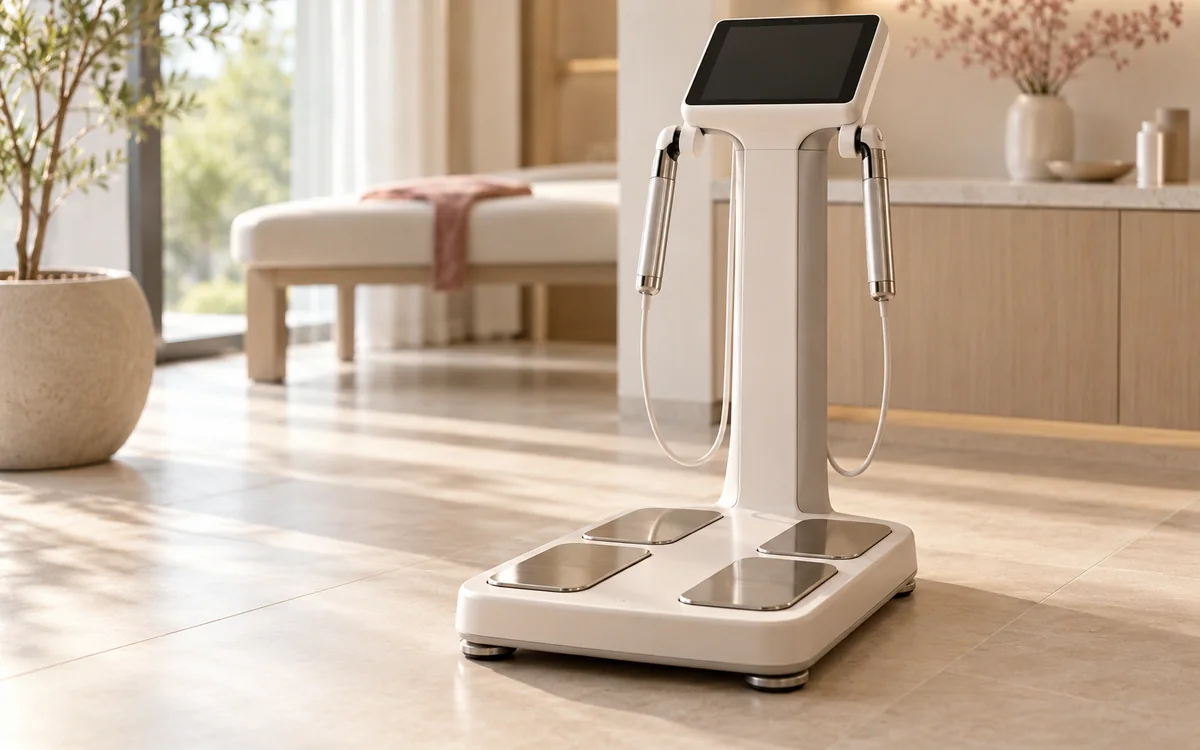
Where can you have an InBody test in Maadi?
If you are looking for an InBody test in Maadi, body-composition analysis is available at La Rose's New Maadi branch, 14 El-Mokhtar Street, off El-Nasr Street, behind QNB Bank. The measurement sits inside a clinical-nutrition assessment: a physician reviews your health history, medicines and available test results, then discusses the fat, muscle and water estimates with you instead of leaving you with an unexplained sheet of numbers. Dr Shimaa Fouad is at the Maadi branch on Saturday, Monday and Tuesday from 3 to 8 pm, while Dr Alyaa Said Abu Taleb is there on Saturday and Monday from 2 to 7 pm.
The key point is that InBody uses bioelectrical impedance analysis (BIA). It sends a very low electrical current through the body, measures tissue impedance, and applies equations to estimate body compartments. It is therefore a quick, useful baseline and trend tool, but it does not directly image fat or muscle and cannot make a medical diagnosis by itself [1, 2, 3].
This guide explains who may benefit, what the report can and cannot tell you, how to prepare, and how to choose a service that provides clinical interpretation and follow-up rather than only printing a result. It also gives practical routes from nearby Maadi areas and the next booking step.
Who benefits from body-composition testing, and who needs a different assessment?
Testing may help when you are starting a weight-loss or weight-gain plan, when scale weight is stable while measurements change, or when the goal is to preserve muscle while reducing fat. It can also give an athlete or somebody beginning resistance training a baseline, while helping a nutrition physician discuss changes in fat, fat-free mass and water alongside weight and waist circumference. Its value is in the trend over time, not in chasing a perfect score or comparing yourself with somebody else [1, 4, 7].
Not everyone needs an InBody test to begin appropriate care. If you have a new symptom, unintentional weight loss, obvious swelling, breathlessness, functional weakness or an undiagnosed medical concern, assessment of the cause comes before trying to explain everything from a body-composition sheet. A low muscle estimate does not diagnose sarcopenia by itself; the revised European consensus starts with muscle strength, uses muscle quantity or quality to confirm the diagnosis, and assesses physical performance to grade severity [11].
When fluid balance is clearly changing because of oedema, ascites, acute illness or complex kidney disease, ordinary BIA equations may be less suitable because water distribution is central to their assumptions. During pregnancy, body composition and water change with gestational age, and studies show enough method disagreement and imprecision that a standard result should not be treated as a stable fat measurement. If you have a pacemaker or another implanted electrical device, the InBody device instructions say not to use the measurement; tell the team before stepping onto the device [4, 10, 12].
What does an InBody device actually measure?
The device directly measures weight and electrical impedance; the report then displays estimates based on that model and its equations. Depending on the model, the sheet may include total body water, fat-free mass, fat mass, body-fat percentage, skeletal muscle mass, and estimated segmental muscle and fat distribution. Some reports also show a visceral-fat indicator or water-balance fields. These estimates can be useful when interpreted properly, but they are neither tissue samples nor medical images [1, 3, 14].
Body mass index (BMI) uses only height and weight, so a muscular person and a person carrying more fat may have a similar value. InBody adds estimates of different mass compartments, while waist circumference adds practical information about central adiposity. None of these alone diagnoses diabetes, fatty liver, heart disease or malnutrition. A clinician connects them with history, symptoms, blood pressure, movement, eating pattern, medicines and any tests that fit the individual situation [2, 4, 12].
Accuracy is not one simple property. A device may repeat a similar reading under stable conditions without matching a reference method such as DXA for every individual. Studies of multi-frequency impedance devices have found high repeat reliability but systematic differences from DXA in estimates of fat and fat-free mass, while visceral-fat estimates performed less strongly than some whole-body measures. Use the result as one part of an assessment and a trend, not as anatomical truth down to the gram [7, 8]. If this is your first measurement, the first InBody test guide explains the device steps and baseline in detail.
How should you prepare for an InBody test in Maadi?
Before booking, ask the service which protocol applies to its device model, because device instructions can differ. The practical rule is not to manipulate the result by fasting excessively, dehydrating yourself or suddenly drinking a very large amount. Keep ordinary hydration and avoid a large meal or eating immediately before the test according to the site's instructions. Methodological evidence shows that food, drink, hydration, skin temperature, posture and recent exercise can alter impedance and the resulting estimates [2, 5, 6].
Avoid strenuous exercise before measurement, use the bathroom when possible and wear light clothing. You will remove shoes and socks so the feet contact the electrodes, along with metal items that interfere with contact or add unnecessary weight. During the test, stand still and follow the hand and foot position demonstrated by the operator. The current is extremely low and most people do not feel it; the test is quick, but speed does not make preparation and context unimportant [1, 12].
For follow-up, consistency matters more than trying to manufacture a “better” reading: use the same device, a similar time of day, similar preparation, and roughly the same relationship to meals and exercise. Tell the clinician and record it beside the result if you are ill, have swelling, started a new medicine or the day is clearly unusual. For a step-by-step protocol, use the InBody preparation guide rather than repeating its full scope here [5, 6, 9].
What happens during the measurement and nutrition visit at La Rose?
A useful visit does not begin with “what is my fat percentage?” and end when the sheet prints. The team asks about your goal: reducing fat, preserving muscle, gaining weight, improving nutrition for a health condition, or monitoring a change already under way. Bring any previous InBody report, your medicine list, recent tests relevant to your condition, and notes about food, movement and sleep. You do not need to order a fixed panel yourself; the physician decides whether testing is indicated from your history and symptoms [4, 7].
At La Rose's Maadi branch, Dr Shimaa Fouad and Dr Alyaa Said Abu Taleb are physicians specialising in clinical and therapeutic nutrition. The measurement is part of an assessment that includes health history and available test results. The physician then reviews weight, estimated fat, muscle and water in relation to your goal, waist and risk factors. The result may help select follow-up indicators, but it does not dictate one diet, one medicine or the target printed by the device [2, 4, 11].
Leave the visit understanding three things: the baseline worth following, the behaviour or plan you will work on, and when reassessment makes sense. Ask which field matters for your situation, how much change might affect a decision, and whether the next measurement needs similar conditions. If the only explanation is that your “score must rise,” the report has not been used to its full clinical value [3, 7, 14].
Why is clinician interpretation more useful than the printout alone?
The report is full of numbers, bars and targets, but not every field has equal value for every person. A high body-fat estimate can start a discussion about waist, blood pressure, glucose and activity, but it does not prove a disease. A low muscle estimate can prompt questions about protein, movement, injury or weakness, but it cannot diagnose sarcopenia without strength, function and context. A shift in body water may reflect different preparation, a medicine or swelling that needs separate assessment [4, 11, 14].
Responsible interpretation separates a change in the body from a change in measurement conditions. When weight, estimated fat mass and waist move in the same direction over a suitable period, the pattern is stronger than a small difference between two nearby sheets. If estimated muscle suddenly falls after hard exercise or a low-fluid day, do not radically change your plan from one reading; review the circumstances and repeat under comparable conditions [5, 6, 7].
The article InBody results explained walks through the report fields one by one. The local takeaway is to choose a service that makes time to interpret the result, explain its limits and define a follow-up question. The sheet is a tool for discussion and a reviewable decision, not a pass-or-fail certificate or a reason to use an extreme diet to improve the next number [2, 8, 11].
How often should you repeat InBody, and how should you compare results?
There is no single repeat interval that suits everyone. Timing depends on the goal, the expected pace of change, and whether a new result would actually change a decision. Daily or very frequent testing often magnifies noise from fluid, food and exercise. In a follow-up plan, the physician may choose a point that allows a meaningful trend to emerge and use weight, waist or behaviours between tests instead of repeating the device simply to collect sheets [2, 5, 7].
Compare yourself with yourself on the same device and model whenever possible. Studies show that readings from different devices can be correlated yet not interchangeable, especially as body size or fluid balance changes. Record the date, time, relationship to meals and exercise, and any swelling, illness or new medicine. If the device changes, treat the new result as a new baseline rather than calculating the difference as though it were a true tissue change [7, 9].
Visceral-fat fields use different units and displays depending on the device; do not transfer a “normal” value from another sheet or video to a different model. Connect it with waist circumference, risk factors and context, and use the visceral fat, waist and InBody guide if that is your main question. Repeating the test should examine a defined trend or decision, not chase a universal number for every body [4, 9, 14].
How should you choose a body-fat testing service in Maadi?
Choose the service by what happens before and after you step onto the device. Ask who reviews the result, whether a nutrition physician considers history, medicines and tests, whether preparation is written and clear, whether follow-up uses the same device under similar conditions, and whether the service honestly explains that the report is an estimate with limits. Avoid guaranteed outcomes, disease diagnoses from one score, or an extreme plan designed only to make the fat number fall quickly [2, 4, 7].
The practical order of options is: 1) La Rose, Maadi branch, where InBody is part of an assessment with Dr Shimaa Fouad or Dr Alyaa Said Abu Taleb and the report is read with history, available tests and a follow-up plan. 2) A hospital-based obesity or medical-nutrition clinic with a physician and a standardised protocol. 3) A university-hospital outpatient clinic for a complex case involving changing fluid balance or several specialties. A gym or pharmacy can produce a number, but if you need a clinical decision, ask who is qualified to interpret it and what referral route exists if a health question appears [3, 4, 11].
A newer device or longer printout is not enough by itself. Practical quality means a repeatable measurement, modest interpretation without overstatement, and a plan that says what will be followed and why. If testing is unsuitable because of an implanted device, pregnancy, swelling or acute illness, a responsible service pauses the test or changes the assessment instead of printing a result and treating it as exact [9, 10, 12].
Getting to and booking an InBody test in Maadi
The address is 14 El-Mokhtar Street, off El-Nasr Street, behind QNB Bank, New Maadi, Cairo. Dr Shimaa Fouad's appointments are Saturday, Monday and Tuesday from 3 to 8 pm; Dr Alyaa Said Abu Taleb's are Saturday and Monday from 2 to 7 pm. To book or ask a question, call or use WhatsApp on 010 4066 1893. Schedules can change, so confirm the day, time and preparation instructions when booking.
According to the recorded road measurements from the branch, Maadi Grand Mall is about 1.5–1.7 km and 4–5 minutes by car; Degla is 2.6–3.6 km and 7–8 minutes; Road 9 is about 2.9–3.1 km and around 8 minutes; and Old Maadi is 3.4–4.1 km and 8–11 minutes. El Basatin is about 3.5–3.8 km and 9–10 minutes, Corniche El Maadi 5.5–5.7 km and around 11 minutes, Tora El-Balad 5.8–6.8 km and 14–15 minutes, and Zahraa El Maadi 6.8–7.3 km and around 11 minutes. These are driving estimates and can change with traffic.
Before travelling, tell the team if you have a pacemaker or another implanted electrical device, or if there is pregnancy, swelling or a major fluid change. Sudden severe swelling, especially with breathlessness, chest pain or feeling faint, is not an InBody question and needs urgent care instead of waiting for a measurement appointment [12, 15]. For a non-urgent visit, Book at the Maadi branch and bring any earlier reports so the comparison can be useful.