Gout doctor in Fifth Settlement: the direct answer
If you are looking for a gout doctor in Fifth Settlement, the most appropriate specialist is a rheumatologist: Dr Shimaa Sherif at La Rose Clinics, CMC Medical Mall, 4th floor, North 90th Street, behind the Air Force Specialized Hospital, Fifth Settlement, New Cairo. The clinic runs on Wednesdays from 3:30 to 8 pm, and you can book by phone or WhatsApp on 010 4066 1893 [1, 2, 4].
Gout is not simply sudden pain in the big toe that you silence with an occasional painkiller; it is a form of inflammatory arthritis caused by the deposition of monosodium urate crystals when serum uric acid exceeds its saturation threshold [1, 3, 12]. A consultation at the Fifth Settlement rheumatology clinic is not designed to hand you a quick painkiller that calms the joint for two days until the next attack strikes. The real goal is a structured two-stage management plan: controlling acute inflammation and pain rapidly, followed by gradual urate lowering to reach proven clinical targets, dissolving stored crystals and protecting your joints [1, 2, 4, 8]. Our Maadi branch at 14 El-Mokhtar Street behind QNB Bank is also open Saturday, Monday and Tuesday from 3 to 8 pm if you prefer a different weekday [1, 4].
Rheumatology, orthopaedics or kidneys? The right specialty for gout
Many patients in New Cairo wonder whether they should see a rheumatologist, an orthopaedic surgeon, or a kidney and urology specialist for gout. The evidence-based answer is that a rheumatologist is the primary medical specialist responsible for diagnosing gout and directing its long-term management [1, 3, 10]. Rheumatology is the medical discipline dedicated to inflammatory joint conditions, connective tissue diseases and crystal-induced metabolic disorders. The specialist evaluates the inflammatory pattern, rules out competing diagnoses, selects acute flare medications that protect your stomach, kidneys and blood pressure, and coordinates long-term urate lowering with routine laboratory monitoring [1, 2, 4].
Orthopaedic surgery is an essential surgical and mechanical discipline when there is a fracture, a ligament rupture, or advanced joint damage after years of untreated gout requiring reconstructive assessment or surgical drainage of an infected tophus. However, orthopaedic surgeons do not oversee systemic metabolic titration of urate-lowering drugs [1, 10, 12]. Kidney health is closely tied to gout because the kidneys clear most circulating uric acid; impaired kidney function requires careful dose titration of urate-lowering medication and strict avoidance of kidney-toxic painkillers [1, 4]. At La Rose, there is no in-house surgery or separate nephrology clinic; Dr Shimaa Sherif coordinates medical care, monitors renal blood tests, and refers for external advanced nephrology assessment whenever clinically indicated [1, 4]. If your home is closer to Maadi, read our guide on the Gout doctor in Maadi to explore scheduling at that branch.
Acute gout flare versus chronic damage: clinic signs and emergency red flags
An acute gout flare strikes with dramatic suddenness, frequently waking patients in the middle of the night or early morning with excruciating pain so intense that even the weight of a bedsheet is unbearable [5, 12]. The affected joint becomes swollen, fiery red or purplish, distinctly hot to the touch, and visibly tense [5, 12]. While the base of the big toe is the classic site, attacks frequently hit the ankles, knees, midfoot joints, elbows, or fingers [5, 7, 12]. Without treatment, an attack usually lasts one to two weeks before settling on its own, which misleads many into believing the disease has permanently resolved [5]. A comprehensive explanation of flare progression is available in our overview of gout symptoms and attacks.
Without a structured medical strategy, flares recur with shorter intervals between episodes, affect multiple joints simultaneously, and last longer [1, 2, 12]. As monosodium urate crystals accumulate over months and years, chalky white deposits called tophi develop beneath the skin, frequently appearing around the elbows, finger joints, Achilles tendons, and ear cartilage. Unchecked tophaceous disease causes bone erosions, cartilage destruction, and permanent joint deformity [2, 3, 12].
When should you go straight to an emergency room instead of waiting for a clinic slot? If a hot, intensely swollen joint is accompanied by high fever, shivering, shaking chills, severe malaise, or a total inability to move the limb. These red flags suggest septic arthritis: a bacterial joint infection that mimics an acute gout flare almost identically and cannot be safely distinguished at home, requiring urgent synovial fluid aspiration and immediate intravenous antibiotics in a hospital emergency department [5, 11].
What happens during your first gout consultation in Fifth Settlement?
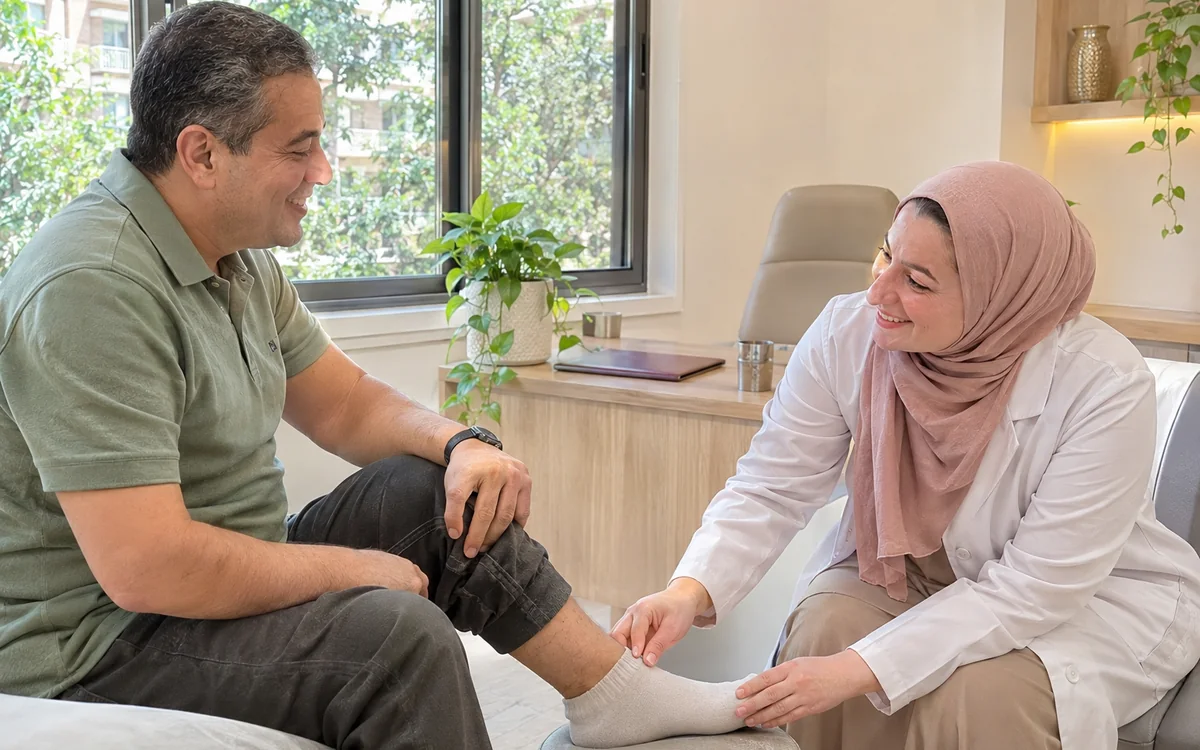
Your first rheumatology consultation at CMC Medical Mall in Fifth Settlement begins with an in-depth clinical interview and a structured examination to understand your case completely [1, 4]. Dr Shimaa Sherif asks when your first flare occurred, how many attacks you have had, which joints were affected, your diet and fluid intake prior to flares, and any family history of gout or kidney stones [1, 4, 15]. She also examines your medication list in detail, as loop or thiazide diuretics, low-dose aspirin, and certain blood pressure medications can elevate serum uric acid levels [1, 4, 15].
Following your medical history, the doctor performs a comprehensive physical assessment. She gently examines the symptomatic joint to assess effusion, warmth, and range of movement, followed by a systematic check of all peripheral joints to locate occult inflammation or subcutaneous tophi across the hands, elbows, feet, and ears [2, 3, 12]. The visit also includes blood pressure measurement, cardiovascular risk screening, and body-composition analysis using the in-house InBody machine at the branch to assess visceral adiposity, because excess body weight and insulin resistance are directly linked to elevated urate production and impaired renal excretion [4, 8, 15].
If you are experiencing an active acute flare during the consultation, the doctor immediately initiates an anti-inflammatory protocol. Internationally approved options comprise colchicine, non-steroidal anti-inflammatory drugs, or oral or intra-articular corticosteroids [1, 2, 5]. The chosen agent depends strictly on kidney function, gastric health, blood pressure, and cardiovascular status; a patient with chronic kidney disease or peptic ulcer disease requires a very different approach from someone with normal organ function [1, 2, 4]. The doctor details the precise schedule and what to do as pain subsides, while a dedicated guide on gout attack treatment provides supplementary reading.
Urate-lowering therapy and the treat-to-target goal: breaking the flare cycle
Many patients ask: what is the best pill to cure gout? The clinical reality is that attack medications only suppress acute inflammation; they do not alter the underlying metabolic disease or prevent future flares [1, 4, 5]. Breaking the cycle of gout requires long-term urate-lowering therapy, primarily xanthine oxidase inhibitors such as allopurinol or febuxostat [1, 2, 4]. International guidelines from the American College of Rheumatology and the European League Against Rheumatism emphasize that urate-lowering therapy must follow a treat-to-target strategy [1, 2, 4]. Rather than remaining on an arbitrary fixed dose, the medicine is titrated based on serial blood tests until serum uric acid drops below 6 mg/dL (360 micromol/L), or below 5 mg/dL (300 micromol/L) if you have tophi or flares continue despite reaching the first target [1, 2, 4].
When serum urate is sustained below this crystallization threshold, established monosodium urate deposits gradually dissolve over months [1, 2, 14]. However, in the early months of treatment, the shifting crystals can provoke transient breakthrough flares, known as mobilization flares [1, 2, 6]. To prevent these, your rheumatologist prescribes concomitant daily low-dose anti-inflammatory prophylaxis (such as low-dose colchicine or an NSAID) for 3 to 6 months alongside your urate-lowering drug until joint deposits stabilize [1, 2, 4].
Routine monitoring is the cornerstone of safe care: during the dose-titration phase, the dose is guided by serum uric acid checked about monthly, together with kidney and liver blood tests whenever the doctor judges them necessary, until the target is reached; after that, urate is usually checked about once a year [1, 4]. These medications are taken continuously over the long term; you must never stop or adjust your dose independently when feeling well, as sudden discontinuation causes urate levels to rebound and triggers severe flare relapses [1, 2, 6]. Read more about prevention protocols in our guide on long-term gout prevention and urate lowering.
Tests and imaging reports to bring to your Fifth Settlement gout visit
To make the most of your consultation at our Fifth Settlement clinic and avoid repeating recent diagnostic tests, prepare a folder containing the following reports if you have them available [1, 4]:
1. Previous serum uric acid tests: Bring all prior lab slips showing your uric acid numbers [9]. Notably, serum uric acid can read within the normal range during an acute flare, so a normal level during an attack does not rule out gout; if it was below 360 micromol/L (6 mg/dL) during a flare, it is rechecked at least 2 weeks after the flare settles [4]. 2. Comprehensive renal profile: Serum creatinine, blood urea nitrogen, estimated glomerular filtration rate, and routine urinalysis to check for protein, microalbuminuria, or crystals [4]. These tests are vital for tailoring the starting dose of urate-lowering drugs and avoiding drug accumulation [1, 4]. 3. Complete blood count and inflammatory markers: ESR and CRP to evaluate systemic inflammatory activity [3]. 4. Liver function panel: Baseline transaminases (ALT, AST) to ensure safe initiation and monitoring of medications [1, 4]. 5. Imaging reports: Plain radiographs of the affected joint, or musculoskeletal ultrasound reports demonstrating the characteristic double contour sign or tophaceous deposits [3, 12]. 6. Comprehensive medication list: A complete list of prescription drugs, over-the-counter products, and supplements, particularly blood pressure tablets, diuretics, and aspirin [1, 4].
Regarding diet and lifestyle: dietary modifications improve overall cardiovascular, renal, and metabolic health, but dietary changes alone are usually not enough to replace urate-lowering medication in established recurrent or tophaceous gout [1, 4, 5]. Moderating red meat, shellfish, organ meats, and high-fructose corn syrup beverages while staying well-hydrated provides excellent complementary support. Detailed dietary recommendations are covered in our comprehensive guide on uric acid levels and gout diet.
Getting to the Fifth Settlement branch at CMC Mall and clinic schedule
The La Rose Clinics Fifth Settlement branch is located in CMC Medical Mall, 4th floor, North 90th Street, behind the Air Force Specialized Hospital, Fifth Settlement, New Cairo. The branch operates on Wednesdays from 3:30 to 8 pm, hosting Dr Shimaa Sherif's rheumatology and joint clinic alongside clinical nutrition, weight management, body contouring, and InBody body-composition assessments [1, 4].
Reaching the clinic is straightforward from across New Cairo and surrounding districts: - Nearest landmark: the Air Force Specialized Hospital on North 90th Street; CMC Medical Mall is directly behind it. - From Cairo Festival City or the Ring Road: head towards 90th Street and continue along North 90th Street until you reach CMC Medical Mall (about 5.2 km, approximately 10 minutes by car via South 90th Street). - From El Yasmeen: about 5 km, about 10 minutes by car via North 90th Street or Moustafa Kamel Axis. - From Al Narges: about 6.5 km, about 12 minutes by car via South 90th Street. - From El Banafseg: about 6.9 km, about 10 minutes by car via North 90th Street. - From First Settlement: about 7.4 km, about 12 minutes by car via Moustafa Kamel Axis. - From Katameya Heights: about 8 km, about 12 minutes by car via South 90th Street. - From Point 90 Mall and AUC Avenue: about 9 km, about 12 minutes by car via North or South 90th Street.
Upon arriving at CMC Medical Mall, take the elevator to the fourth floor; the clinic operates under the La Rose name. You can book an appointment or ask questions by phone or WhatsApp on 010 4066 1893, or visit our page to book an appointment at La Rose Clinics. If Wednesday hours in Fifth Settlement do not fit your schedule, our Maadi branch (14 El-Mokhtar St, behind QNB Bank, New Maadi) welcomes rheumatology patients on Saturday, Monday and Tuesday from 3 to 8 pm [1, 4].