A PCOS weight-loss doctor in Maadi: the right order before any diet
If you are looking for a weight-loss doctor for PCOS in Maadi, the short answer is this: start by confirming the diagnosis, then follow a structured lifestyle plan, and only then discuss medicine if your case needs it. Much of what is written online jumps straight to a diet, but the order is what makes the difference: diagnosis first, then food, movement and sleep, then a medicine prescribed by a doctor after assessment [1, 2, 5].
PCOS is not simply "cysts on the ovary" and it is not simply extra weight. The World Health Organization estimates that it affects roughly 10 to 13 percent of women of reproductive age, and that up to 70 percent of them may not know they have it [1]. That means many women try to lose weight without ever learning why their cycle, skin or hair has been changing.
The encouraging part is that a fairly modest weight change can matter. The Saudi Ministry of Health page says that losing about 5 percent of body weight can noticeably improve symptoms [9], and the US Office on Women's Health says that a 10 percent loss can make cycles more regular and improve the chance of pregnancy [7]. Neither figure is a promise to any one person, but they show that the goal is not a perfect body. It is a real improvement in symptoms.
This article walks through the order step by step: when the diagnosis is confirmed, why weight is stubborn with PCOS, what to do about food and movement, when medicine enters the picture, and what happens at a first visit with Dr Alyaa Abu Taleb at the La Rose Maadi branch. If you want the general picture first, read the guide on [PCOS and weight](../articles/pcos-and-weight.html).
Step one: confirm it really is PCOS
Before you begin any weight-loss programme, you need to know whether your symptoms are caused by PCOS or by something that looks like it. No single test settles the diagnosis. The doctor relies on your history, an examination, blood tests and an ultrasound, and after other causes are excluded the diagnosis is made when two of three features are present: irregular cycles or absent ovulation, signs or blood tests of raised male-type hormones, and a polycystic appearance of the ovaries on ultrasound [1, 4, 7].
Cysts on the ovary are not required for the diagnosis, and the WHO says so explicitly [1]. On the other hand, an ultrasound can show "polycystic ovaries" in a woman who is perfectly healthy. That is why the whole picture matters more than any single result. The 2023 international PCOS guideline simplified the diagnostic algorithm, and in adults the hormone AMH can in some cases stand in for the ultrasound [2].
Some conditions must be excluded before the diagnosis is made, such as thyroid disease, high prolactin and certain adrenal gland disorders [3]. This matters a lot for our topic, because an underactive thyroid can cause weight gain and a disturbed cycle, and in that case a diet alone will not solve the problem. If you suspect your thyroid, read the guide on [PCOS and weight](../articles/pcos-and-weight.html) and talk to your doctor about the right tests.
For teenagers the picture is stricter. The guideline says that diagnosing PCOS in adolescence needs clear signs of raised male-type hormones together with persistent irregular periods, because irregular cycles alone are normal in the first years after puberty [3]. So do not label a teenage girl with PCOS just because her period is late.
The formal diagnosis is the doctor's responsibility, usually a gynaecologist or an endocrinologist. Our role at La Rose is to build the weight and nutrition plan on top of it, to review the tests you have already done, and to tell you whether a test or scan is still missing before we start.
Why is weight so stubborn with PCOS?
Many women say, "I eat less than my friends and still nothing moves." That is not imagination and it is not weak willpower. In many cases PCOS goes together with insulin resistance, meaning the body needs more insulin to handle sugar, and high insulin makes it easier to store fat, especially around the waist, and harder to lose it. Stony Brook Medicine describes insulin resistance as one of the most important elements in managing the condition [11], and NICHD notes that women with PCOS may also have metabolic problems such as insulin resistance or obesity [4].
Raised male-type hormones affect fat distribution, skin and hair, while poor sleep and stress raise appetite and the pull toward sugary food. Harsh restriction also brings weight back quickly, which is what happens to many people who lose on a punishing diet and then regain. If that sounds like you, read [weight regain with PCOS](../articles/qa-pcos-weight-regain.html).
It is also important to know that not every woman with PCOS is overweight. The guideline makes clear that weight loss alone is unlikely to be an adequate treatment for women of normal weight [3], and in that case the plan centres on food quality, movement and treating the symptoms themselves. So the question is not always "how do I lose weight" but "what does my body need".
We should also be honest: the research on lifestyle in PCOS is still of fairly weak quality. A 2022 systematic review of 79 randomised trials found that most were old and at high risk of bias, and that a lower-calorie diet was the intervention tested most often [10]. In practice that means there is no magic PCOS diet, and the most useful plan is the one you can actually keep up [3, 10].
The practical result is that dealing with insulin resistance, sleep and stress alongside food gives you a better chance than cutting calories alone. You will find more on suitable food for insulin resistance in the guide on the [insulin resistance diet](../articles/insulin-resistance-diet.html).
The order of care: diagnosis, then lifestyle, then medicine
This is the most important part of the article, because most competitors skip it. A structured plan for PCOS and weight runs in three stages, and each one builds on the one before.
Stage one is diagnosis and assessment: confirming that the condition is PCOS, excluding thyroid disease and high prolactin, and checking blood sugar, blood fats and blood pressure, because the syndrome raises the risk of diabetes, heart problems and sleep disorders [2, 4]. Without this stage you can lose months on the wrong plan.
Stage two is lifestyle: suitable food, regular movement, enough sleep, and a way of handling stress and emotional eating. The international guideline stresses healthy lifestyle, quality of life and awareness of weight stigma as a core part of care [2], and the Endocrine Society guideline starts with a calorie-restricted diet and exercise for women with obesity [3]. Give this roughly three to six months of regular follow-up before judging whether the plan has worked [3, 10].
Stage three is medicine, and it comes in when the assessment shows that lifestyle alone is not enough or when there is a clear medical reason. Take metformin as an example: the Endocrine Society guideline recommends it for women with type 2 diabetes or impaired glucose tolerance who do not respond to lifestyle changes, and does not suggest it as first-line treatment for obesity itself [3]. Hormonal contraceptives regulate the cycle and ease acne and excess hair, and anti-androgen medicines have a role for hair and acne [1, 7]. Weight-loss medicines can be discussed for adults who are overweight [5], and that is a doctor's decision after reviewing your history, your current medicines and any reasons not to use them.
So a diet is not a magic solution on its own, and a medicine is not a replacement for food and movement. If someone offers you injections or a drug before any diagnosis is confirmed, ask why, and go back to [PCOS and weight](../articles/pcos-and-weight.html) to understand the picture.
Food, movement and sleep: what to do in practice
No single eating pattern has been proven best for PCOS, and the Endocrine Society guideline says plainly that no one diet type has been shown to be superior [3]. What the sources keep returning to is a simple, balanced pattern that fits an Egyptian home.
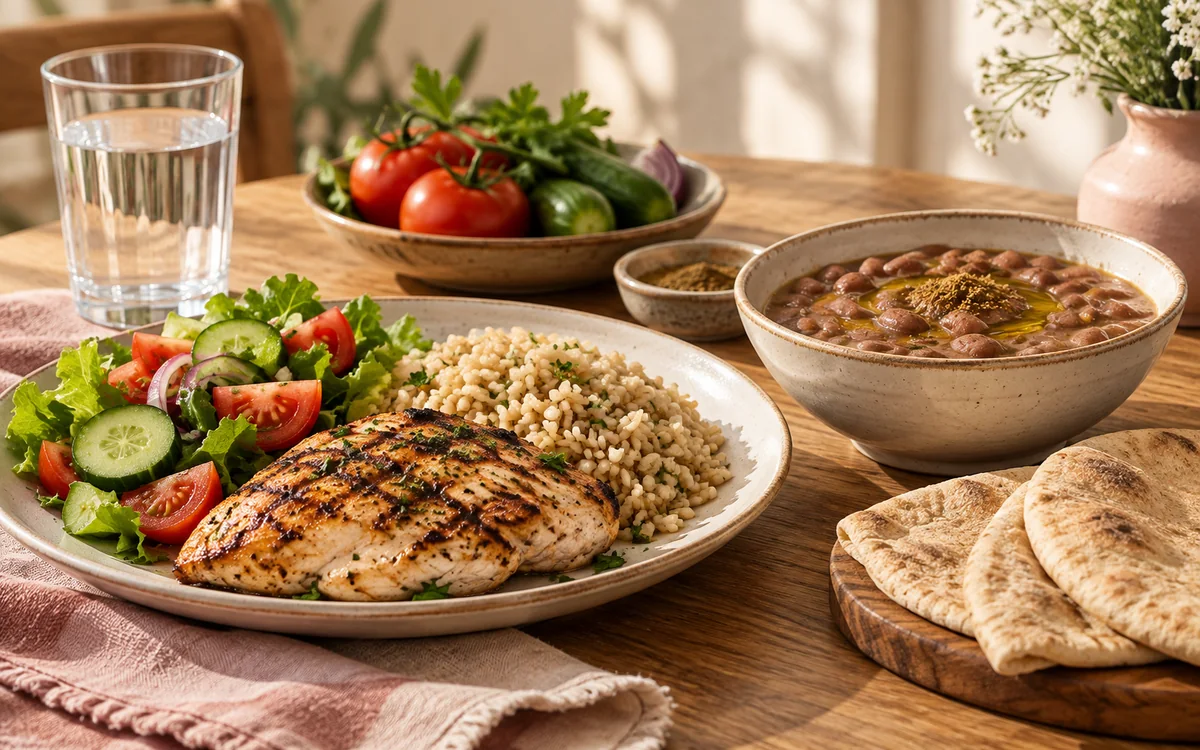
A Mediterranean-style pattern, for example, is built around vegetables, beans, whole grains, fish or poultry, olive oil as the main fat, and fruit for dessert [11]. That is close to many Egyptian kitchens already: ful, lentils, salad, cooked vegetables, grilled fish. The key is to cut back on processed foods, sugary drinks and sweets that spike blood sugar, to spread protein and fibre across your meals so you stay full longer, and to avoid long fasts followed by large meals, which tend to trigger binge eating.
For movement, start with something small that you can keep doing. Stony Brook Medicine suggests a 30-minute walk at lunchtime as a starting point, then adding 5 to 10 minutes of daily resistance work with light weights or water bottles [11]. Resistance work matters because it builds muscle that uses up sugar and improves insulin sensitivity. It is also more useful than punishing runs that stop after two weeks.
Sleep and stress are part of treatment, not luxuries. Poor sleep raises hunger and the pull toward sweets, and emotional eating is a common reason for a plateau. The same source advises a realistic routine and working with a therapist if eating is tied to stress and boredom [11].
At La Rose Maadi, Dr Alyaa builds the plan on an InBody analysis and a reading of your tests, without deprivation, using everyday home food. You can read about the [InBody test in Maadi](../articles/inbody-test-maadi.html) to see what is measured and how to prepare.
Tests and medicines: when and why
The usual tests in PCOS include blood hormones (such as male-type hormones and thyroid hormones), blood sugar and blood fats, and sometimes an ovarian ultrasound for adults [5, 8]. The NHS page makes clear that an ovarian ultrasound is only done for women over 18 [5]. Insulin and glucose are useful for assessing insulin resistance, but a single result does not settle the picture, which we explain in the [insulin resistance diet](../articles/insulin-resistance-diet.html) guide.
If you already have results from any laboratory, bring them with you. You do not need to repeat a test you did recently, and the doctor will tell you only what is missing.
On medicines, the choice depends on your goal. If you are not planning a pregnancy, hormonal methods to regulate the cycle may be discussed, along with insulin-sensitising medicines, anti-androgen medicines and lifestyle change [8]. If you do want to conceive, the options shift toward ovulation-inducing medicines and other treatments [7, 8]. Weight-loss medicines, including the GLP-1 class, are a doctor's decision after assessment, and the evidence specific to PCOS is still developing [5]. No medicine should be taken without a prescription or because of an advert.
Metformin is a well-known diabetes medicine that is used in some PCOS cases to improve the response to insulin and the regularity of the cycle [8], but it is a doctor's decision after checking blood sugar, kidney function and digestive symptoms, and no dose is given here because dosing is individual.
Most important: do not stop a medicine you already take, and do not start a PCOS supplement (such as inositol or any other) before talking to your doctor. Supplements marketed as a miracle treatment are not a replacement for a diagnosis and a plan.
The first visit in Maadi: what happens
The visit at the La Rose Maadi branch is with Dr Alyaa Said Abu Taleb, a physician specialising in clinical and therapeutic nutrition and weight management, with more than seven years of experience in Maadi, who focuses on safe weight-loss programmes for women without deprivation or harsh regimes, consistent with the guideline's call for lifestyle support without weight stigma [2]. For more about the clinic, read about the [nutrition clinic in Maadi](../articles/nutrition-clinic-maadi.html).
Before the visit, prepare a list of your medicines and supplements, any earlier tests or ultrasound, a note of how regular your cycle has been over roughly the last six months, and the symptoms bothering you: acne, extra hair, shedding, tiredness, or strong sweet cravings. Jot down your sleep and habits briefly. You do not need to arrive fasting or try a "perfect week" before the visit.
In the session the doctor reviews your medical history, medicines, cycle and earlier attempts, measures weight, height and waist, and performs an InBody analysis to estimate fat, muscle and water. She then reads your tests and decides whether anything is missing. If your case needs a gynaecological diagnosis or an ultrasound, the team tells you that up front instead of starting a plan on an unconfirmed basis, and you can bring the result from any laboratory or imaging centre.
The plan is set around your real eating and work schedule, with weekly follow-up and adjustments as you progress. If your case needs a gynaecologist or endocrinologist in parallel, the doctor coordinates with you and explains the next step. Dr Shimaa Fouad, who focuses on insulin resistance and PCOS and has more than 18 years of experience, reviews this article.
By the end you will know what still needs to be confirmed, what your first food and movement step is, when to follow up, and which signs mean you should come back before your appointment.
Pregnancy, teenagers and warning signs
If you are planning a pregnancy or having fertility treatment, the plan changes. The Saudi Ministry of Health page explains that reaching a healthy weight and normal blood sugar before pregnancy reduces the risk of complications, and that the doctor can discuss ways to help ovulation [9]. So do not start a harsh diet or a weight-loss medicine while trying to conceive without talking to your doctor.
For teenagers, the guideline suggests lifestyle therapy aimed at weight as first-line for those who are overweight, while a hormonal medicine or metformin may be discussed depending on the goal [3]. For parents the task is support without blame: shared family meals work better than a separate programme for the girl alone. Over-restricting food can be risky at this age.
Warning signs that call for an earlier review include a period missing for several months, heavy bleeding, severe pelvic pain, strong thirst with frequent urination (which can point to diabetes), loud snoring with pauses in breathing, or sudden weight change without a clear reason [2, 4, 7].
There is also an emotional side. Negative feelings about weight are common in women with PCOS, and the international guideline stresses awareness of weight stigma and mental health [2]. If food has become tied to control and anxiety about weight, if you vomit or use laxatives, or you struggle with binge episodes you cannot control, the priority is specialised psychological and medical support before any weight-loss programme, and for emotional eating the Stony Brook source suggests working with a therapist [11]. Weight-loss medicines are not for pregnant or breastfeeding women.
Getting there and booking at the Maadi branch
The La Rose branch is at 14 El Mokhtar Street, off El Nasr Street, directly behind QNB bank, in New Maadi. Dr Alyaa Abu Taleb is in Maadi on Saturday and Monday from 2 to 7 pm. Dr Shimaa Fouad is in Maadi on Saturday, Monday and Tuesday from 3 to 8 pm, and in Fifth Settlement on Wednesday. Confirm your slot before you set out, because schedules can change.
To book or to ask about the cost of the visit, message us on WhatsApp or call 010 4066 1893. Booking ahead helps the team prepare your time, and lets you come with what we need: your medicines and supplements, earlier tests or ultrasound, and notes about your cycle and your questions.
If you want to read more before booking, there is [PCOS and weight](../articles/pcos-and-weight.html) for the overall picture, [weight regain with PCOS](../articles/qa-pcos-weight-regain.html) if your weight came back after a diet, and the [nutrition clinic in Maadi](../articles/nutrition-clinic-maadi.html) for service details. This article is general information and not a substitute for an examination, and diagnosis and medicines are the doctor's decision [2, 3].
Book your appointment and start in the right order: a confirmed diagnosis, then a food and movement plan you can keep up, then medicine if it is needed. [Book at the Maadi branch](../patients/booking.html).