Postpartum weight loss in New Cairo: the short answer before any diet
If you are looking for postpartum weight loss in New Cairo, the best start is not a harsh diet. It is a calm assessment that places you in your recovery stage, builds a food plan that still covers breastfeeding, and decides whether anything else needs attention first. Breastfeeding itself has health benefits for the mother [7], and it needs roughly 330 to 400 extra calories a day according to US Centers for Disease Control guidance [1], so cutting food sharply is the wrong first move.
This article is about the mother only: when to start, what food suits breastfeeding, why weight-loss medicines are generally not used during it, and when body contouring becomes a sensible question. At the end you will see how to reach the La Rose Fifth Settlement branch. It is general, source-based information and does not replace an assessment of your own case with your obstetrician and a nutrition doctor.
When to start: timing follows recovery stage, not a fixed number
Arabic websites give different numbers: some say wait about six weeks, others say start after the sixth month. Neither is simply right or wrong. The spread shows that no single number fits every mother, because caesarean birth, bleeding, anaemia, broken sleep and the state of milk supply all change the answer. Medical guidance treats the weeks after birth as an ongoing process: contact with the obstetric provider within 3 weeks and a comprehensive visit no later than 12 weeks, covering physical recovery, mood, sleep and chronic conditions [8].
In practice, the first phase is about recovery and settling breastfeeding, not about the scale. Once your obstetrician is satisfied with the wound, the womb and your blood tests, you can begin a gentle change in food quality, which is very different from a diet. When breastfeeding is stable you can discuss a slow, supervised loss. If the numbers on the scale worry you, read the details in our article on weight loss after birth while breastfeeding.
The breastfeeding plate: food that fills you and protects energy and protein
The core idea is that you are not removing food from the plate, you are arranging it. Breastfeeding raises your energy needs [1], so improve quality before quantity: protein at every meal (eggs, milk and yoghurt, beans, lentils, chickpeas, chicken, fish), clear portions of vegetables and fruit, whole starches instead of refined ones, and sensible amounts of healthy fats such as olive oil and nuts. Small, closely spaced meals help if hunger arrives at night because of feeding, and a protein-rich breakfast tends to reduce sweet cravings in the afternoon.
US guidance flags two practical points: choose low-mercury fish and limit high-mercury types, and keep caffeine to roughly two small coffees a day at most [1]. Drink fluids according to thirst, with a simple check: if urine is dark or your mouth is dry, increase fluids.
We will not give you a fixed calorie number in an article, because the need changes with your weight, your movement and how intensely you feed. The number is set at the visit after body measurements and a review of what you actually eat.
What does the evidence say about losing weight after birth?
A Cochrane review of women after childbirth pooled randomised trials in women after childbirth. Diet, or diet combined with exercise, reduced weight more than usual care, while exercise alone made no clear difference, and there was no apparent harm to breastfeeding [3]. So food is the foundation and movement is the support.
A newer review focused on lactating women gathered 7 trials and linked a moderate calorie deficit with macronutrient adjustment, lasting over a month, to weight loss and better body composition without self-reported harm to breastfeeding. The authors stressed that studies are few and that effects on milk composition are still unclear [5]. On the link between breastfeeding and weight change, a systematic review found inconsistent results: some women lose weight, others do not [4].
In short, breastfeeding does not guarantee weight loss for everyone, and fast dieting has not been shown safe. What is needed is gradual, supervised loss, and when the scale stalls we look at sleep, stress and actual intake rather than cutting more.
Keto, fasting and fat-burning herbs: why they do not fit breastfeeding
A systematic review of carbohydrate restriction during lactation found 16 case reports, mostly women who began ketogenic or low-carbohydrate diets for weight loss. Most reports described hospital admission with vomiting, muscle weakness, nausea, abdominal pain and fatigue, and concluded that carbohydrate restriction during lactation may harm the mother and contribute to lactational ketoacidosis [6]. The evidence is case reports rather than large trials, but the pattern is clear enough that we do not start there.
The same reasoning applies to prolonged fasting, very low calorie plans, and teas or herbal products promising to burn belly fat. These are not part of a medically described plan for a breastfeeding mother, and some may affect sleep, digestion or milk supply. If you take a supplement or herbal drink, tell the nutrition doctor its name and amount instead of stopping it or continuing it alone.
Signs that need an early medical review: severe dizziness, general weakness, palpitations, persistent nausea, or a clear drop in milk with any change in food.
Weight-loss medicines and injections while breastfeeding: what the labels say
This question comes up often, and the answer is that data are incomplete and the decision is not one to take alone. The US Wegovy label says breastfeeding is not recommended during treatment with the tablets, and for the injection it states there are no data on whether semaglutide is present in human milk [9]. The Zepbound (tirzepatide) label describes a single-dose study in 11 lactating women in which the drug was undetectable in most milk samples, yet the label itself says there are no data on effects on breastfeeding or milk production and asks the prescriber to weigh the benefits of breastfeeding against clinical need [10].
None of that means either medicine is safe. Reviews also describe postpartum use as controversial, with data insufficient to support routine use [11]. That is why, at La Rose, safe food and recovery come first, and no medicine is started or stopped without medical assessment. If you were taking a medicine before pregnancy or after birth, do not stop or continue it on your own; go back to the prescriber.
The full detail for each medicine group is in our article on weight-loss medicine during pregnancy or breastfeeding.
Movement and the belly after birth: gradual and with your obstetrician's approval
US activity guidance after birth points to about 150 minutes a week of moderate-intensity activity, but you build towards that number gradually from gentle walking, not from week one [2]. After a caesarean, the timing of abdominal exercise or heavy lifting is set by your obstetrician according to the wound, not by an internet article.
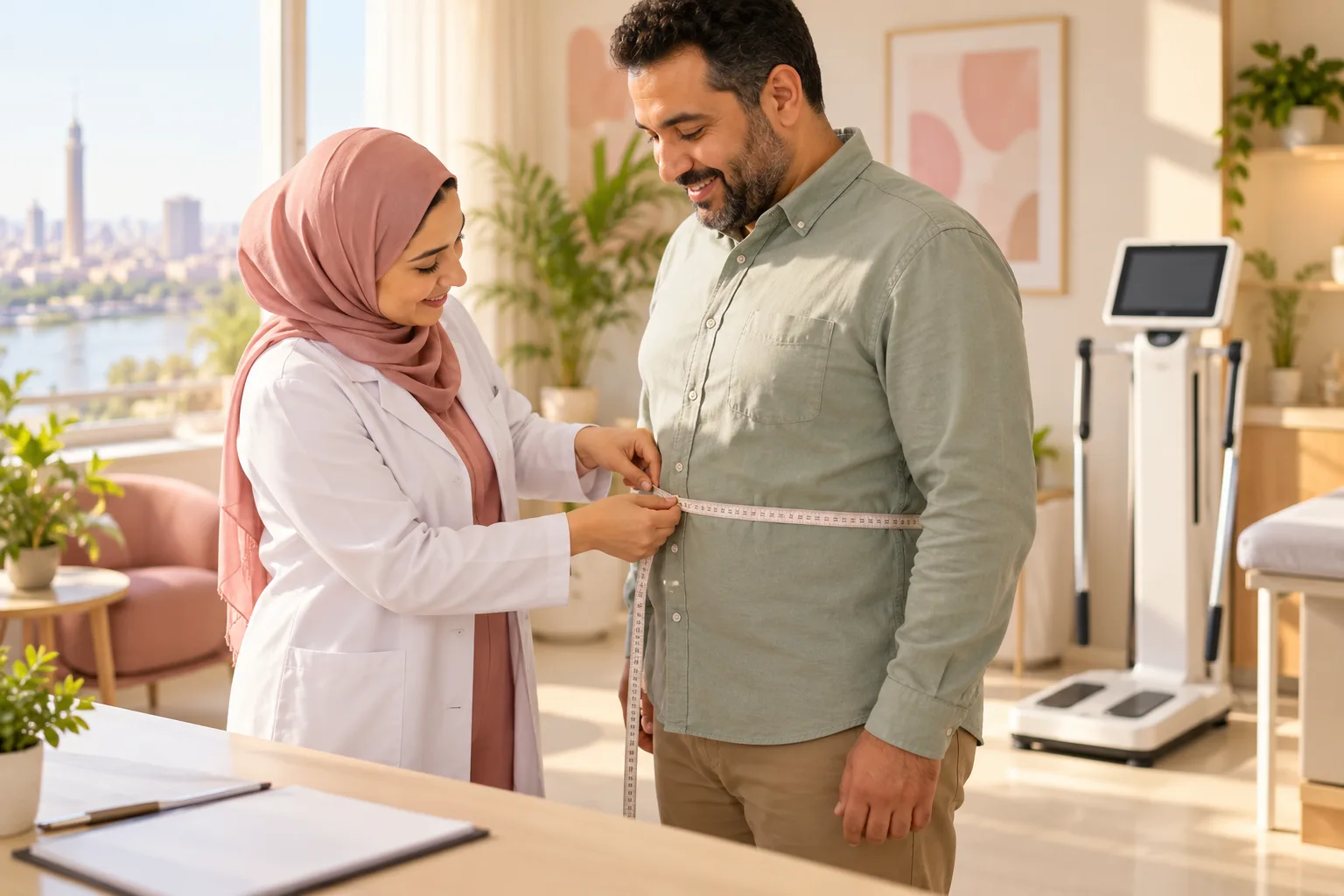
The postpartum belly has several components: fat, loose skin, abdominal muscle that needs time to recover, and sometimes bloating and constipation. That is why measuring beats relying on the mirror: at the Fifth Settlement branch we measure body composition with an InBody device, and you can learn how to read InBody results before deciding any step. If the belly persists after food has settled and improved, body contouring can be discussed later, and because data on cosmetic procedures during breastfeeding are still scarce, postponing them is the better course. Read about mesotherapy after pregnancy for the full picture.
The postpartum nutrition visit: what happens and who it suits
The visit with Dr Shimaa Fouad starts with questions about the birth (vaginal or caesarean), breastfeeding, sleep and what you actually eat, followed by a review of tests, medicines and supplements. Then comes body-composition measurement with an InBody device and a Body Contouring measurement, and the plan that fits your case: a food plan, follow-up, or referral to another doctor if something needs treatment first, such as anaemia, a thyroid disorder or signs of postpartum depression [8]. Detail on the clinic is on the page for the nutrition clinic in Fifth Settlement.
The visit suits a mother who has passed the first recovery stage with her doctor's approval, wants a food plan that protects breastfeeding, has a stalled or rising weight, has insulin resistance or gestational diabetes in her history, or is thinking about body contouring once breastfeeding ends.
Call emergency services or your obstetrician immediately, before any clinic appointment, if you have fever, heavy bleeding, chest pain, shortness of breath, calf pain or swelling, or thoughts of self-harm [8].
Reaching the Fifth Settlement branch from New Cairo and booking
The address is CMC Medical Mall, fourth floor, North 90th Street, behind the Air Force Specialized Hospital, Fifth Settlement, New Cairo. The clinic runs on Wednesday from 3:30 to 8 pm with Dr Shimaa Fouad. That is the only day currently available at the branch, so confirm before you travel because schedules may change.
Measured distances from the branch: the Air Force Specialized Hospital is about 750 m (a walk), Cairo Festival City about 5.2 km and roughly 10 minutes by car, El Yasmeen 4.9 to 5.6 km and 9 to 10 minutes, Al Narges 6.5 km and about 12 minutes, El Banafseg 6.9 km and about 10 minutes, First Settlement 7.4 km and about 12 minutes, and Point 90 Mall and AUC Avenue 8.9 to 9.4 km and 11 to 12 minutes. Al Rehab City is also reachable at 11 to 11.6 km and about 16 minutes. These are typical times, not guarantees, so check the map and traffic when you leave.
To book, call or WhatsApp 010 4066 1893. Ask on WhatsApp and the team will tell you the cost before you book. Bring your list of medicines and supplements, recent tests and your birth report if you have one, because a comprehensive postpartum review covers recovery, medicines and mood [8]. Book at the Fifth Settlement branch and the medical team at La Rose will confirm the details with you.