Why list complete meals instead of ingredients?
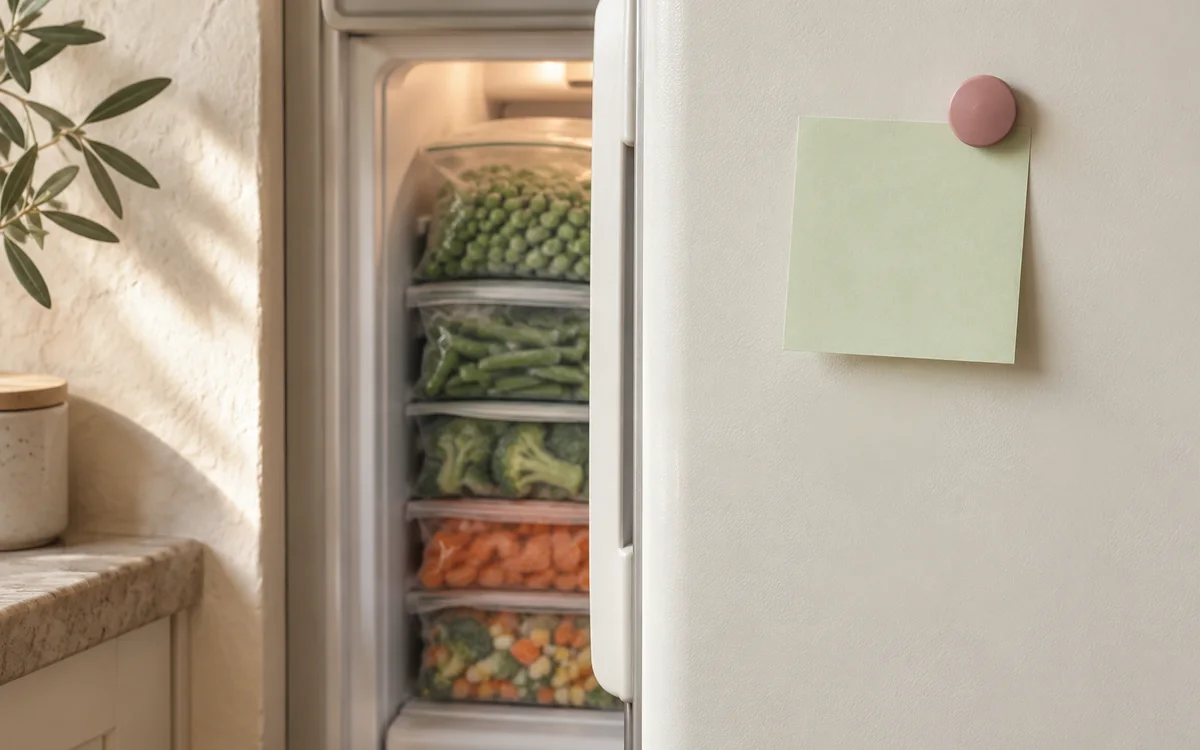
At the end of a long day, the problem is often not an empty freezer. It is seeing many containers and needing several decisions while tired and hungry. A bag of vegetables, a container of chicken, and frozen rice still leave the question: how do these become dinner? A small note on the door converts vague inventory into a clear option: “chicken + vegetables + rice.” We call that a meal pair even when it contains three items because it pairs a frozen base with the additions that make a meal.
Start with only three lines made from food that is genuinely available. Twenty suggestions can turn the note into another burden. Cross off a line when you use it, then add a replacement after shopping or cooking. Keep it outside the door so you see it before searching through drawers. The household need not eat identical amounts; one base can be completed for individual needs.
A large observational study found meal planning associated with better dietary variety and quality, but it cannot show that planning alone caused those outcomes. A freezer note does not promise weight loss and does not treat disease. Its practical value is simpler: it reduces decision friction and makes available food visible. Healthy eating still rests on adequacy, balance, moderation, diversity, and safety; the note merely helps put those principles into practice [1, 2].
Take a quick inventory and build three lines
Open the freezer once and list bases with a clear route to the table: cooked lentils, cooked chicken, well-wrapped raw fish, frozen vegetables, bread, rice, or homemade sauce. Then check the refrigerator and cupboard for additions. Do not write “healthy meal”; write an action: “lentil soup + bread + cucumber,” “chicken + vegetables + rice,” or “fish + potatoes + salad.” When one component runs out, that line is unavailable until replaced.
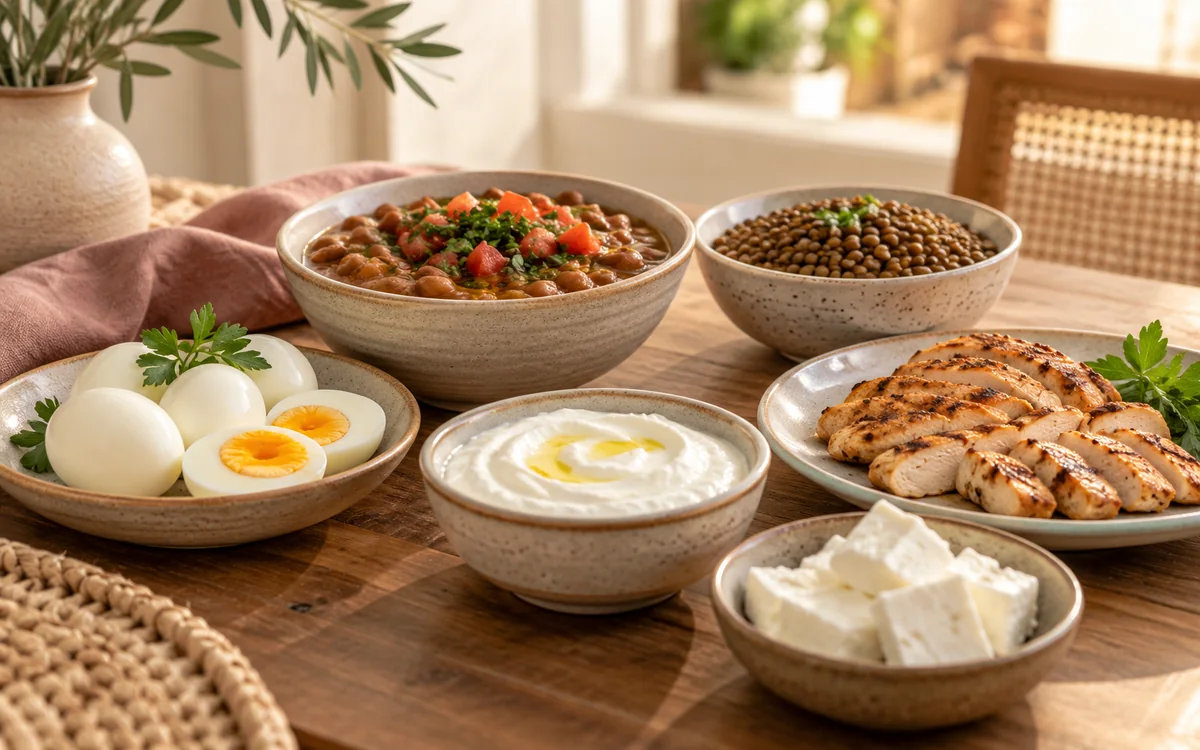
A practical combination often includes a protein source, vegetables or fruit, and a suitable starchy food, with other choices fitted to the day and your needs. Every plate does not need to match a rigid diagram; balance can be achieved across a day or week. Pulses, eggs, fish, meat, and poultry are possible protein sources, frozen vegetables still count as vegetables, and bread, rice, or potatoes can complete the meal [2, 3].
If protein repeatedly goes missing, Build emergency protein portions explains how to reserve two plain portions while cooking. Your door note only needs the portion and its addition. When buying prepared frozen food, read the ingredients and information for serving size, salt, fat, and sugars; “frozen” alone is not a health verdict [4].
Choose a pair that satisfies and fits your day
Treat pairs as templates, not compulsory recipes. A “soup + side” template could be lentil soup with bread and salad, or vegetable soup with an egg and bread. A “protein + vegetables + starch” template might be chicken with peas, carrots, and rice, or fish with potatoes and vegetables. A pulse base could be beans with rice and vegetables. Variety across weeks matters more than chasing a perfect meal every evening [2, 3].
Write the finishing action too: “add cucumber,” “heat vegetables,” or “move the container to the refrigerator in the morning.” That phrase prevents discovering, while hungry, that dinner needs another hour. When salad is unavailable, plain frozen vegetables can complete the plan. Pay attention to sauces and mixtures, and use the label to compare salt, fat, or sugars [3, 4].
Satisfaction is not determined by one ingredient. A very small meal or one low in suitable protein and fibre may leave hunger returning soon, but sleep, stress, activity, and medicines also affect appetite. If the question recurs, I eat a proper meal and feel hungry again an hour later. Why? reviews the pattern without banning carbohydrate or assigning blame. The freezer list should make a real meal easier, not force you to ignore hunger [2, 3].
Cool, portion, and label safely
Safety starts before freezing. Wash hands and equipment, keep raw meat, poultry, and seafood away from ready-to-eat food, and cook thoroughly. The World Health Organization summarises the foundations as keeping clean, separating raw from cooked food, cooking thoroughly, keeping food at safe temperatures, and using safe water and ingredients [5]. U.S. guidance expresses the same idea as clean, separate, cook, and chill [6].
After cooking, do not leave a large pot on the counter for hours. Divide leftovers into small or shallow containers so they cool faster, and refrigerate or freeze perishable food within two hours, or one hour when the surrounding temperature exceeds 90°F (32°C). Hot food can go into the refrigerator in suitable small containers; it does not need to reach room temperature first [6, 8].
Label the food, date, and number of portions. Dating helps you use older items first; do not rely on colour or smell alone. Freeze the amount you expect to use so excess need not be thawed. Keep well-wrapped raw food away from ready-to-eat food so leaking juices cannot contaminate it. Freezing stops the growth of many microbes, but it does not sterilise food or repair unsafe handling before freezing [6, 7, 8].
Thaw and reheat safely, then adapt the meal
If a meal needs slow thawing, move it to the refrigerator the night before or in the morning. Safe methods are the refrigerator, cold water with a leak-proof package and regular water changes, or the microwave followed by immediate cooking. Do not thaw on the counter or in a car. Some soups and leftovers can be reheated from frozen, but heating takes longer and must reach the whole portion [6, 7, 8].
Stir and cover food while reheating when appropriate, especially in a microwave where cold spots may remain. U.S. leftovers guidance recommends reheating leftovers to 165°F (74°C) and bringing soups and sauces to a clear boil. Follow product instructions; some foods look cooked but still require full cooking. Refrigerator limits vary, while freezer times usually address quality at 0°F (-18°C) or below, so check a storage chart for the item [8, 9].
The same meal does not suit everyone in the same amount. Diabetes, kidney disease, allergy, pregnancy, or weakened immunity may change selection and handling, and children under two have different needs. Your first clinical nutrition visit explains individual assessment, while Photograph one ordinary day helps reveal timing and gaps. Do not copy another person's portion; keep medical decisions with your treating professional [3, 4, 10].
Keep the system small and easy to renew
If all three lines disappear on one day and leave no option for the rest of the week, do not call the system a failure. Rotate two portions instead of preparing many dishes: use one and replace it from ordinary cooking. If one container remains forgotten, add its missing action to the note, such as ‘needs bread,’ ‘thaw overnight,’ or ‘serves two.’ That detail makes the list executable and reduces waste without turning a day off into an exhausting preparation project. Check freezer space too, allowing cold air to circulate rather than adding a dense stack of warm containers at once. After shopping, place older items in front and newer ones behind so the food needing earlier use stays visible [6, 8, 9].
Review the list and recognise warning signs
Once a week, ask which line you used and which did not move. Was the meal unappealing, slow to thaw, or missing an addition? Adjust the friction: freeze a smaller portion, move it at a fixed time, or choose an addition that is normally available. Three options you use are better than ten forgotten containers.
Discard food with an abnormal smell or appearance, but absence of a bad smell does not prove safety. Microbes can be present without an obvious sign, so time, temperature, and handling matter more than tasting [7, 10]. During a power failure, keep the door closed. Food that still has ice crystals or remains as cold as refrigerated food may be used or refrozen according to guidance; discard perishable food held above 40°F (4°C) for over two hours [7].
Seek medical assessment for bloody diarrhoea, diarrhoea lasting over three days, vomiting that prevents drinking, high fever, or dehydration signs such as little urination, dry mouth, and dizziness on standing. Fever with flu-like symptoms during pregnancy needs clinician contact, and higher-risk groups need earlier advice [10, 11]. If the issue is repeatedly missed meals or changing appetite or weight, you can request a clinical nutrition appointment at the clinic to review your needs. Individual decisions remain with your treating clinician or dietitian [2, 3].