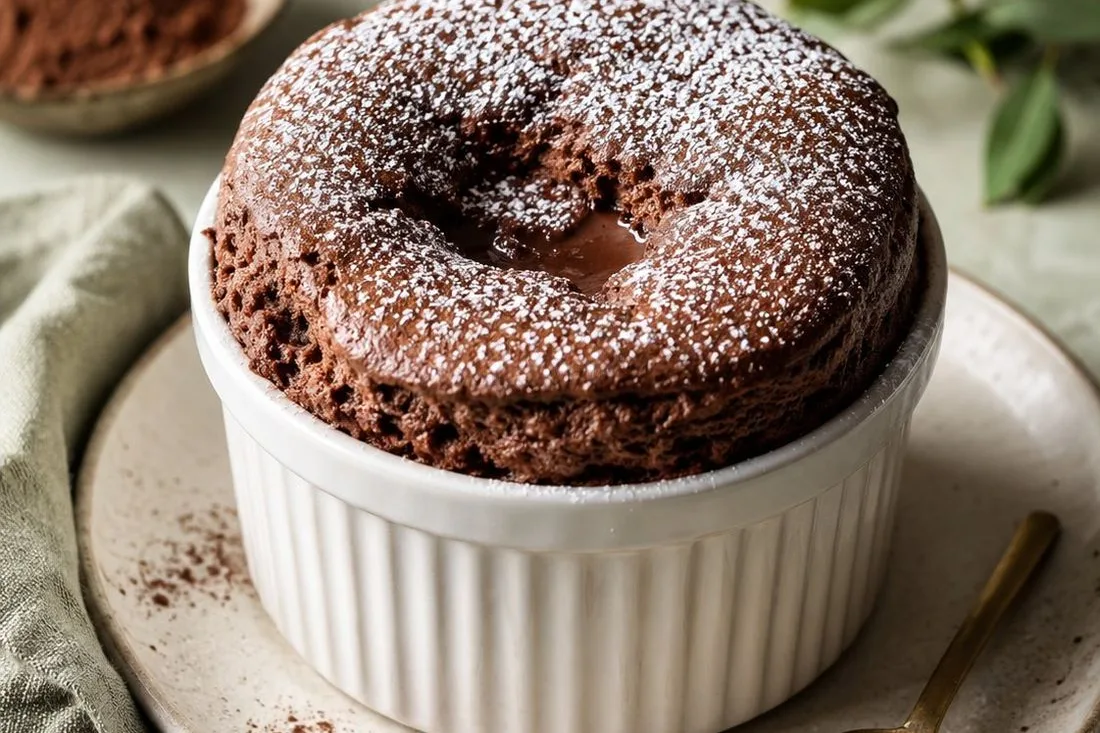
High-protein healthy desserts: what is a chocolate protein soufflé?
A chocolate protein soufflé is a warm, risen dessert made from 4 egg whites, a scoop of chocolate protein powder and a spoon of cacao, and one serving gives about 33 g of protein for only 180 kcal. It takes around 22 minutes (10 to prepare and 12 to bake) in a small 300 ml ramekin.
It answers a question people ask often: "I want a sweet that fills me up without wrecking my day." It suits the time after training, after a light dinner, and any moment you want chocolate, whether you train, watch your weight, or look for a lighter dessert for the family. It needs no flour, butter or refined sugar, but it needs the right whisking and folding to rise.
In this article you will see how it differs from a traditional soufflé, the exact arithmetic behind the 33 g, why soufflés fall and how to prevent it, a version without protein powder, and the egg-safety point that applies to everyone who eats it.
Why is a traditional soufflé heavy, and what changed in this version?
A classic soufflé is built from egg yolks, butter, flour, milk or cream and sugar, with whipped whites folded in. The result is wonderful, but one serving usually passes 300 kcal and carries plenty of fat and sugar, so it does not work as an everyday dessert for someone counting calories.
This version removes the yolk, butter, flour and sugar, and keeps the part that makes a soufflé a soufflé: the whipped white. The white is almost pure protein (about 3.6 g in a large one) with no fat, and the protein powder enriches flavour and texture and delivers most of the chocolate. Raw cacao brings a bittersweet depth with no sugar.
The protein here is not for show. The International Society of Sports Nutrition suggests 20 to 40 g of protein per serving for people who train [1], and this serving sits in the middle of that range. At the same time the World Health Organization advises limiting free sugars and saturated fat as part of a healthy eating pattern [3], which is exactly what the recipe does.
How is the 33 g of protein calculated, and is that a lot?
One serving delivers 180 kcal and 33 g protein, alongside 7 g carbohydrate and 2 g fat. The rough protein arithmetic: four large whites give about 14 g, a scoop of powder (30 g) gives about 19 g if the label shows around 65 percent protein, and cacao adds under 1 g. The total is about 33 g, and if your powder has a higher protein percentage the figure rises, so read the label.
Is 33 g a lot? A person's protein need depends on body weight. The European Food Safety Authority sets the reference intake for healthy adults at about 0.83 g per kilogram per day [11], roughly 58 g for a 70 kg person. For someone who trains, the International Society of Sports Nutrition gives a range of 1.4 to 2.0 g per kilogram [1]. So this serving covers about half to two thirds of an average adult's need, and around a quarter of the need of someone training hard.
That makes the soufflé a part of the day, not the whole day. Harvard stresses that quality and variety matter as much as quantity, and that a healthy plate is built on half vegetables and fruit, a quarter protein and a quarter whole grains [4], and that good protein sources should rotate among legumes, fish, eggs, poultry and dairy [2]. And remember that for people with kidney disease the amount must be set by a doctor.
Why egg whites, lemon and cacao? What each ingredient does
Four egg whites at room temperature: warm eggs whip to a bigger volume than cold ones, so take them out of the fridge about half an hour ahead. The white is the engine that makes the soufflé rise, because whipping traps air inside a network of protein, and oven heat expands that air while setting the network.
Half a teaspoon of lemon juice: the acid steadies the foam and stops it from collapsing; without it the whipping is less stable. A teaspoon of zero-calorie sweetener goes in over two additions until the texture turns glossy, which gives shine and prevents graininess. The scoop of chocolate protein powder is sifted together with a teaspoon of raw cacao so no tiny lumps weigh the mixture down.
Finally, a teaspoon of powdered sweetener dusts the top while it is hot. Flavour changes easily: vanilla protein powder with two teaspoons of cacao makes a gentler chocolate soufflé. And if you want a sweeter, real-chocolate treat with fewer calories than a classic cake, also see the article on the 70-Calorie Chocolate Cake.
How do I make the protein soufflé step by step?
Every quantity in grams and spoons is written out here: Full recipe in the Recipe Guide. The short steps:
Heat the oven to 180 degrees Celsius with the rack in the middle, and brush the 300 ml ramekin with a very thin layer of oil or oil spray. Sift the powder with the cacao. Whip the whites with the lemon in a clean, dry bowl to soft peaks, then add the sweetener in two additions and keep going until the peaks are glossy and stand up. Add the dry mixture in three batches, folding from the bottom up with a wide spoon in a gentle turning motion, not stirring. Level the top and bake 11 to 12 minutes until risen and set at the edges with a soft centre. Dust with sweetener and serve at once.
The most important tip: the bowl and whisk must be spotless and completely dry, because any trace of fat or yolk stops the whites from whipping. And if your oven runs hot from below, raise the rack a little.
One more tip that matters: prepare everything before you start whipping, meaning the ramekin is greased, the oven is hot and the dry mixture is sifted beside the bowl. A soufflé does not wait, and every minute between whipping and baking lets the foam lose some of its lift. If you are making more than one serving, whip each batch separately instead of whipping a large amount and dividing it.
Why does a soufflé fall, and how do I stop it?
A soufflé falls because the air inside cools and contracts as soon as it leaves the oven; that is normal and happens to every soufflé, even in restaurants. What you can control is whether it collapses too early or comes out dense in the first place.
Common causes: whipping the whites too little so the peaks are too soft, or whipping too much so the foam turns broken and dry. Heavy stirring breaks the bubbles. Opening the oven door in the first 8 minutes lets cold air in. A ramekin greased too heavily makes the batter slip instead of climbing the walls. And protein powder added all at once weighs the foam down.
The practical fix: start with glossy peaks, fold in batches, open the oven only after 10 minutes, and serve at once because you want to eat it while it is still risen. If it sinks a little the taste does not change, it simply turns into a pleasantly creamy texture. For a first attempt, prepare two small ramekins instead of one large one, since a small size cooks faster and sets better.
A sweet after training: when to eat it and how filling is it?
The soufflé is very suitable after training because it is light on the stomach and easy to digest, but it does not have to be right after training. The International Society of Sports Nutrition says protein within about two hours after training is useful, without naming a magic moment [1]. So you can eat it an hour after the gym, or after dinner.
On fullness: 180 kcal is a small portion, so if you are truly hungry add a glass of milk or a light salad. A full meal after training is still best as real food, such as the meals in the article on What to Eat Before and After a Workout: A Practical Guide. The soufflé then becomes the dessert that follows.
On supplements: protein powder is a convenient way to add protein, but it is not necessary for everyone. Read the article on 5 Sports Supplements: What Does the Evidence Support? to see who needs it and who does not. And if you are trying to lose weight, high protein with a calorie deficit helps protect muscle, which is the subject of the article on protecting muscle while losing weight.
Can I make a filling sweet without protein powder, and how do I vary it?
Yes. Without powder, prepare the same four whites with two teaspoons of cacao, a tablespoon of sweetener and two tablespoons of Greek or strained yoghurt. You get a risen, slightly smaller sweet with about 18 g protein and roughly 100 kcal. You can also blend 100 g of smooth cottage cheese with a teaspoon of cacao and a teaspoon of sweetener and eat it by the spoon with a strawberry, a quick protein sweet with no oven.
Variations are easy: a pinch of cinnamon, a drop of vanilla or grated orange zest changes the flavour. And if you want to turn the sweet into a meal plan, try the morning idea in the article on high-protein breakfast, the egg skillet idea in the article on healthy pizza for weight loss, or the weekly cooking in the article on healthy meal prep meals. They all come from the same family of recipes and complement each other.
Keep in mind that a healthy dessert is not meant for every day. Variety is the rule, and protein does not have to come only from powder [2].
Is a half-set egg dessert safe? Egg safety and cholesterol
A soufflé is made with a soft centre, which means the middle may not reach the temperature that makes eggs safe. The US Food and Drug Administration advises cooking eggs until yolks and whites are firm, and cooking egg dishes to an internal temperature of 71 degrees Celsius [8]. This applies to everyone, not only one group, and pregnant women, young children, older adults and people with weakened immunity are more at risk from foodborne illness [9].
The solution for anyone: add 3 to 4 minutes of baking until the centre is firm and reaches 71 degrees Celsius on a thermometer, or use pasteurized liquid egg whites if you want a soft centre, and serve only when fully cooked. Buy clean, uncracked eggs, store them in the fridge and wash your hands after handling them.
On cholesterol: the recipe uses whites only, so it has no yolk cholesterol. If you eat whole eggs at other meals, results differ: analyses of trials [5][6] found a rise in LDL or total cholesterol when egg intake increased, and the observational review [7] set no amount. If you have high cholesterol, check with your doctor. For storage: refrigerate any leftover within two hours of baking and eat it within 3 or 4 days [10].
When is a dietitian's opinion worth having?
This dessert suits a wide range of people, but the figures are general. A personal calculation is worth having if you have kidney disease, track your blood sugar, have an egg or milk allergy, are preparing for a weight-class competition, or are pregnant and want to know your own protein share. A plan written for your case is more accurate than a general number.
If you would like a plan fitted to your own situation, start here: Book a nutrition consultation. And if you want to understand your protein need in general, the range discussed earlier (0.83 to 2.0 g per kilogram depending on activity) is a good starting point [1][11].